For retailers and distributors stocking golf bags, warranty terms are not a footnote—they are a core component of your profit model, customer retention strategy, and brand reputation management. A golf bag that fails six months after sale, with no clear path to resolution, can turn a satisfied customer into a vocal detractor. Conversely, a well-structured warranty program builds trust, encourages repeat purchases, and differentiates your product line on crowded retail shelves.
This guide breaks down everything B2B buyers, retail store owners, and distribution managers need to know—whether you are sourcing different golf bag types for your product line or evaluating a new supplier about golf bag warranties and after-sales support—from industry-standard warranty types and real-world brand benchmarks, to cost models that show exactly how warranty coverage impacts your margins, and a practical supplier evaluation checklist you can use before placing your next order.
💡 Why this matters for B2B buyers: Understanding warranty structures helps you negotiate better terms with manufacturers, set accurate customer expectations, budget for after-sales costs, and choose suppliers whose coverage aligns with your market positioning.
The Four Main Types of Golf Bag Warranties
Before comparing brands or negotiating terms, it is important to understand the four warranty structures most commonly used in the golf bag industry. Each type carries different cost implications and customer experience outcomes.
1. Limited Warranty (Industry Standard)
The limited warranty is the dominant model in golf bag manufacturing. It covers defects in materials and workmanship for a fixed period—typically one year from the date of original purchase—under normal use conditions. Titleist’s official FAQ confirms a one-year limited warranty against defects in materials or workmanship for all its golf bag products, a standard echoed across most major brands.
What is typically covered: Stitching failures, zipper malfunction, frame cracks, coating delamination, and hardware defects that occur without misuse.
What is typically excluded: Normal wear and tear, cosmetic fading from UV exposure, damage from airline handling, modifications made by the end user, and accidental damage such as tears from cart straps or pet claws.
B2B implication: A one-year limited warranty means the manufacturer accepts liability for manufacturing defects during the first 12 months. Retailers should clarify with their supplier whether the warranty period starts from the manufacturing date, the wholesale shipment date, or the end-consumer purchase date—this distinction directly affects your claim window.
2. Lifetime Warranty
A lifetime warranty covers the product for the “lifetime of the product”—not the lifetime of the owner. In practice, this typically means the manufacturer will repair or replace the bag for as long as it remains in production or for a defined period (often 3–5 years) that the manufacturer considers the product’s reasonable service life. Some premium brands extend this further as a marketing differentiator.
B2B implication: Lifetime warranties command higher wholesale prices but reduce retailer liability for long-term customer complaints. However, retailers must verify what “lifetime” means in the supplier’s legal definition—some manufacturers use this term loosely without binding commitments.
3. Pro-Rated Warranty
Under a pro-rated warranty, the manufacturer covers a declining percentage of repair or replacement costs over time. For example, a 2-year pro-rated warranty might cover 100% of costs in year one and 50% in year two. The customer or retailer absorbs the remaining cost.
B2B implication: Pro-rated warranties are common in higher-end bag categories where replacement cost is significant. They protect manufacturers from open-ended liability while still offering customers meaningful coverage. Retailers should clearly communicate the pro-ration schedule to end consumers to avoid disputes.
4. No Warranty (Budget/White-Label Segment)
Budget-tier and some white-label golf bags come with no formal warranty. The supplier’s obligation ends at the point of delivery. This is common in low-MOQ, factory-direct orders from emerging manufacturing hubs.
B2B implication: Zero-warranty products carry the lowest wholesale cost but transfer 100% of after-sales risk to the retailer. For private label golf bag brands building a reputation, this model is risky—a single batch of defective bags can damage brand equity far beyond the savings from skipping warranty coverage.
Industry Benchmark: Warranty Terms Across Major Golf Bag Brands
Understanding what established brands offer helps retailers set realistic expectations when negotiating with OEM/ODM suppliers. Below is a comparison based on publicly available warranty information from leading golf bag manufacturers:
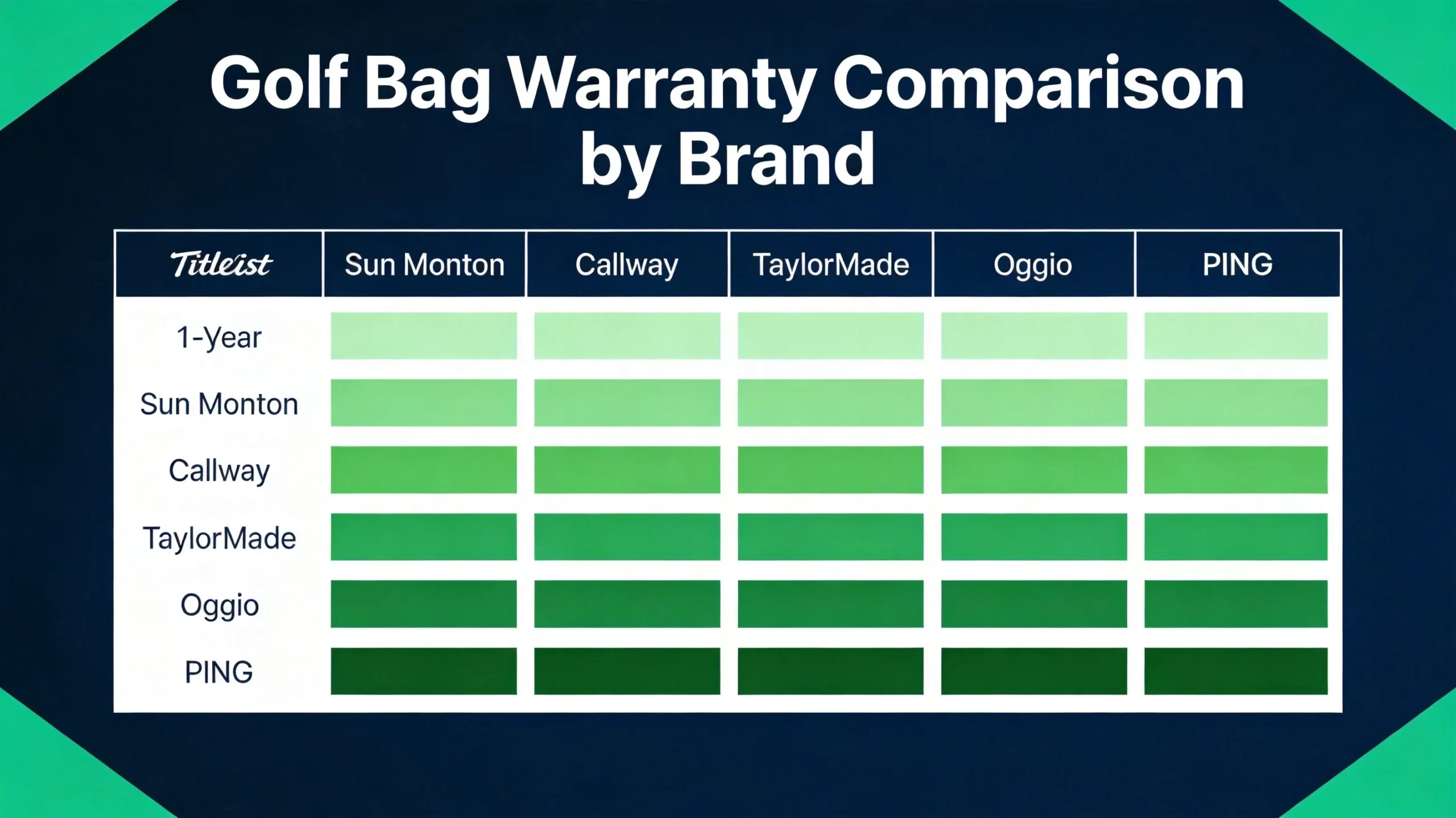
| Brand | Warranty Duration | Claim Process | Key Notes |
|---|---|---|---|
| Titleist | 1-year limited | Contact customer service with proof of purchase; return to authorized dealer | Covers defects in materials and workmanship; replacement parts (zippers, leg screws, rubber feet) available on request. See Titleist FAQs |
| Sun Mountain | 1-year limited (bags); 3-year (cart frames) | Call 1-800-227-9224 or register online; original receipt required | Explicitly excludes normal wear, fading, and misuse; Sun Mountain is sole judge of claims. See Sun Mountain Warranty |
| Callaway | 1-year limited (gear); 2-year (clubs) | Through authorized retailers with purchase verification | Regional variations apply; counterfeit products excluded from coverage |
| TaylorMade | 1-year limited | Through authorized dealer network | Standard industry coverage for manufacturing defects |
| OGIO | 1-year limited | Contact customer service with proof of purchase | Part of Callaway family; similar warranty framework |
| PING | 1-year limited | Through authorized dealers with receipt | Industry-standard coverage for workmanship and material defects |
📌 Key takeaway: The industry standard for golf bag warranty is 1-year limited coverage against manufacturing defects. Brands that differentiate on warranty (e.g., Sun Mountain’s 3-year cart frame coverage) typically do so in specific product categories, not across their entire bag lineup.
The Warranty Cost Model: How Coverage Impacts Your Margins
Every warranty commitment has a cost. As a retailer or distributor, understanding this cost structure helps you price your products appropriately and negotiate warranty terms that protect your margins. Here is how warranty costs flow through the supply chain:
Manufacturer Cost Allocation
Most golf bag manufacturers allocate 2–5% of the wholesale price to warranty reserves. This covers the expected rate of defect-related claims based on historical data. When negotiating OEM terms, manufacturers that quote significantly lower prices often do so by reducing this reserve—which translates to slower claim processing, stricter claim approval, or shorter effective warranty periods.
Retailer Cost Impact
| Warranty Model | Estimated Cost Impact | Risk Level for Retailer | Customer Satisfaction Impact |
|---|---|---|---|
| No Warranty | 0% of wholesale | 🔴 High – full liability transfers to retailer | Low – customers feel unprotected |
| 1-Year Limited (Standard) | 2–3% of wholesale | 🟡 Moderate – shared liability | Medium – meets baseline expectations |
| Extended/2-Year | 4–6% of wholesale | 🟢 Low – manufacturer absorbs more risk | High – strong competitive advantage |
| Lifetime (Premium) | 6–10% of wholesale | 🟢 Very Low – maximum coverage | Very High – premium positioning |
For a retailer ordering 500 bags at $45 FOB, the warranty cost differential between a standard 1-year plan (2.5% = $562.50 total) and an extended 2-year plan (5% = $1,125 total) is $562.50 for the entire order. Spread across 500 units, that is approximately $1.13 per bag—a marginal cost that can justify premium retail pricing and significantly reduce after-sales headache.
Warranty Claim Processing: A Step-by-Step Guide
Whether a claim originates from a retail customer, a pro shop buyer, or an online marketplace purchaser, the claim process follows a standard flow. Understanding this flow helps retailers set up efficient after-sales operations and manage customer expectations.
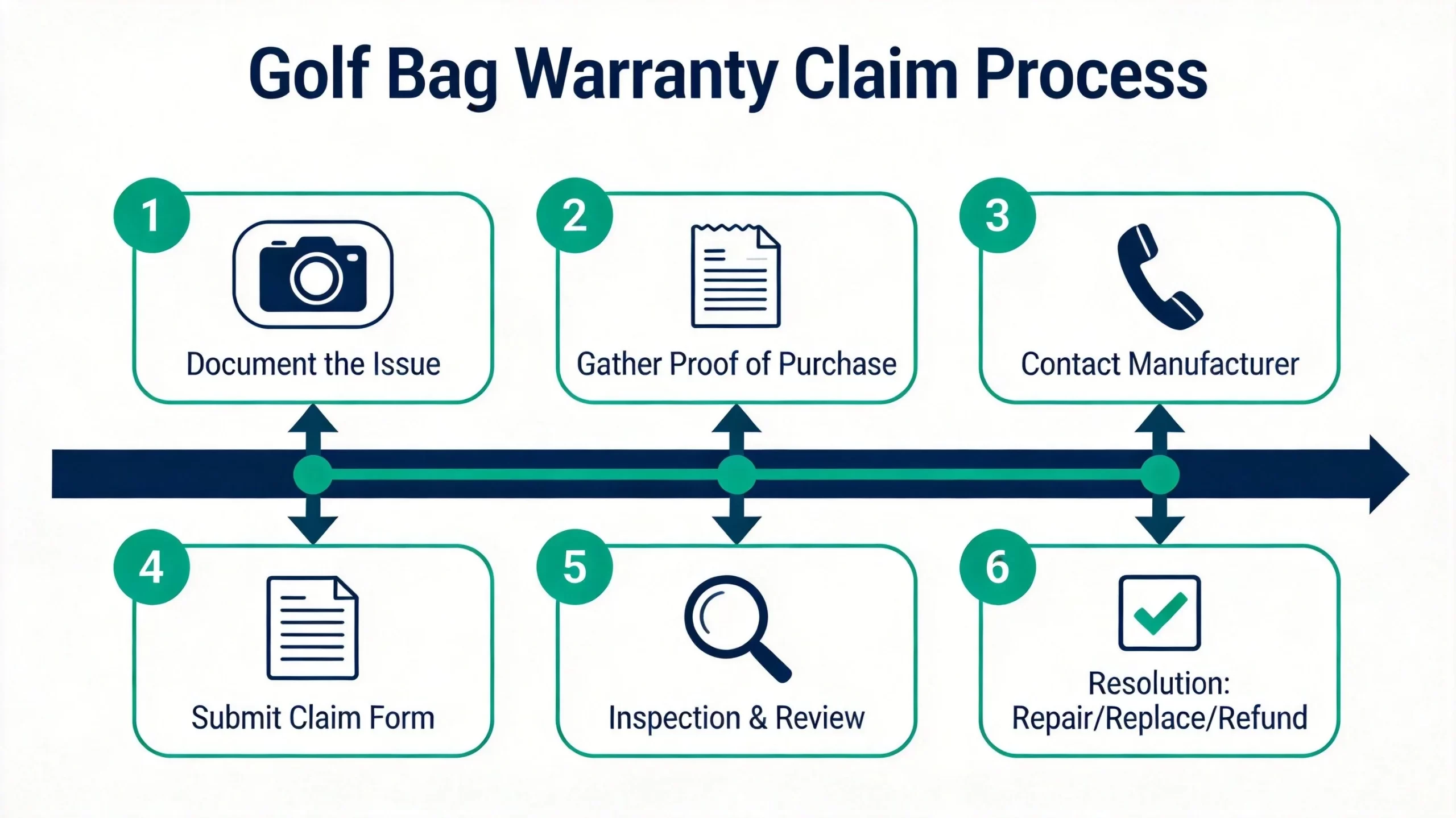
Step 1: Document the Issue
The end customer or retail staff photographs the defect clearly, noting the specific failure (e.g., zipper teeth separation, stitching unravel, base cracking). Timestamped photos are essential for establishing whether the defect falls within the warranty period.
Step 2: Gather Proof of Purchase
Original receipt, order confirmation email, or warranty registration record establishes the purchase date and verifies the product is within the warranty window. Without proof of purchase, most manufacturers will not process the claim—this is consistently stated in brand warranty policies from Titleist to Sun Mountain.
Step 3: Contact the Manufacturer or Authorized Dealer
The claim can be submitted directly to the manufacturer (for DTC brands) or through the authorized dealer where the bag was purchased. B2B retailers should establish a designated warranty contact at their supplier to streamline this step.
Step 4: Submit the Claim Form
Most manufacturers require a standardized claim form including product model, serial number (if applicable), purchase date, description of defect, and supporting photos. Processing time typically ranges from 2–10 business days for initial review.
Step 5: Inspection and Review
The manufacturer evaluates whether the defect qualifies under warranty terms. This may involve shipping the bag back to the factory or a regional service center. The manufacturer is typically the sole judge of whether a claim is valid—Sun Mountain’s policy explicitly states “Sun Mountain is the sole judge of any claim or warranty.”
Step 6: Resolution
Approved claims are resolved through one of three paths: repair (replacement parts shipped), replacement (new bag sent), or refund (credit issued to the point of purchase). Industry benchmark for resolution time is 7–14 business days from claim approval. Sun Mountain and other major brands follow this timeline.
Supplier Warranty Evaluation: 7 Critical Questions for B2B Buyers
Before committing to a golf bag supplier—whether for OEM, ODM, or wholesale distribution—ask these seven questions to assess their warranty and after-sales capability:
- What is the exact warranty duration, and when does it start? Clarify whether the clock starts at manufacturing, shipment, or end-consumer purchase. This directly affects your claim window.
- What specific defects are covered and excluded? Request a written list. Vague terms like “normal use” should be defined with examples.
- What is the claim process for international/B2B customers? Do they have a regional service center, or must bags be shipped back to the factory? Cross-border returns can cost more than the bag itself.
- What is the average claim resolution time? Ask for data, not promises. A supplier that takes 60 days to resolve claims will damage your customer relationships.
- Do they offer replacement parts (zippers, legs, straps) separately? Access to spare parts extends product life and reduces full replacement costs. Titleist offers replacement parts like zipper pulls, leg screws, and rubber feet—this should be standard for OEM partners.
- Is there a minimum claim threshold or deductible? Some suppliers only process claims above a certain value or require the retailer to absorb a portion of each claim.
- What happens after the warranty expires? Do they offer paid repair services? A supplier that provides post-warranty support demonstrates long-term commitment to product quality.
Extended Warranties as a Value-Added Sales Tool
Beyond the manufacturer’s base warranty, retailers can offer extended warranty plans as an upsell. This is a proven revenue stream in consumer electronics and is gaining traction in sporting goods.
How Extended Warranties Work
The retailer (or a third-party warranty provider) offers customers an optional extended coverage plan—typically 2–3 years beyond the manufacturer’s warranty—for an additional fee. Common pricing is 10–15% of the bag’s retail price.
Revenue Potential
For a golf bag retailing at $250, an extended warranty priced at $30–$37 generates incremental margin. If 20–30% of customers opt in (a conservative attach rate for sporting goods), the program adds meaningful profit with minimal operational overhead, provided the retailer has a clear claim process with their supplier.
Key Considerations
Before launching an extended warranty program, retailers should:
- Negotiate back-to-back coverage with the manufacturer so that claims during the extended period are supported
- Clearly define what the extended warranty covers beyond the manufacturer’s base warranty (e.g., accidental damage, wear-and-tear coverage)
- Set up a dedicated claim processing workflow to avoid bottlenecks
- Communicate terms transparently to avoid consumer protection issues, which vary by jurisdiction
International After-Sales: Managing Cross-Border Warranty Claims
For retailers and distributors operating across multiple countries, warranty logistics add a layer of complexity that domestic-focused brands often overlook.
Key Challenges
- Return shipping costs: Shipping a defective golf bag from Europe back to a manufacturer in Asia can cost $80–$150—sometimes exceeding the bag’s wholesale value. Negotiate regional repair centers or local replacement policies with your supplier.
- Customs and duties on replacement shipments: When a manufacturer ships a replacement bag internationally, it may trigger import duties. Clarify in your supply agreement who bears these costs.
- Warranty validity across regions: Some brands limit warranty coverage to the country of original purchase. Verify whether your supplier’s warranty is global or regional before marketing to international customers.
- Language and communication barriers: Establish a dedicated English-speaking warranty contact at your supplier. Delayed or unclear communication frustrates both retailers and end customers.
💡 Pro tip for distributors: When evaluating manufacturers for international distribution, prioritize suppliers who offer regional warranty support or have established service partnerships in your target markets. This reduces claim resolution time from weeks to days and protects your brand reputation in every market you serve.
How Keep Perfect Golf Approaches Warranty and After-Sales
As a golf bag manufacturer with over 20 years of production experience serving 200+ brands across 100+ countries, Keep Perfect Golf Gear takes warranty seriously as a core component of our B2B partnership model.
Our warranty framework includes:
- Standard 1-year limited warranty covering all manufacturing defects in materials and workmanship, with flexible terms based on product type and customization level
- Direct claim process—retailers and distributors can file claims via email with proof of purchase, bypassing complex dealer networks for faster resolution
- 7–10 business day resolution for approved claims, including repair, replacement, or refund options
- Replacement parts availability for zippers, legs, straps, and hardware components—extending product life beyond the warranty period
- FOB Xiamen shipping with a minimum order quantity of 100 pieces, backed by our quality assurance process that reduces defect rates at the source
For retailers and distributors evaluating a long-term manufacturing partner, our direct factory model means warranty claims are handled by the same team that produced the bag—no intermediaries, no finger-pointing, and no delays from third-party service centers.

Ready to discuss warranty terms for your next golf bag order? Our team provides transparent warranty documentation before you commit—so you know exactly what is covered, what the claim process looks like, and what support you can expect throughout the product lifecycle.
📧 Email us at [email protected] or WhatsApp +86 17750020688 to request our complete warranty terms sheet and supplier evaluation package.
Frequently Asked Questions
1. What is the standard golf bag warranty period?
The industry standard for golf bag warranty is 1 year limited coverage from the date of purchase, protecting against defects in materials and workmanship under normal use. Most major brands—including Titleist, Sun Mountain, Callaway, TaylorMade, OGIO, and PING—offer this baseline coverage. Some manufacturers extend coverage for specific components (e.g., Sun Mountain offers 3 years on cart frames).
2. What defects are typically covered under a golf bag warranty?
Standard warranty coverage includes stitching failures, zipper malfunction, frame or base cracking, coating delamination, and hardware defects that occur without misuse or accidental damage. Normal wear and tear, UV fading, airline damage, and user modifications are typically excluded.
3. How do I file a golf bag warranty claim as a retailer?
Document the defect with clear photos, gather proof of purchase (receipt or order confirmation), contact the manufacturer or your designated B2B supplier contact, submit the required claim form with all supporting documentation, and await inspection and resolution. Most manufacturers process approved claims within 7–14 business days.
4. What does a golf bag warranty NOT cover?
Warranty exclusions typically include normal wear and tear, cosmetic fading from sun exposure, damage from airline handling or cart straps, accidental tears or punctures, modifications made by the end user, and any damage resulting from misuse or failure to follow care instructions.
5. Can I offer extended warranty to my golf bag customers?
Yes. Many retailers offer extended warranty plans (2–3 years beyond the manufacturer’s coverage) as a paid upsell, typically priced at 10–15% of the bag’s retail price. Before launching, ensure your supplier agreement includes back-to-back coverage for the extended period and establish a clear claim workflow. Extended warranties can be a profitable value-added service when managed properly.
Quality Control as Warranty Prevention: The Manufacturer’s Role
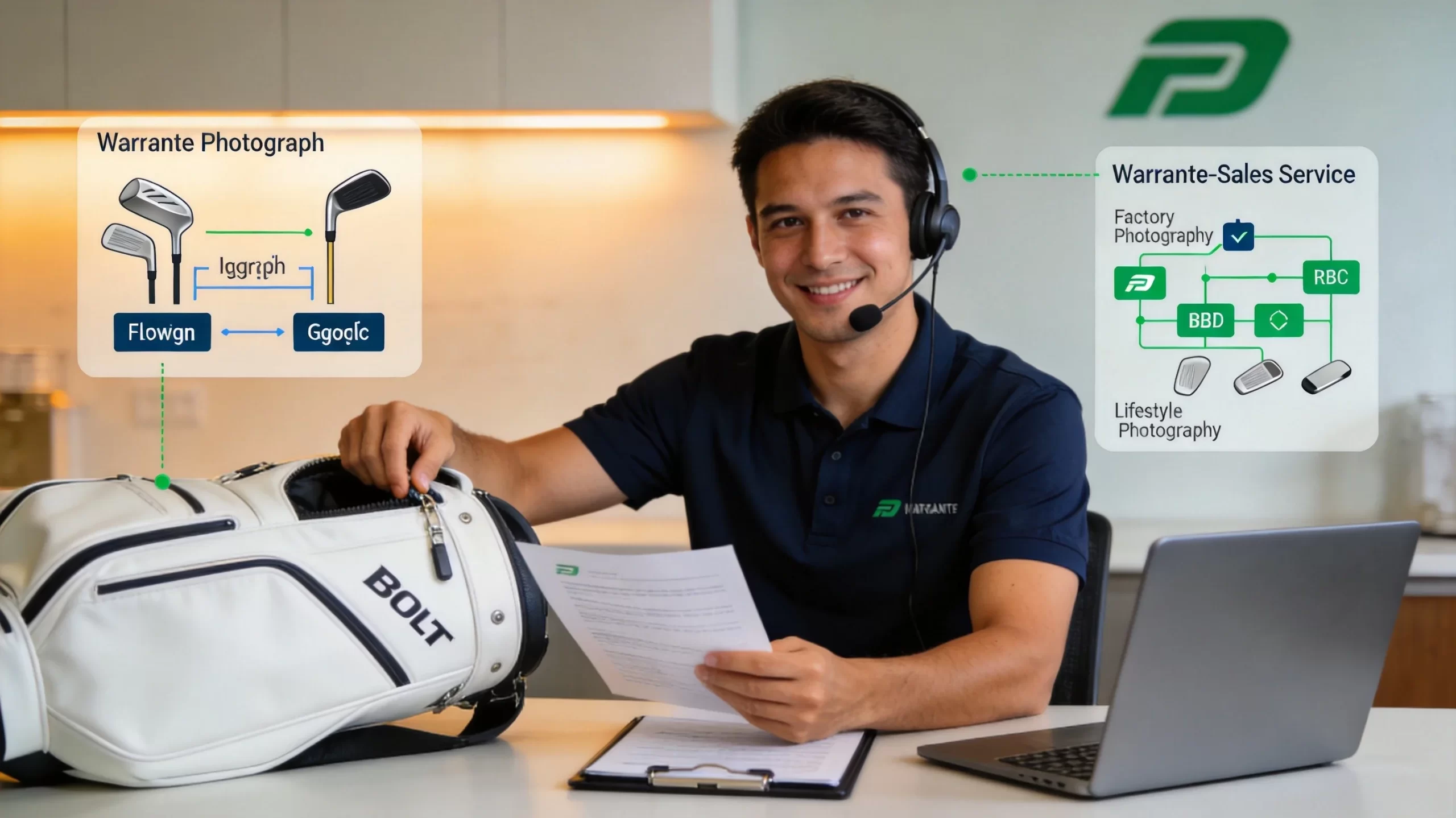
The most effective warranty strategy is prevention. Manufacturers that invest in rigorous quality control reduce defect rates, which in turn lowers warranty claim volumes and costs for both parties in the supply chain.
Key QC Checkpoints in Golf Bag Production
Professional golf bag manufacturers implement multi-stage quality inspections throughout the production process. These checkpoints directly correlate with the types of defects that generate warranty claims:
- Raw material inspection: Verifying fabric denier, coating thickness, zipper brand specification, and hardware grade before production begins. Substandard materials are the root cause of approximately 40% of warranty claims in the golf bag industry.
- In-process stitching inspection: Checking stitch density (SPI—stitches per inch), thread tension, and seam alignment at multiple points during assembly. Stitching failures are consistently among the top 3 warranty claim categories across all brands.
- Zipper functionality testing: Each bag undergoes a minimum 50-cycle open/close test before packing. Zippers from reputable suppliers (YKK, SBS) have documented failure rates below 0.5% over 10,000 cycles, compared to 3–8% for generic alternatives.
- Final AQL inspection: A statistically valid sample from each production batch is inspected against AQL (Acceptable Quality Level) standards. Most professional manufacturers use AQL 2.5 for critical defects and AQL 4.0 for minor defects.
- Load and stress testing: Selected samples undergo weight-bearing tests (typically 30–50 kg static load), strap pull tests, and drop tests to simulate real-world usage conditions.
How QC Investment Affects Warranty Economics
The relationship between quality control spending and warranty cost is not linear—it is exponential. A manufacturer that spends an additional 1% of production cost on QC can reduce warranty claim rates by 30–50%, because the defects that generate the most expensive claims (structural failures, widespread zipper problems) are caught at the source.
For B2B buyers evaluating a golf bag manufacturer, this means that a supplier quote that appears 3–5% higher than competitors may actually deliver lower total cost of ownership when warranty claims, customer service overhead, and brand reputation impact are factored in. This is particularly relevant for retailers serving premium markets where customer expectations for product longevity are high.
Negotiating Warranty Terms: What Retailers Should Ask For
When negotiating with a golf bag manufacturer, warranty terms are one of the most impactful levers for protecting your business. Here are specific terms to negotiate beyond the baseline 1-year limited warranty:
Critical Warranty Clauses for B2B Contracts
| Clause | Standard Offer | Better Terms to Negotiate | Business Impact |
|---|---|---|---|
| Warranty start date | Manufacturing date | End-consumer purchase date or +6 months buffer | Extends your effective coverage window by 3-6 months |
| Claim resolution time | Not specified | Maximum 14 business days with escalation path | Prevents indefinite delays that damage customer relationships |
| Replacement parts availability | Not guaranteed | Guaranteed parts availability for 3+ years post-production | Enables cost-effective repairs vs. full replacements |
| Regional claim processing | Return to factory | Regional service center or local replacement authorization | Eliminates expensive cross-border shipping for claims |
| Batch defect protocol | Case-by-case | Automatic batch replacement if defect rate exceeds 5% | Protects against systemic quality failures affecting entire orders |
| Warranty transferability | Non-transferable | Transferable to end consumer at point of retail sale | Simplifies claim process and improves customer experience |
These negotiated terms should be documented in your supply agreement, not just in email exchanges. A well-drafted warranty clause protects both parties and provides a clear reference when disputes arise.
The Future of Golf Bag Warranty: Trends for 2026 and Beyond
The golf bag warranty landscape is evolving as manufacturers adopt new technologies and consumer expectations shift. Several trends are shaping the future of after-sales support in this industry:
Digital Warranty Registration
More manufacturers are implementing QR-code-based warranty registration systems. A unique QR code on each bag links to a digital warranty card that the end consumer activates via smartphone. This eliminates paper receipts, provides manufacturers with direct consumer data, and enables faster claim processing through automated validation.
Predictive Quality Analytics
Advanced manufacturers are using production data analytics to predict which batches may have elevated defect risk before they ship. By analyzing variables such as material lot numbers, operator assignments, and machine calibration records, manufacturers can proactively quarantine at-risk batches—preventing warranty claims before they occur.
Sustainability-Linked Warranties
As environmental concerns grow, some manufacturers are linking warranty terms to product sustainability. Bags made with recycled materials or sustainable processes may carry extended warranty periods as a confidence signal. This trend is particularly relevant for retailers targeting environmentally conscious consumer segments—see our sustainable golf bag manufacturing guide for material options in European and North American markets.
AI-Powered Claim Triage
Machine learning models trained on historical claim data can automatically triage incoming warranty requests, routing straightforward claims (clear manufacturing defects with valid documentation) to fast-track approval while flagging complex cases for human review. This technology is beginning to reduce claim processing times from days to hours at leading manufacturers.
📌 Bottom line for B2B buyers: The golf bag warranty is not just a legal obligation—it is a strategic business tool. The right warranty structure protects your margins, builds customer loyalty, differentiates your product offering, and signals confidence in your supply chain quality. Whether you are a pro shop owner, an online retailer, or a regional distributor, investing time in understanding and negotiating warranty terms is one of the highest-ROI activities in your procurement process.
Related Products
Explore our manufacturing capabilities in this category:
Need custom golf bags? Contact us for OEM/ODM quotes — MOQ 100pcs, FOB Xiamen.