Your golf bag should do one job well: help you find the right club fast and keep your gear from banging around. If you carry up to 14 clubs under the rules, a fixed layout makes it easier to spot a missing club, cut down on shaft tangles, and keep the bag easier to use on the course.
Here’s the short version:
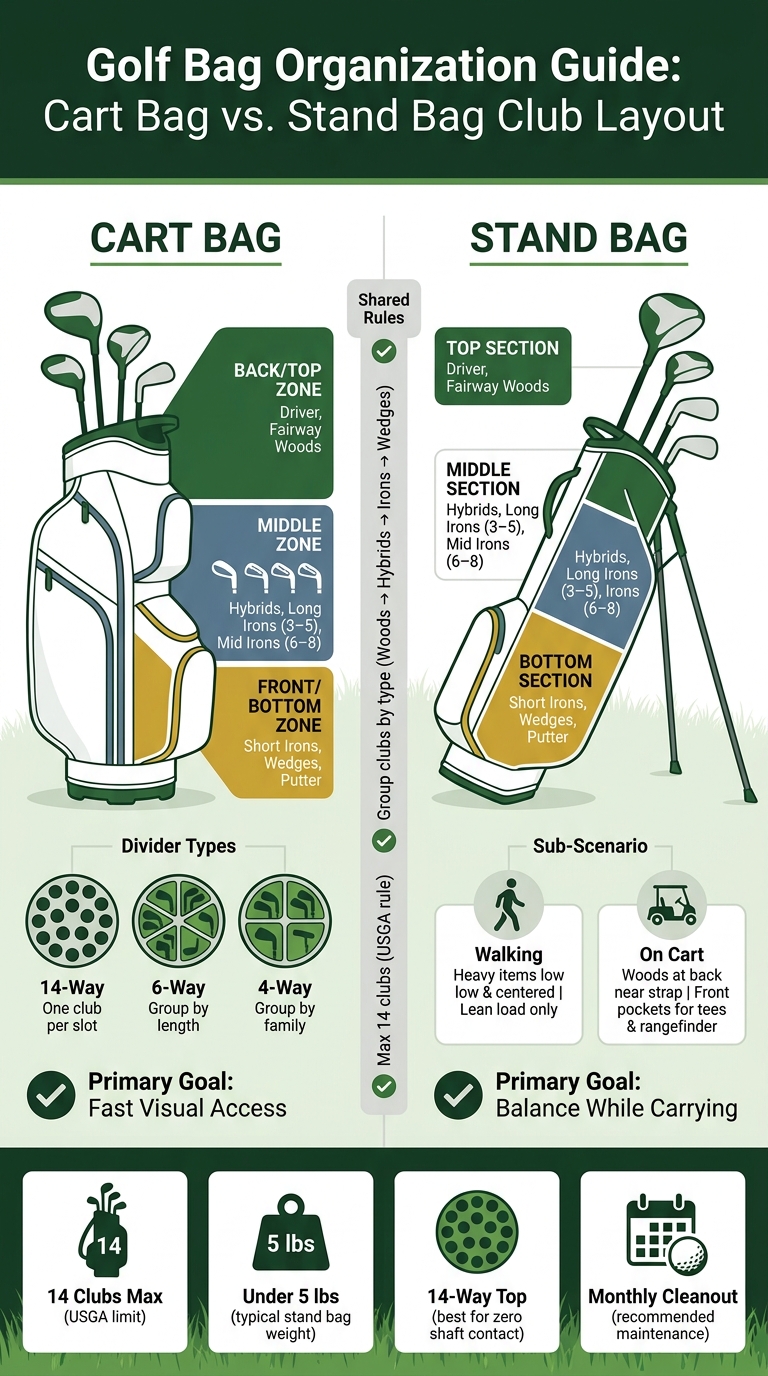
- Cart bags: put long clubs in the back, short clubs and putter in the front
- Stand bags: put long clubs in the top section, wedges and putter in the bottom
- 14-way tops: one club per slot, less rattling
- 4-way or 6-way tops: group clubs by type and keep the same order every round
- Full-length dividers: help stop shafts from crossing deep in the bag
- Walking: keep heavier gear low and centered
- Riding: keep your most-used items in easy-to-reach pockets
- Headcovers: help protect woods, hybrids, and putters during play and transport
I’d boil the whole article down to this: sort clubs by length, group them by type, and never change the setup unless the bag forces you to. That simple system helps with speed, club count, and gear wear.
A few points stand out:
- The USGA limit is 14 clubs
- Many stand bags weigh under 5 lbs
- Fewer dividers often mean more club contact
- A monthly cleanout helps remove dirt that can wear grips and shafts
If you use a cart bag and a stand bag at different times, the rule stays about the same. Long clubs go on the high side. Short clubs go on the low side. The only thing that changes is the bag angle and which pockets are easiest to reach.
| Bag type | Best club order | Main focus |
|---|---|---|
| Cart bag | Back to front, long to short | Fast access on cart |
| Stand bag for walking | Top to bottom, long to short | Balance while carrying |
| Stand bag on cart | Back/high side to front/low side | Access plus bag position |
The rest of the article explains how to set that up based on divider count, bag style, and how you play.
Golf Bag Organization Guide: Cart Bag vs. Stand Bag Club Layout
How to Organize a Golf Bag – Best way to Arrange a cart bag or 6 divider bag
sbb-itb-4fa7e8b
Golf Bag Types, Dividers, and Orientation Basics
Bag design changes the easiest club layout. Once layout starts to matter, the next move is simple: match your club order to the bag you use.
A cart bag has a flat base, pockets that face outward, and a shape that sits well on a riding cart or push cart. A stand bag is made to carry. It usually weighs under 5 lbs, has retractable legs, and uses fewer dividers to cut weight. That lower divider count gives you less room for error, so club placement matters more. Start with the number of dividers and the way the bag sits, then sort clubs by height.
Cart Bag Layout Basics: 14-Way, 6-Way, and 4-Way Tops
Most cart bags use a 14-way divider top, which means each club gets its own slot. That helps cut down on club rattle and can protect graphite shafts from nicks during travel. On a cart, put the driver and woods on the high side near the handle. Put wedges and the putter on the low side. A stand bag follows the same basic order, but the carry angle changes how the clubs sit and how easy they are to grab.
Bags with 6-way or 4-way tops place more than one club in each slot. They weigh less, but there’s a tradeoff. Shafts can tangle near the bottom unless the bag has full-length dividers that run all the way down. Top-only dividers separate clubs at the opening, but lower in the bag the shafts can cross over each other. That can cause grip wear and make clubs harder to pull out. Full-length dividers help keep shafts apart deeper in the bag.
Stand Bag Layout Basics: Carry Position vs. Stand Position
Stand bags usually have 4 to 6 dividers, so each slot holds multiple clubs. In most cases, the upper slots are for the driver and woods, while the lower slots are for wedges and the putter. If your bag’s divider setup doesn’t work well for your set, a custom layout can fix that.
When you carry a stand bag, the angle changes everything a bit. Clubs shift, access feels different, and balance starts to matter more. Keep heavier items low to help the bag stay balanced.
Custom Divider and Pocket Options from Keep Perfect Golf Gear

Some golfers need a setup that a stock bag just can’t handle. Keep Perfect Golf Gear offers custom cart bags, stand bags, and Sunday bags with OEM/ODM options for divider count, putter wells, materials, logo placement, and pocket layout.
Core Rules for Organizing Clubs Efficiently
Once you’ve picked your bag style and divider setup, keep the layout simple. Follow three rules: arrange clubs from long to short, keep similar clubs together, and give each club a set spot.
Place Longer Clubs High and Shorter Clubs Low
Set your clubs in long-to-short order. Put the driver and fairway woods at the top or back of the bag. Hybrids and irons belong in the middle. Short irons, wedges, and the putter go at the bottom or front.
| Section | Club Types |
|---|---|
| Top/Back | Driver, Fairway Woods |
| Middle | Hybrids, Long Irons (3–5), Mid Irons (6–8) |
| Bottom/Front | Short Irons, Wedges, Putter |
This setup makes the bag easier to scan at a glance. It also helps keep longer clubs out of the way of the shorter ones.
Group Clubs by Type to Find Clubs Faster
After sorting by length, group clubs by type. Keep woods together, then hybrids, then irons in number order, with wedges grouped near the bottom. That way, each slot starts to feel automatic.
Over time, fixed slot assignments build muscle memory. You don’t have to stop and think about where each club goes, and it becomes much easier to notice when one is missing after a hole.
Protect Clubs and Shafts In Play and Transit
A steady layout does more than keep things tidy. It also cuts down on wear because clubs don’t bang into each other as much while you walk, ride, or load the bag in and out of your car.
Use headcovers on your driver, fairway woods, hybrids, and putter whenever they’re not in use. That helps prevent dings and lowers the odds of iron heads hitting graphite shafts.
A clean bag helps too. When shafts and grips keep rubbing against each other, wear builds up faster, especially in bags with top-only dividers. Wipe down the dividers once a month and clear out dirt or loose debris from inside the bag to help slow that wear.
Best Club Layouts for Cart Bags and Stand Bags
Recommended Cart Bag Setup by Section
Once you’ve set your clubs from long to short, match that order to your divider setup. With cart bags, the goal is simple: fast visual access. Put the longest clubs in back and the shortest clubs in front.
| Divider Type | Placement Rule |
|---|---|
| 14-Way | One club per slot, ordered back to front by length. |
| 6-Way | Group woods, irons, wedges, and putter into separate slots by length. |
| 4-Way | Group clubs by family: woods, long/mid irons, short irons, wedges, putter. |
Full-length dividers help keep shafts separated all the way to the bottom of the bag, which cuts down on tangling.
Recommended Stand Bag Setup for Walking and Cart Use
Stand bags follow the same long-to-short club order, but the best setup changes based on how you use the bag. If you walk, balance matters most. If you use a cart, access matters more.
When walking, put woods and hybrids in the top section closest to your shoulder straps to help balance the load. Heavier items, like extra balls or a water bottle, should go in pockets closest to your spine and stay centered from side to side.
When the same stand bag goes on a riding cart or push cart, the bag’s orientation changes. The back of the bag becomes the highest point near the cart strap, so woods naturally belong at the top. Keep tees, balls, and the rangefinder in front pockets so they’re easy to grab.
| Feature | Walking (Carry) Setup | Cart (Riding/Push) Setup |
|---|---|---|
| Primary Goal | Ergonomics and weight balance | Easy access to clubs and gear |
| Club Layout | Woods at top (near straps) | Woods at back (near cart strap) |
| Pocket Strategy | Heavier items close to the spine | Most-used items in front-facing pockets |
| Gear Volume | Lean – only essentials | Can carry a full rain suit and extra balls |
If your divider setup makes clean separation tough, don’t force it. Group clubs by family and adjust pocket weight instead of trying to sort every club on its own.
How to Adjust Layout for Fewer Dividers
With a 4-way or 5-way divider setup, group clubs by family and keep irons in number order so you can grab them faster.
The main downside of fewer dividers is club rattle. That’s when clubheads knock into each other while you ride or walk. Use headcovers on woods and hybrids to help protect fragile graphite shafts from the steel shafts of irons.
"The ‘right’ way is the way that stops you from having to think about it. Stick with one system for a few rounds. Let the muscle memory build." – Spencer Lanoue, Founder, Caddie AI
With fewer dividers, consistency matters more. Put each club back in the same group every time so the setup starts to feel automatic.
Customizing Organization for Playing Style and Bag Design
Layouts for Beginners, Frequent Riders, Walkers, and Better Players
Once you’ve picked the divider count and direction, the next step is simple: set up the bag around how you actually play.
For a beginner, the best setup is a fixed system you can repeat every round. When every club has the same spot each time, club selection starts to feel automatic. Frequent riders should think about seat access first, with shorter clubs and wedges up front. Walkers usually do better when heavier items sit low and near the center. Better players often keep scoring clubs in the spots that are easiest to reach.
| Player Profile | Bag Type | Divider Setup | Layout Strategy |
|---|---|---|---|
| Beginner | Stand Bag | 4-Way or 6-Way | Fixed order; consistent slot assignments every round |
| Frequent Rider | Cart Bag | 14-Way | Long clubs at back; wedges and putter in front for seat access |
| Walker | Lightweight Stand | 4-Way or 5-Way | Longest clubs away from legs; heavy items centered and low |
| Advanced Player | Tour or Cart Bag | 14-Way with putter well | Most-used scoring clubs in the easiest-to-reach slots |
U.S. Climate and Course Conditions That Affect Bag Setup
Course conditions should shape pocket use just as much as club order. In humid parts of the Southeast, it helps to keep gloves in a dry pocket and swap out worn grips on a regular basis. In the Pacific Northwest, or in places where afternoon storms roll in without much warning, rain gear should live in a long side pocket so you can grab it fast.
Coastal courses bring a different headache. Sand and salt grit can wear down zippers fast, so if you’re picking or customizing a bag, heavy-duty wipe-clean zippers deserve extra attention.
Using Keep Perfect Golf Gear for Custom Divider and Pocket Planning
If you’re working through a custom bag program, these layout choices should be part of the design spec from the start. That way, the setup you plan is the setup that shows up.
Keep Perfect Golf Gear offers full OEM/ODM production with options for divider count, putter wells, pocket layout, and material choices. So the organization system decided at the spec stage is the one that ships. Full-length dividers also help keep shafts apart and make club retrieval cleaner.
Conclusion: Build a Club Layout That Stays Consistent Round After Round
Use one setup you can repeat every round. In a cart bag, keep the long clubs in back and place the wedges and putter in the front slot. In a stand bag, keep the long clubs at the top and the wedges and putter in the bottom section. Group clubs by type – woods, hybrids, irons, and wedges – and match the divider layout to how the bag is used. That kind of consistency cuts hesitation before every shot.
A steady layout also makes club selection faster and helps prevent mix-ups. On top of that, it helps protect your gear, since full-length dividers reduce tangling and wear.
Once a month, reset the bag: empty it, remove debris, and check that all 14 clubs are there.
If you want the layout built into the bag itself, make those calls early. For custom builds, Keep Perfect Golf Gear handles OEM/ODM production from design through delivery, so divider count, pocket placement, and materials are built into the final bag.
FAQs
How do I organize a mixed set with fewer than 14 clubs?
The basic rule stays the same: arrange clubs from longest to shortest.
Put your driver, woods, and hybrids in the top sections, irons in the middle, and wedges and putter in the bottom, easiest-to-reach section.
Even if you’re carrying fewer clubs, it still helps to group them by type. That keeps the bag balanced and cuts down on shaft tangling and clubhead clatter during your round.
Do full-length dividers really make a noticeable difference?
Yes. Full-length dividers create separate channels from top to bottom, which cuts down on shaft-on-shaft friction. That helps limit wear and gives graphite shafts more protection.
They also help stop grips from snagging and tangling, so clubs slide in and out with less hassle. They do add some weight, but Keep Perfect Golf notes they’re a great option for cart riders and golfers who want premium club protection.
Should I use a different layout when switching from walking to riding?
No. Your basic club layout – longest to shortest, back to front – should stay the same whether you walk or ride.
What changes is how you use the pockets and how you set up the bag.
When you’re riding, keep the items you use the most in spots you can reach easily from the cart seat. When you’re walking, set the bag up so your go-to clubs are simple to grab, with the longest clubs positioned farthest from your body.
Related Blog Posts
- Top 7 Golf Bag Layout Tips for Easy Access
- Tour-Approved Golf Bag Organization Hacks You Need Now
- Golf Accessory Compatibility Checker: Ensuring Perfect Fit for Your Gear
- How to Optimize Golf Bag Compartments
Related Resources
Related Products
Explore our manufacturing capabilities in this category:
 Premium Stand Bag
 Ultra-Light Stand Bag
 Hybrid Stand Bag
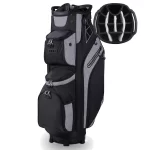 Rain-Resistant Stand Bag
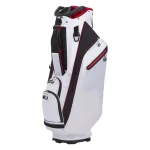 Premium Tour Cart Bag
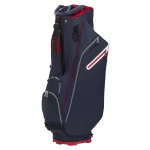 Lightweight Cart Bag
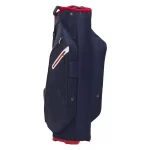 Waterproof Cart Bag
 Staff Cart Bag
 Classic Sunday Carry Bag
 Ultra-Light Sunday Bag
 Custom Golf Headcovers Set
 Golf Bag Rain Cover
 Golf Cooler Bag
Need custom golf bags? Contact us for OEM/ODM quotes — MOQ 100pcs, FOB Xiamen.