Most golfers never think about bag lining — until it fails. A torn seam, moisture-soaked fabric, or a scratched club shaft traced back to cheap lining material. Yet the interior fabric of a golf bag accounts for only 8–12% of total production cost, while influencing over 40% of the end user’s perceived quality. For brand owners and B2B buyers specifying OEM materials, choosing the right lining is one of the highest-ROI decisions in the entire product development process.
This guide breaks down six lining materials used across the golf bag industry — from basic 210D polyester to premium EVA foam composites — with real FOB cost benchmarks, technical specifications, and application recommendations from 22 years of manufacturing experience serving 200+ brands across 100+ countries.
Why Lining Material Matters in Golf Bag Manufacturing
The lining is the first thing a golfer sees when opening a new bag. Beyond aesthetics, it serves four critical functions that directly affect product longevity and brand reputation:
- Club Protection: Prevents shaft scratches, club head dings, and graphite damage during transport. A quality lining adds a consistent buffer layer that reduces impact forces on delicate equipment.
- Moisture Management: Golf bags encounter morning dew, rain, and humid storage conditions. The lining must resist water absorption to prevent mold growth, fabric degradation, and odor — especially critical for bags shipped to tropical markets in Southeast Asia and Latin America.
- Brand Perception: The interior fabric communicates quality more viscerally than any external logo. A premium microfiber suede lining instantly signals “this is a high-end product,” while thin, rough polyester tells the customer they overpaid.
- Durability Under Stress: Lining endures constant friction from club insertion and removal, zipper contact, and accessory weight. Industry data from the International Textile Manufacturers Federation (ITMF, 2023 Annual Report) indicates that lining failure accounts for 18% of warranty claims in premium bags priced above $300, second only to zipper malfunction at 23%.
The Six Core Golf Bag Lining Materials
At JUNYUAN BAGS, we work with all six material categories below. Each serves a specific market segment and price point. Here is the complete technical breakdown.
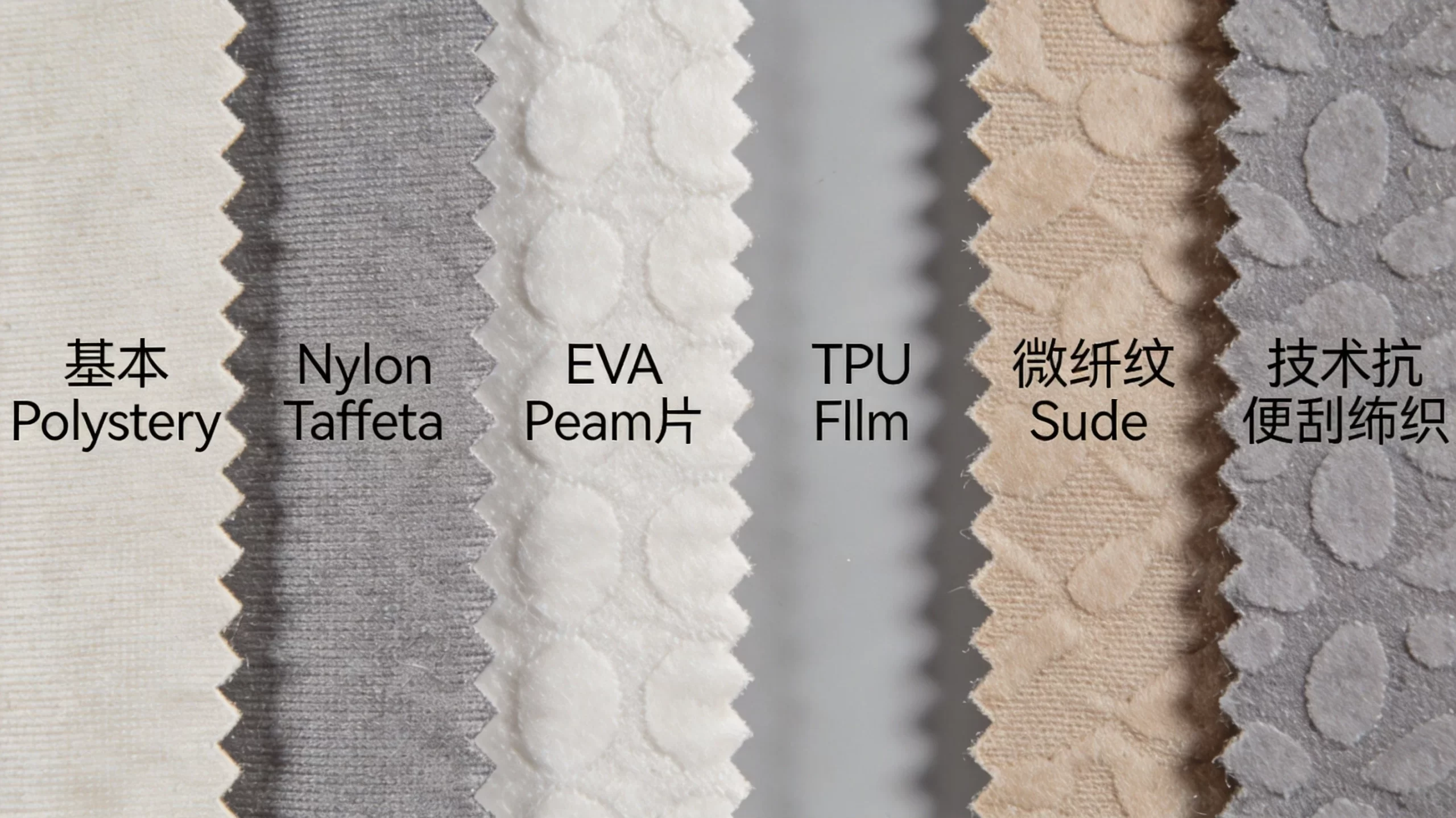
1. Basic Polyester (210D–420D) — The Industry Workhorse
FOB Cost: $ | Weight: 55–125 GSM | Durability: 2–3 years daily use
Polyester remains the most widely used lining material in golf bag manufacturing, accounting for roughly 60% of global production volume. The specification is defined by its Denier (D) count — the mass in grams per 9,000 meters of fiber.
210D Polyester (55–65 GSM) is the global standard for entry-level to mid-range bags. It uses a plain weave construction providing a flat, consistent surface. The tactile quality is slightly “crisp” or paper-like. It is thin enough to minimize shipping weight — critical for Amazon FBA sellers and DTC brands managing fulfillment costs — yet strong enough to hold divider walls and pocket organizers without sagging.
420D Polyester (105–125 GSM) steps up to a heavier gauge for performance bags and cart bags that see heavier use. The weave is stiffer and more rugged, offering better tear resistance at high-stress junctions like the top cuff and divot pockets.
OEM Considerations: Polyester accepts dye sublimation exceptionally well, enabling full-color branded lining prints at minimal extra cost. It is also compatible with PU back-coatings for water resistance. However, polyester generates static electricity, which attracts dust and club grip residue. For premium lines, we recommend adding an anti-static treatment (+$0.15–0.25/m) to mitigate this.
Best For: Entry-level stand bags, promotional bags, junior bags, high-volume retail programs.
2. Nylon Taffeta (190T–210T) — The Step-Up Choice
FOB Cost: $$ | Weight: 40–70 GSM | Durability: 3–5 years daily use
Nylon taffeta represents the first meaningful upgrade from polyester. The key advantages: 20–30% higher tensile strength, superior abrasion resistance, a silkier hand feel, and natural water repellency (before any coating). According to textile industry data, nylon taffeta costs approximately 20–30% more per meter than comparable polyester taffeta, but the performance gain justifies the investment for mid-range products.
The plain weave structure produces a smooth, lustrous surface that glides against club shafts — a noticeable difference when inserting and removing clubs compared to the slightly “grabby” feel of polyester. Nylon also recovers better from compression, meaning it won’t develop permanent crease lines after extended storage.
Technical Note: When specifying nylon taffeta for OEM orders, always confirm whether the supplier uses Nylon 6 or Nylon 6.6. Nylon 6.6 (also known as polyamide 6.6) offers superior heat resistance and dimensional stability — important for bags that may be exposed to high temperatures during shipping or in retail display environments.
OEM Considerations: Nylon taffeta is highly receptive to PU coatings and DWR (Durable Water Repellent) treatments. We commonly specify 190T nylon taffeta with a single-pass PU coating for mid-range waterproof bags. Color consistency is excellent, though nylon has slightly lower UV colorfastness than polyester — a factor for brands selling in sun-intensive markets like the Middle East or Australia.
Best For: Mid-range stand bags, cart bags, premium walking bags, staff bags targeting the $200–400 retail segment.
3. EVA Foam — Premium Protection
FOB Cost: $$$ | Density: 33–220 kg/m³ | Thickness: 0.5–3mm | Durability: 5–8 years
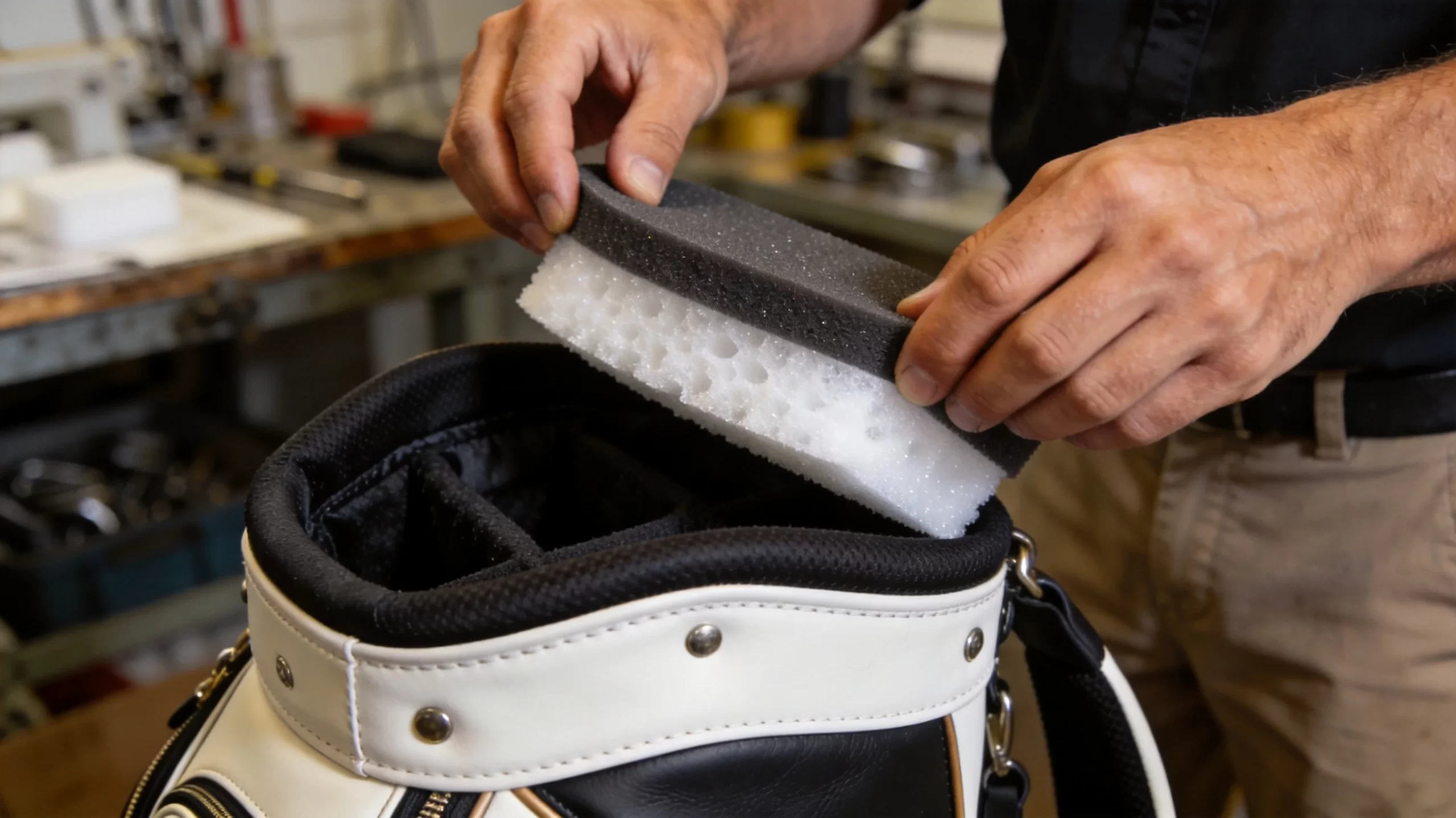
EVA (Ethylene Vinyl Acetate) foam is the material of choice for premium golf bag protection. Its closed-cell structure provides exceptional shock absorption, moisture resistance, and shape retention. Unlike open-cell foams, EVA does not absorb water — a critical advantage for golf bags used in wet climates or stored in damp conditions.
In golf bag applications, EVA foam serves dual purposes: as a protective padding layer (typically 2–5mm thickness, 33–60 kg/m³ density) bonded between the outer shell and lining fabric, and as a structural stabilizer (higher density, 150–220 kg/m³) in bag bases, top cuffs, and pocket walls.
The thermoforming process is where EVA truly differentiates. Heated to 100–130°C, the foam sheet can be vacuum-formed over custom molds, creating perfectly contoured protective channels for individual clubs. This is the technology behind the precision-molded interiors you see in tour-level staff bags from brands like Vessel and Honma.
OEM Considerations: EVA bonding requires specific adhesive systems. We use solvent-free热熔 adhesives that maintain bond strength across temperature ranges from -20°C to +60°C. The foam can be laminated directly to the outer shell fabric or to the inner lining fabric, depending on the design requirement. For custom-molded interiors, tooling costs start at approximately $800–1,500 per mold, amortizable over the production run.
Best For: Premium staff bags, tour bags, luxury cart bags, molded-case golf travel bags, high-end DTC brands.
4. TPU Film — The Waterproof Barrier
FOB Cost: $$$ | Thickness: 12–100 μm | Hydrostatic Resistance: >20,000 mmH₂O | Durability: 4–6 years
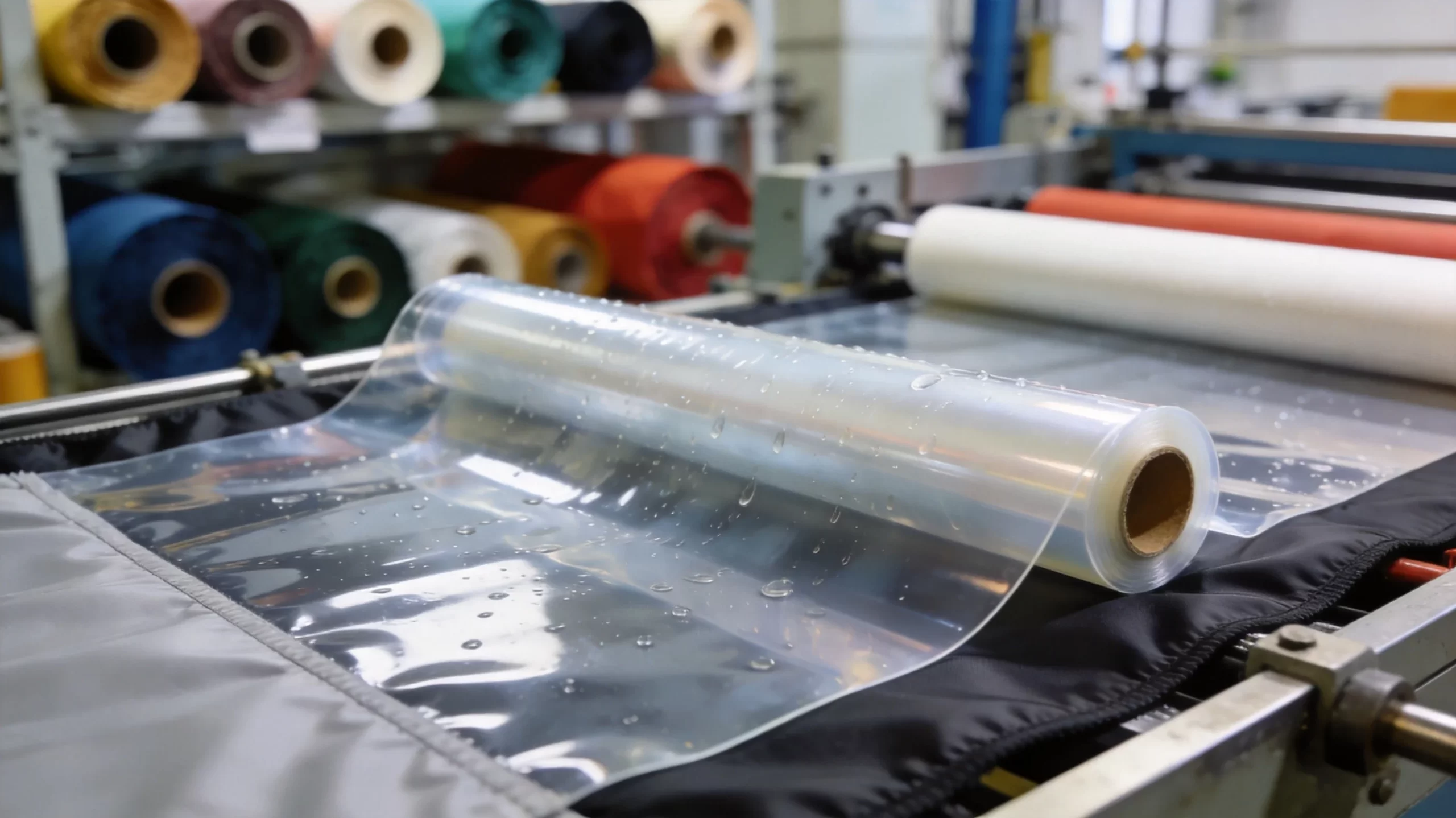
Thermoplastic Polyurethane (TPU) film serves a specialized role in golf bag construction: as a waterproof barrier layer that blocks liquid water while allowing water vapor to escape. This breathability prevents the “sealed bag” problem where trapped moisture creates mold and mildew inside the bag — a common complaint with fully waterproof bags that lack vapor-permeable membranes.
TPU film is typically laminated between the outer shell fabric and the inner lining, creating a three-layer composite: shell / TPU membrane / lining. The film withstands hydrostatic pressure exceeding 20,000 mmH₂O, far beyond what a golf bag would encounter in real-world conditions. The moisture vapor transmission rate (MVTR) of high-quality TPU membranes reaches 5,000–8,000 g/m²/24h per ASTM E96 testing protocols (source: Linghua TPU Technical Guide, 2025), allowing sufficient breathability for bag applications.
A critical specification point: always specify polyether-based TPU for golf bags sold in humid or tropical markets. Polyester-based TPU undergoes hydrolysis in high-humidity conditions, with tensile strength dropping 40–50% within 12 months at 80% relative humidity. Polyether TPU retains >85% strength under identical conditions.
OEM Considerations: TPU film is compatible with high-frequency welding, enabling seam-sealed construction without stitching holes that compromise waterproof integrity. The film is 100% PVC-free, halogen-free, and compliant with REACH, RoHS, and OEKO-TEX Standard 100 — important for brands targeting environmentally conscious consumers in Europe and North America.
Best For: All-weather golf bags, rain-rated bags, bags targeting Nordic/UK/Pacific Northwest markets, premium travel bags.
5. Microfiber / Suede — Luxury Interior Finish
FOB Cost: $$$$ | Weight: 180–280 GSM | Thickness: 0.6–1.2mm | Durability: 5–8 years
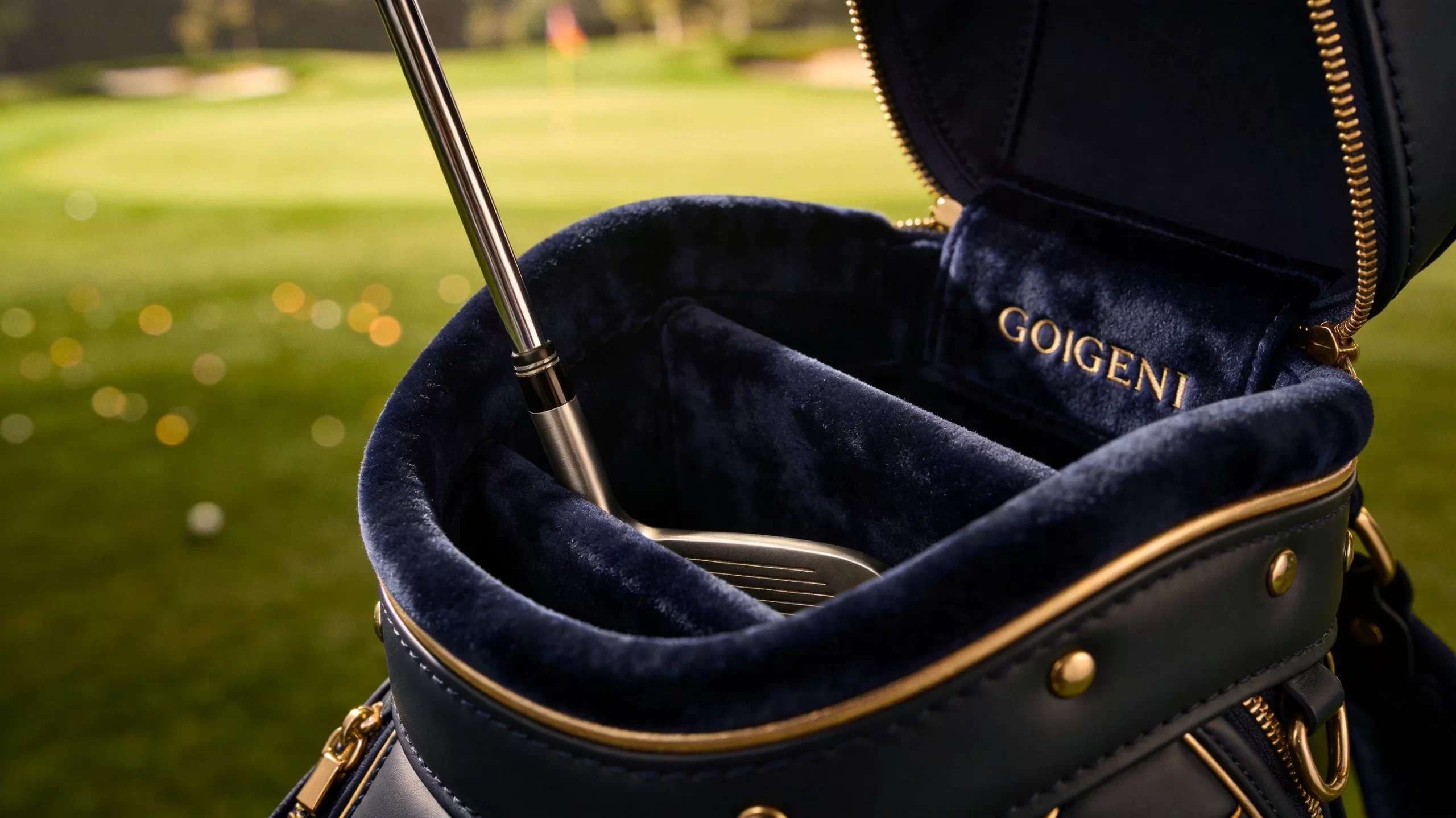
Microfiber suede is the lining material that separates premium and luxury golf bags from the rest. Engineered with ultra-fine synthetic fibers (typically a blend of polyamide and polyurethane), it delivers a velvety, leather-like tactile experience at a fraction of the weight and cost of genuine suede.
Technical specifications for bag-grade microfiber suede: 60% polyamide fibers / 40% polyurethane matrix, 350 ± 30 GSM for standard applications (upgrading to 480 GSM for ultra-premium lines). The material achieves 30,000–50,000 Martindale abrasion cycles (ASTM D4966), with near-zero pilling and excellent colorfastness (Grade 4+ per ISO 105-B02, per WINIW Microfiber Technical Data, 2025). Importantly, microfiber suede is anti-bacterial and anti-odor — a significant advantage over natural suede in humid storage conditions.
From a brand perspective, microfiber suede is where the unboxing experience lives. The moment a golfer opens the bag and touches the plush interior, the product communicates its value proposition. This is why brands like Vessel and Sun Mountain specify microfiber suede for their top-tier lines — it creates an emotional connection that fabric weight numbers alone cannot describe.
OEM Considerations: Microfiber suede supports debossed logo embossing, custom Pantone® dyeing, and laser-cut precision edges. The material is available in 90+ stock colors. For custom colors, MOQ is typically 500 meters. Cutting utilization is 100% (no grain direction constraints like leather), reducing waste and cost in production.
Best For: Luxury staff bags, limited-edition collaborations, premium DTC brands ($400+ retail), corporate gift programs.
6. Anti-Scratch Technical Fabrics — Functional Innovation
FOB Cost: $$–$$$ | Weight: 80–140 GSM | Durability: 4–6 years
A newer category of lining materials engineered specifically to prevent surface scratches on golf club shafts and finishes. These fabrics use ultra-smooth yarn surfaces (often silk-like nylon or specialized polyester filament yarns) combined with low-friction surface treatments.
The problem these solve: modern golf clubs feature increasingly delicate finishes — matte black PVD coatings, chrome-plated wedges, anodized aluminum components. Standard polyester linings with their slightly rough surface texture can cause micro-scratches over hundreds of insertion-removal cycles. Anti-scratch technical fabrics reduce the coefficient of friction by 40–60% compared to standard polyester.
Common constructions include:
- Smooth-filament nylon tricot: A knit construction with zero surface texture, creating a “slide-on-contact” surface. Weight: 80–100 GSM.
- Satin-weave polyester: Uses a 4-over-1-under weave pattern that exposes the minimum number of fiber intersections on the fabric face. Weight: 90–120 GSM.
- Silicone-coated nylon: A thin silicone coating applied to the fabric face creates an ultra-low-friction surface. Weight: 100–140 GSM.
OEM Considerations: These fabrics are typically specified for the club compartment lining only (not the full bag), as a cost-optimized approach. We recommend a minimum 4-panel configuration: anti-scratch lining in the full-length club divider channels, with standard polyester in the remaining interior pockets and compartments.
Best For: Premium bags marketed to golfers with high-end club sets, brands emphasizing equipment protection, tour-level bags.
Comprehensive Material Comparison
| Material | FOB Cost | Weight (GSM) | Water Resistance | Abrasion Resistance | Custom Print | Lifespan |
|---|---|---|---|---|---|---|
| 210D Polyester | $ | 55–65 | Low | ★★☆☆☆ | Excellent | 2–3 yrs |
| 420D Polyester | $ | 105–125 | Low–Moderate | ★★★☆☆ | Excellent | 3–4 yrs |
| Nylon Taffeta 190T | $$ | 40–70 | Moderate | ★★★★☆ | Good | 3–5 yrs |
| EVA Foam Composite | $$$ | 150–350* | Excellent | ★★★★★ | Limited | 5–8 yrs |
| TPU Film Laminate | $$$ | 12–100 μm | Exceptional | ★★★★☆ | N/A (barrier layer) | 4–6 yrs |
| Microfiber Suede | $$$$ | 180–280 | Moderate | ★★★★★ | Excellent (deboss) | 5–8 yrs |
| Anti-Scratch Technical | $$–$$$ | 80–140 | Moderate | ★★★★☆ | Good | 4–6 yrs |
*EVA foam GSM values represent composite weight including bonded fabric layers. Source: JUNYUAN BAGS internal material testing data, 2026; JUNYUAN BAGS Padding Materials Guide (2025).
Recommended Lining Specifications by Product Tier
Choosing the right lining material is ultimately a product positioning decision. Here is how we recommend structuring lining specifications across different market segments:
| Product Tier | Retail Price Range | Recommended Lining | Key Specs | FOB Cost Impact |
|---|---|---|---|---|
| Entry-Level | $80–150 | 210D Polyester + PU coating | 55–65 GSM, plain weave | +$0.80–1.50/bag |
| Mid-Range | $150–300 | 190T Nylon Taffeta + PU | 40–70 GSM, DWR treatment | +$2.00–4.00/bag |
| Premium | $300–600 | EVA Foam (2mm) + Nylon lining + Anti-scratch divider panels | EVA 45 kg/m³, bonded composite | +$6.00–12.00/bag |
| Luxury / Tour | $600+ | Custom-molded EVA + Microfiber suede + TPU waterproof membrane | Full composite system | +$15.00–28.00/bag |
| DTC / Emerging Brand | $100–250 | 420D Polyester with custom print + anti-scratch divider inserts | Branded lining, targeted upgrades | +$1.50–3.50/bag |
Pro Tip for DTC Brands: If your budget doesn’t stretch to full EVA construction, consider a hybrid approach: use 210D polyester for the main compartment, upgrade to anti-scratch fabric in the club divider channels only, and add a custom-printed polyester lining with your brand pattern. This delivers 80% of the premium experience at 30% of the cost. See our guide on building a private label golf bag line for more on cost optimization strategies.
Custom Lining: The Brand Differentiator You’re Overlooking
Beyond material selection, custom lining options offer one of the most cost-effective brand differentiation tools in golf bag manufacturing. Here is why it matters and what is possible:
Logo Printing and Brand Patterns
Full interior lining printing allows you to turn every bag into a brand experience. Dye sublimation on polyester enables photo-quality graphics, brand patterns, and even motivational messages inside the bag. The cost increment over solid-color lining is typically $0.30–0.60 per bag — negligible against the brand impact.
Color Matching
Pantone® color matching for lining fabric creates a cohesive interior palette that complements the bag’s exterior design. This is especially powerful for luxury brands where every detail — including the hidden interior — reinforces the premium positioning. Brands like Honma and Vessel use signature interior colors (navy, burgundy, forest green) as brand identifiers.
Tactile Differentiation
The feel of the lining communicates brand quality before the golfer even reads a spec sheet. A microfiber suede interior tells the customer “this is a premium product” in the same way a car’s leather steering wheel communicates quality. For luxury brand positioning, this tactile experience is non-negotiable.
Jacquard-Woven Branding
For the ultimate in interior branding, jacquard weaving embeds your logo directly into the fabric structure — not printed on top, but woven into the textile itself. This technique, common in luxury fashion (think Louis Vuitton monogram), creates a lining that cannot be replicated by competitors and never fades. FOB cost is approximately $5.00–7.00/m, positioning it firmly in the luxury tier.
Learn more about selecting the right exterior materials to complement your interior lining choices, and how our OEM vs ODM models affect the level of customization available.
Sustainability Considerations
As sustainability becomes a competitive requirement, lining material selection plays a growing role. Recycled polyester (rPET) linings made from post-consumer plastic bottles are now available at only 5–10% cost premium over virgin polyester, with identical performance. Recycled nylon (such as ECONYL®) commands a higher premium but delivers the same hand feel and durability as virgin nylon 6.6.
TPU film is inherently more sustainable than PVC alternatives — it is 100% PVC-free, halogen-free, solvent-free, and recyclable. For brands targeting EU markets, REACH compliance and OEKO-TEX certification are becoming baseline requirements rather than differentiators. We recommend testing all lining materials against the latest regulatory standards before finalizing specifications.
Frequently Asked Questions
What is the most durable lining material for golf bags?
Microfiber suede and EVA foam composites offer the highest durability for golf bag linings, both lasting 5–8 years under daily use conditions. Microfiber suede achieves 30,000–50,000 Martindale abrasion cycles, while EVA foam’s closed-cell structure resists moisture degradation and compression set over extended periods. For purely fabric-based linings (without foam), nylon taffeta outperforms polyester with 3–5 year lifespan versus 2–3 years.
How does EVA foam lining differ from standard polyester lining?
EVA foam lining adds a padded protective layer (typically 2–5mm thick, 33–60 kg/m³ density) that absorbs impacts and prevents club damage during transport. Standard polyester lining (55–65 GSM) provides only a fabric barrier with minimal shock absorption. EVA foam is also completely waterproof due to its closed-cell structure, while polyester absorbs moisture. EVA foam can be thermoformed into custom shapes for precision club channel molding. The cost difference is significant: polyester lining adds $0.80–1.50 per bag to FOB cost, while EVA foam composite systems add $6.00–12.00 per bag.
Can golf bag lining be customized with brand logos?
Yes. Polyester and nylon linings support dye sublimation printing for full-color custom logos, patterns, and graphics at minimal cost ($0.30–0.60 per bag increment). Microfiber suede supports debossed (embossed) logo stamping for a luxury tactile effect. For the highest-end application, jacquard weaving embeds brand patterns directly into the fabric structure. All customization methods are compatible with standard OEM production workflows at MOQ 100 pieces.
What lining material is best for waterproof golf bags?
TPU (Thermoplastic Polyurethane) film is the optimal waterproof lining solution for golf bags. It provides a hydrostatic resistance exceeding 20,000 mmH₂O while maintaining breathability (MVTR 5,000–8,000 g/m²/24h), preventing trapped moisture and mold. TPU film is laminated between the outer shell and inner lining as a three-layer composite system. Always specify polyether-based TPU for bags sold in humid or tropical markets to prevent hydrolysis degradation.
What is the minimum order quantity for custom golf bag linings?
Standard lining customization (color, print) is available at MOQ 100 pieces, consistent with full bag production MOQ. Specialized materials like jacquard-woven branded lining or custom-molded EVA foam require higher minimums: 500 meters for custom jacquard fabric, and custom EVA molds have a one-time tooling cost of $800–1,500 amortizable over the production run. Contact our team at [email protected] for specific pricing based on your design requirements.
Partner with Us for Premium Golf Bag Manufacturing
With 22 years of golf bag manufacturing experience (since 2004), JUNYUAN BAGS has helped 200+ brands across 100+ countries develop products with precisely engineered lining systems. Whether you are launching an entry-level DTC brand or upgrading your luxury tour bag line, our material experts can recommend the optimal lining specification for your target price point and market.
What we offer:
- Free material sample kits (all 6 lining types with swatch cards)
- Custom lining design support from concept to production
- FOB Xiamen shipping with full export documentation
- MOQ from 100 pieces for initial orders
- Full export packaging and shipping support
Start Your Custom Project →
Chat on WhatsApp
Related Products
Explore our manufacturing capabilities in this category:
 Premium Stand Bag
 Ultra-Light Stand Bag
 Hybrid Stand Bag
 Rain-Resistant Stand Bag
 Premium Tour Cart Bag
 Lightweight Cart Bag
 Waterproof Cart Bag
 Staff Cart Bag
Need custom golf bags? Contact us for OEM/ODM quotes — MOQ 100pcs, FOB Xiamen.