A tech pack is the single most important document in golf bag OEM manufacturing. It serves as the contractual blueprint between a brand and its factory, dictating every material, measurement, stitch type, and quality standard that will define the finished product. Brands that invest time in creating and reading tech packs thoroughly typically reach production-ready samples in just two rounds, compared to an average of 4.5 rounds for those who skip this step — a difference that can save anywhere from $360 to $900 per design during the sampling phase alone.
Yet for many brand owners and product managers, especially those entering the golf bag space for the first time, a tech pack can feel like an impenetrable wall of jargon, codes, and diagrams. This comprehensive guide will demystify every section of a golf bag tech pack, teaching you how to read, interpret, and validate each component so you can communicate with confidence with your OEM or ODM manufacturer.
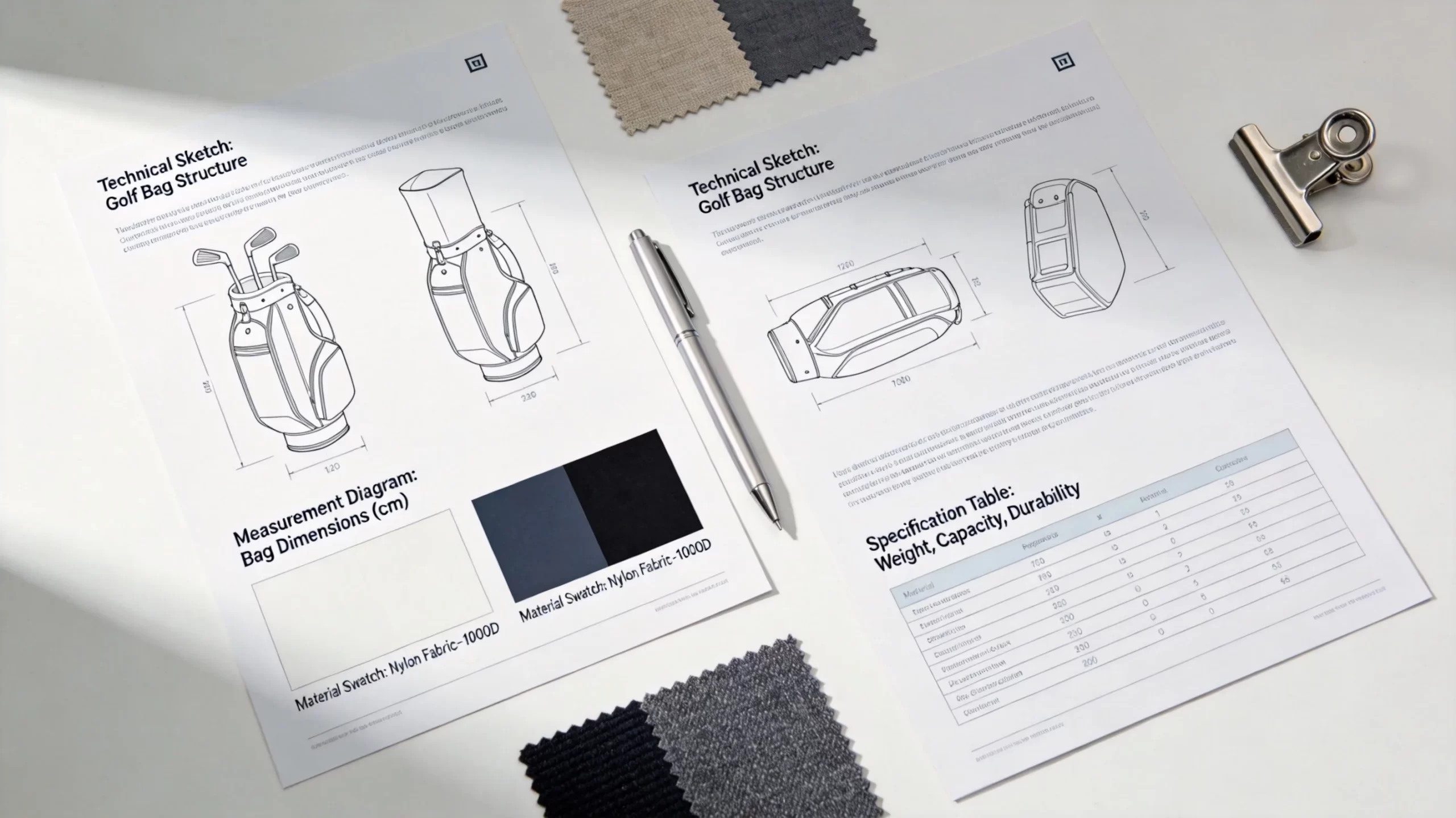
Quick Answer: A golf bag tech pack is a comprehensive manufacturing specification document that includes: (1) Technical flat sketches showing all views, (2) A Bill of Materials (BOM) listing every component with material, color code, size, and supplier, (3) Dimension and measurement specifications with tolerances, (4) Construction and stitching details including SPI and seam types, (5) Color standards using Pantone FHI codes, (6) Hardware specifications for zippers, buckles, and D-rings, (7) Packaging and labeling requirements, and (8) Quality standards with testing protocols. Each section eliminates ambiguity between brand intent and factory execution.
What Is a Golf Bag Tech Pack?
A tech pack (short for “technical package”) is a structured set of documents created by a brand’s design and product development team to communicate every aspect of a golf bag’s design, materials, and construction requirements to a manufacturing facility. Think of it as the complete instruction manual that transforms a concept sketch into a physical, production-ready product.
Unlike a simple design brief or mood board, a tech pack leaves no room for interpretation. Every dimension is specified to the millimeter, every material is identified by code and supplier, and every construction method is defined with industry-standard terminology. This precision is what allows a factory in Xiamen, Quanzhou, or Dongguan to produce a bag that matches exactly what a brand manager in California, London, or Sydney envisioned.
Why Tech Packs Matter in Golf Bag Manufacturing
The golf bag industry is highly competitive, with brands differentiating themselves through material innovation, functional design, and premium finishes. In this environment, a poorly communicated specification can lead to:
- Sample rejection cycles — each round costs $200–$800 and adds 2–3 weeks to your timeline
- Material substitution — factories may use cheaper alternatives if specifications are vague
- Color inconsistency — without Pantone codes, “navy blue” can range from midnight to royal
- Structural failures — incorrect stitch density or seam type leads to bag collapse under club weight
- IP leakage — undocumented innovations can be replicated and sold to competing brands
A well-constructed tech pack protects your design integrity, reduces time-to-market, and establishes a clear basis for quality disputes. According to Techpacker’s manufacturing research, brands that use structured tech packs reduce their product development cycle by approximately four weeks compared to those relying on informal communication.
The 8 Core Sections of a Golf Bag Tech Pack
Every professional golf bag tech pack contains eight core sections. Understanding what each section communicates — and what red flags to watch for — is essential for brand owners and product managers.
Section 1: Cover Page and Style Summary
The cover page establishes the document’s identity and version control. It should include:
- Style name and number — e.g., “KPG Tour Pro Cart Bag — Style #KPG-TC2026”
- Season/collection — e.g., “2027 Spring Collection”
- Designer and product manager names
- Version number and revision date — critical for tracking changes
- MOQ and target FOB price — often included for factory reference
What to verify: The version number must match the latest revision. Factories have been known to produce from outdated versions, resulting in entire batches that don’t match current specifications.
Section 2: Technical Flat Sketches (Fashion Flats)
Technical flats are scaled, black-and-white line drawings that show the golf bag from every angle — front, back, side, base, top opening, and interior views. Unlike marketing photos, flats strip away color and texture to focus purely on structure, proportions, and feature placement.
For golf bags, key views include:
- Front view — showing pocket layout, logo placement, and strap configuration
- Back view — showing dual strap harness, ventilation panel, and carry handle
- Side profile — showing bag silhouette, divider tube height, and base shape
- Base view — showing feet placement, anti-twist mechanism, and bottom reinforcement
- Top opening view — showing divider configuration (5-way, 6-way, 14-way) and cuff design
- Interior cross-section — showing lining, pocket depth, and club shaft routing
What to verify: Ensure callouts (annotation lines with labels) point to specific features and reference the correct section in the BOM. If a zipper is labeled “#5 YKK AquaGuard” in the sketch but “#3 generic” in the BOM, that discrepancy must be resolved before sampling.
Section 3: Bill of Materials (BOM)
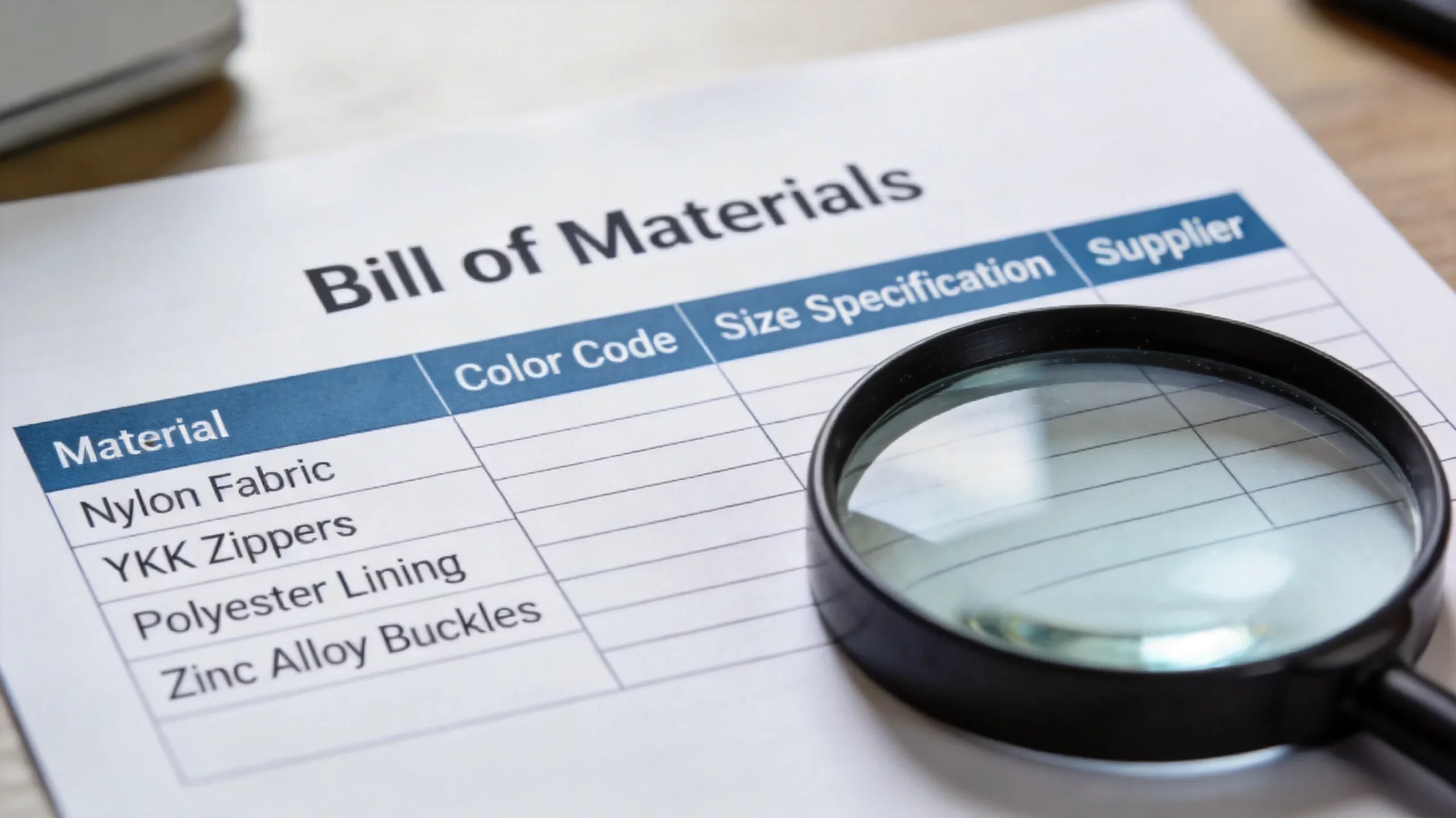
The BOM is the most detailed section of any golf bag tech pack. It lists every single component that goes into the finished product, organized by category. A typical golf bag BOM contains 25–40 line items spanning fabrics, hardware, thread, labels, and packaging.
| # | Component | Material | Color / Finish | Size / Spec | Supplier |
|---|---|---|---|---|---|
| 1 | Shell — Body | 1000D Cordura Nylon + PU coating | Pantone 19-4028 TCX (Navy) | 1.2mm thickness | Cordura / Invista |
| 2 | Shell — Base | 1680D Ballistic Nylon + TPU | Pantone Black 6 TCX | 2.0mm thickness | Cordura / Invista |
| 3 | Lining — Main | 210D Polyester Ripstop | Pantone Cool Gray 4 TCX | 75 GSM | TBD |
| 4 | Lining — Valuables Pocket | Velour Microfiber | Pantone 19-4028 TCX | 0.5mm pile | TBD |
| 5 | Webbing — Straps | Nylon 45mm webbing | Pantone Black 6 TCX | 45mm width, 2.5mm thickness | TBD |
| 6 | Main Zipper | YKK #10 AquaGuard | Matt Black | 60cm length | YKK Corporation |
| 7 | Pocket Zippers | YKK #5 Coil | Black | 25cm / 30cm lengths | YKK Corporation |
| 8 | Buckle — Strap Adjuster | POM (Acetal) | Matt Black | 45mm | Duraflex / Woojin |
| 9 | D-Ring — Side | Zinc Alloy | Gunmetal PVD | 25mm inner diameter | TBD |
| 10 | Bag Feet | Rubber + ABS base | Black | 40mm diameter × 12mm height | TBD |
| 11 | Divider Tubes | EVA + Nylon mesh | Black / Grey | 14-way full-length | TBD |
| 12 | Carry Handle | Nylon webbing + EVA foam pad | Black | 150mm × 40mm pad | TBD |
| 13 | Logo Patch | Silicone rubber | Custom (Pantone match) | 80mm × 30mm | TBD |
| 14 | Thread — Body | Polyester bonded #69 | Match shell color | T-70 weight | Coats / A&E |
| 15 | Thread — Reinforcement | Nylon bonded #92 | Black | T-90 weight | Coats / A&E |
What to verify: Every component in the flat sketches must appear in the BOM. Cross-check material codes, Pantone references, and supplier names. If a supplier is listed as “TBD,” clarify whether the factory will source or if the brand must provide. This is a common source of cost overruns.
For a deeper dive into material selection, see our Custom Golf Bag Materials Explained: Cordura Nylon vs PU Leather vs Canvas guide.
Section 4: Dimension and Measurement Specifications
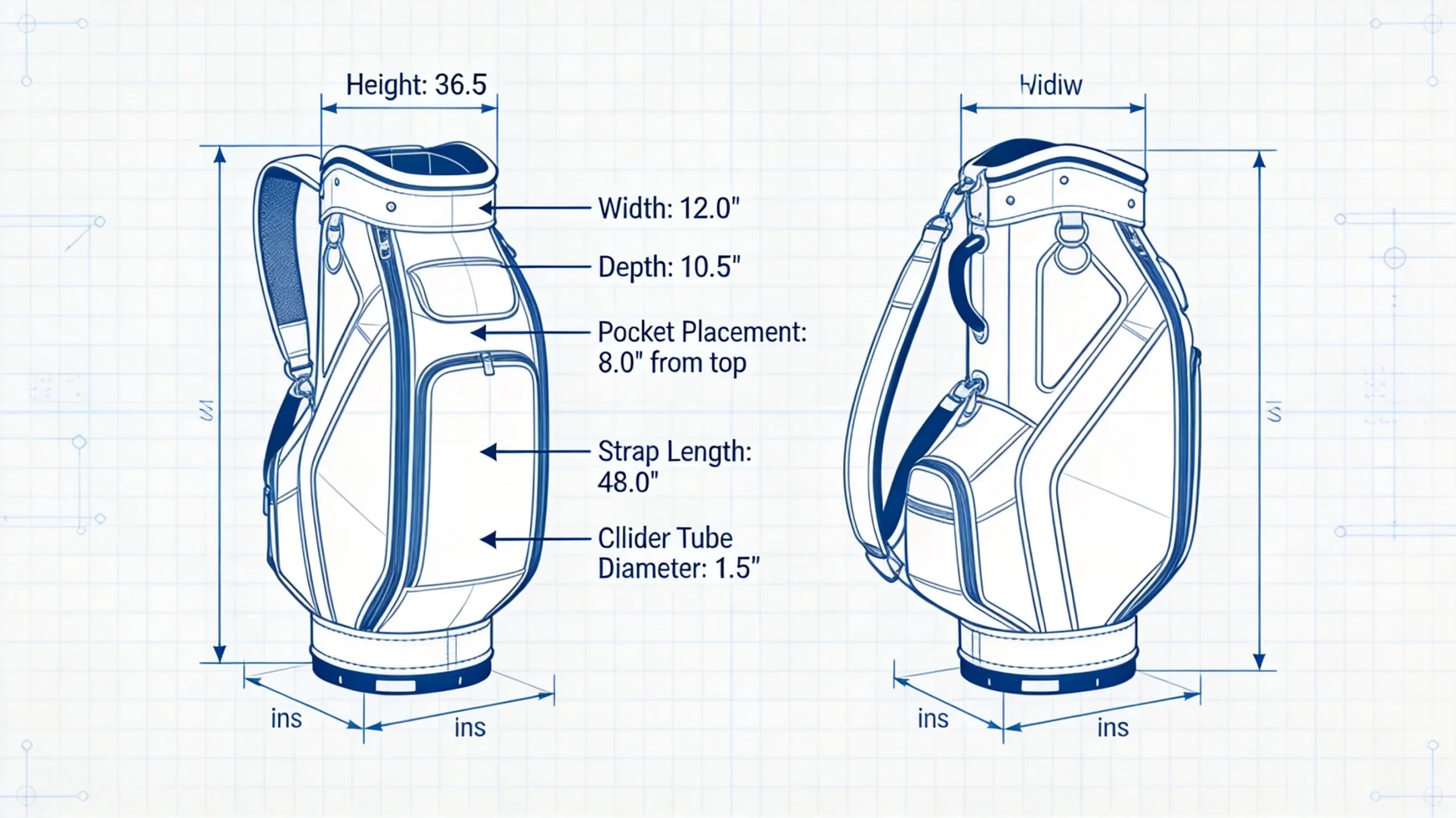
The measurement spec sheet defines the exact dimensions of the golf bag and each of its components, along with acceptable tolerances. For golf bags, critical measurements include:
| Measurement Point | Standard Size (in) | Tolerance | Notes |
|---|---|---|---|
| Total Height (base to top rim) | 36.5″ | ±0.25″ | Measured with bag standing upright, uncompressed |
| Top Opening Width (front-to-back) | 12.0″ | ±0.2″ | At the widest point of the cuff |
| Top Opening Depth (side-to-side) | 10.5″ | ±0.2″ | Determines club head clearance |
| Base Width | 11.0″ | ±0.3″ | Affects cart compatibility |
| Base Depth | 9.0″ | ±0.3″ | Must fit standard cart cradle |
| Strap Length (adjustable range) | 36″–52″ | ±0.5″ | Measured from attachment point to buckle end |
| Strap Width | 2.0″ | ±0.1″ | Wider straps reduce shoulder pressure |
| Pocket Depth (main pocket) | 14.0″ | ±0.3″ | Must accommodate rangefinder + accessories |
| Divider Tube Height | 34.0″ | ±0.5″ | Full-length dividers extend to base |
| Empty Weight Target | ≤5.5 lbs | ±0.3 lbs | Critical for stand/carry bags |
What to verify: Tolerances are your quality enforcement mechanism. A tolerance of ±0.25″ on height means the factory can produce bags between 36.25″ and 36.75″ — anything outside that range should be rejected. Tighter tolerances (±0.1″) cost more but are necessary for critical fit points like cart compatibility. For context, our 5 Critical Quality Tests Every Golf Bag Must Pass article explains how dimensional accuracy is verified during production inspection.
Section 5: Construction and Stitching Specifications
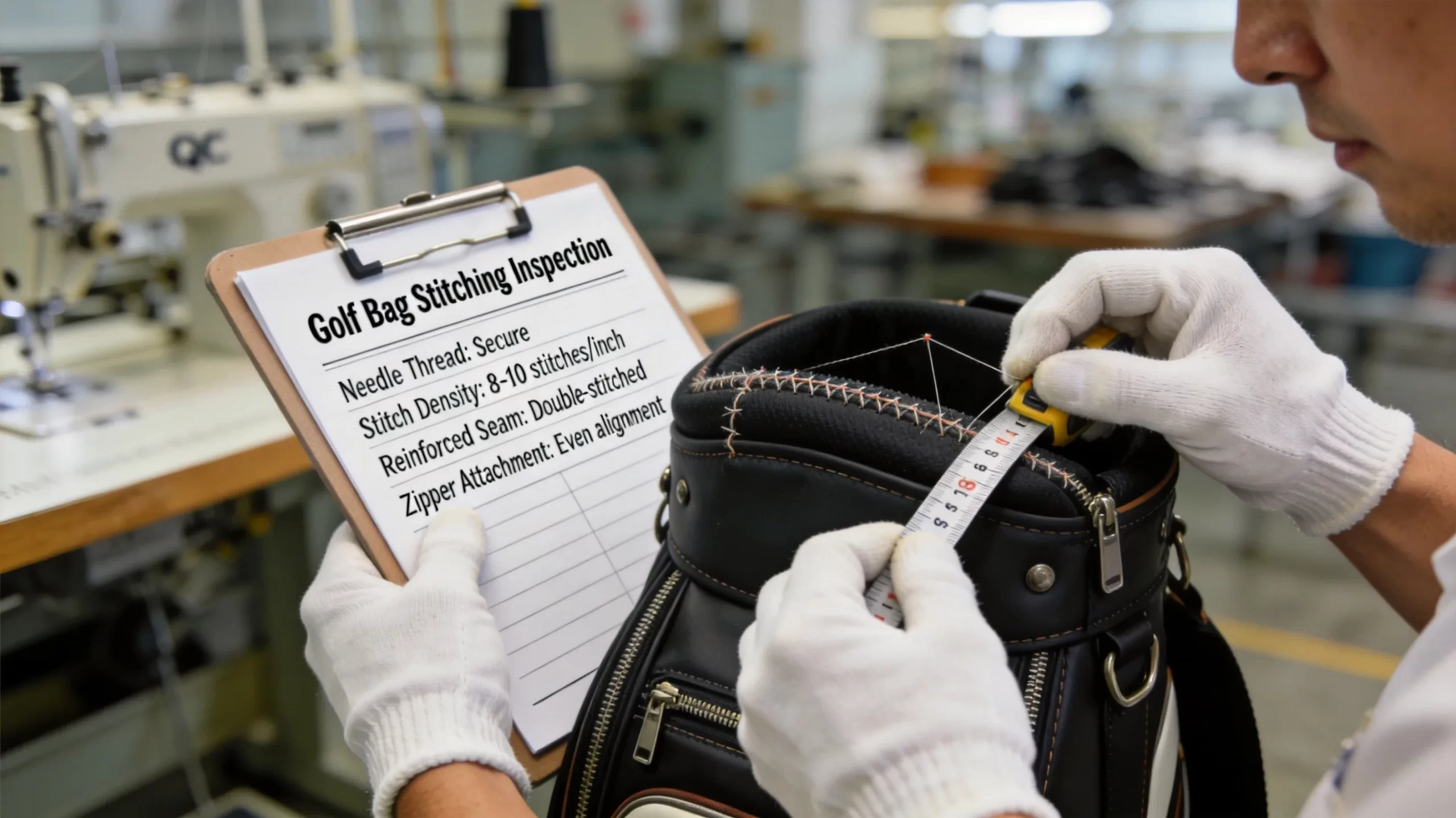
Construction details specify how the bag is assembled — the types of seams, stitching patterns, reinforcement methods, and edge treatments. This section is where many quality failures originate, because the difference between a bag that lasts 2 years and one that lasts 10 often comes down to stitch density and seam type.
| Construction Element | Specification | Industry Standard | Notes |
|---|---|---|---|
| Main Seam Type | Double-needle lockstitch (ISO 301) | Single-needle | Double-needle creates two parallel rows, doubling seam strength |
| Stitch Density (SPI) | 8–10 stitches per inch | 6–8 SPI | Higher SPI = stronger seam but slower production |
| Stress Point Reinforcement | Bar tack (ISO 301, 28 stitches) | Triple backstitch | Required at strap anchors, handle bases, D-ring attachment |
| Edge Treatment — Raw Edges | Folded + topstitched 1/4″ | Raw cut | Prevents fraying and adds durability |
| Edge Treatment — Bonded Panels | Ultrasonic welding + tape seam | Glue only | Used on waterproof models for sealed seams |
| Bottom Panel Attachment | Box stitch + rivet reinforcement | Sew only | Box stitch distributes load across wider area |
| Zipper Attachment | Welt seam with stay tape | Direct sew | Stay tape prevents zipper distortion during use |
| Strap-to-Body Attachment | Box-X stitch pattern (bar tack) | Standard rectangle | Box-X distributes pull force in 4 directions |
| Divider Tube Attachment | Topstitched + bonded at base | Glue only | Prevents tube rotation and collapse |
What to verify: SPI (stitches per inch) is the single most impactful construction variable. At 6 SPI, a seam may fail after 5,000 load cycles. At 10 SPI, the same seam can exceed 15,000 cycles. Insist on your specified SPI being checked during in-line QC, not just final inspection.
Section 6: Color Standards and Pantone References
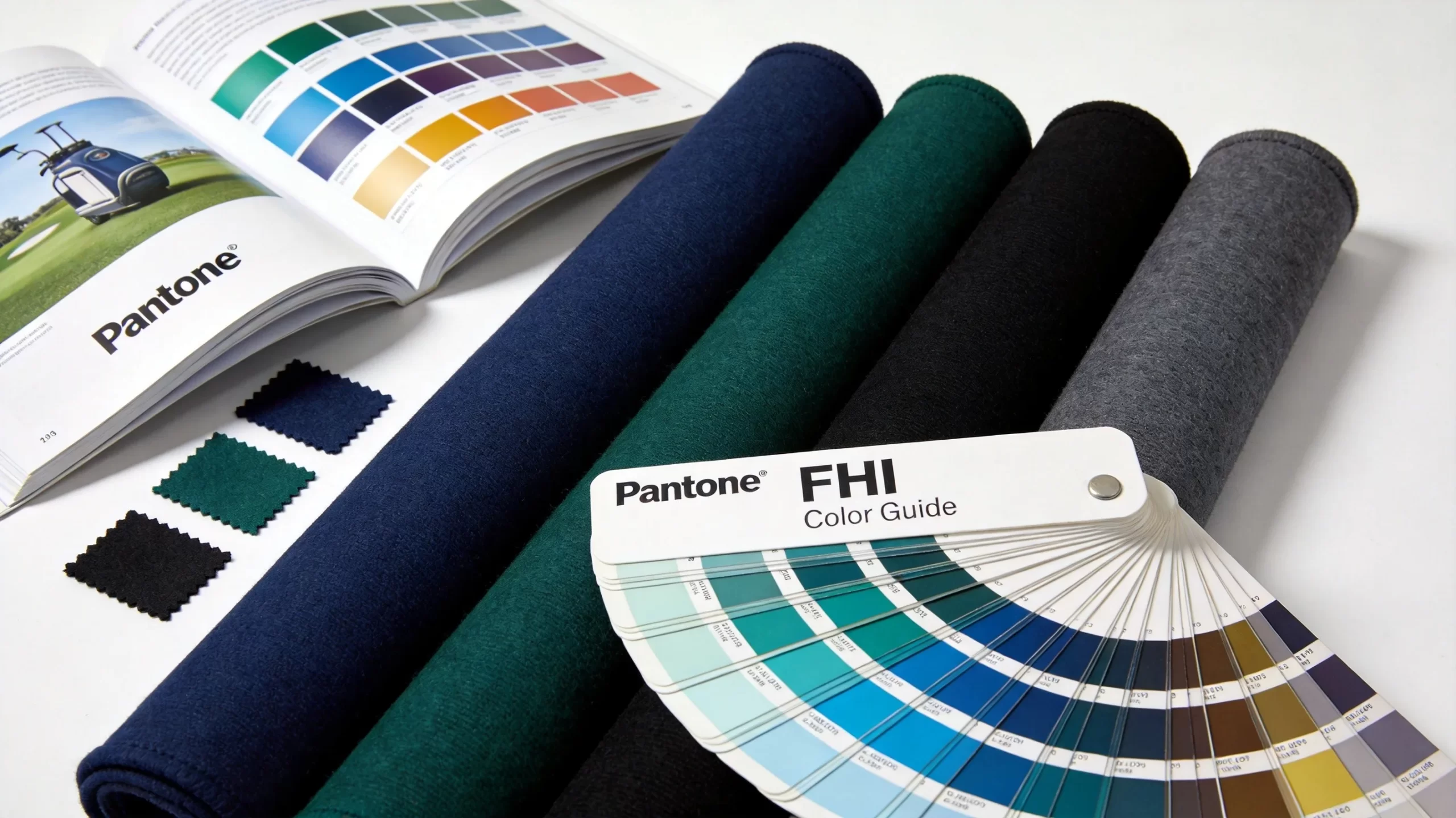
Color is where the most frequent communication breakdowns occur between brands and factories. The phrase “navy blue” is interpreted differently by every person on earth. That’s why professional tech packs use the Pantone Matching System (PMS) to specify exact colors.
For textile and golf bag manufacturing, you must use Pantone FHI (Fashion, Home + Interiors) codes — specifically the TCX (Textile Cotton Extended) or TPG (Textile Paper Green) suffixes. These systems are calibrated for fabric and textile applications, unlike the standard PMS codes used for print graphics.
| Component | Pantone FHI Code | Color Name | ΔE Tolerance | Verification Method |
|---|---|---|---|---|
| Shell — Main Body | 19-4028 TCX | Blue Depths (Navy) | ≤1.5 | Spectrophotometer under D65 |
| Shell — Base Panel | Black 6 TCX | True Black | ≤1.0 | Spectrophotometer under D65 |
| Lining | Cool Gray 4 TCX | Medium Gray | ≤2.0 | Visual match under D65 |
| Webbing / Straps | Black 6 TCX | True Black | ≤1.0 | Spectrophotometer under D65 |
| Zipper Tape | Black 6 TCX | True Black | ≤1.5 | Lab dip approval before bulk |
| Logo Silicone Patch | Custom (brand PMS) | Brand Color | ≤1.0 | Physical golden sample |
| Thread — Body | Match shell TCX | Tone-on-tone | ≤2.0 | Visual match under D65 |
| Packaging Box Print | Standard PMS (not FHI) | Brand Colors | ≤2.0 | Proof approval before printing |
Critical note: The same Pantone code will appear different on nylon vs. polyester vs. PU leather due to how each material absorbs and reflects dye. Always specify separate lab dips for each material type, even when using the same Pantone code. According to LantaoBags’ color matching specialists, fabric and paper absorb color fundamentally differently — always use FHI codes for textiles and PMS codes for packaging to ensure an accurate factory match.
What to verify: Demand physical lab dip samples before bulk fabric dyeing begins. The lab dip is a small swatch of your actual fabric dyed to your Pantone target. Approve it under D65 standardized daylight (not office fluorescent, not sunlight) before authorizing bulk production. See our Waterproofing Technologies Comparison for how coating processes can also affect color appearance.
Section 7: Hardware Specifications
Hardware — zippers, buckles, D-rings, rivets, and feet — represents the highest-wear components of a golf bag. Hardware failures account for over 40% of warranty claims in the industry.
Key hardware specifications to include:
- Zipper brand and model — YKK, SBS, or generic? Specify the exact model (e.g., “YKK #10 AquaGuard water-resistant coil zipper”)
- Zipper size number — #3 (light), #5 (medium), #8 (heavy), #10 (extra heavy). Golf bag main compartments typically use #8 or #10
- Slider type — Auto-lock, non-lock, or two-way pull? Auto-lock prevents accidental opening
- Buckle brand and material — Duraflex, Woojin, or generic POM? Specify load rating (e.g., “45mm side-release buckle, 50kg break strength”)
- D-ring material and finish — Zinc alloy with PVD coating? Specify inner diameter and thickness
- Bag feet — Rubber compound hardness (Shore A), diameter, height, and anti-slip pattern
For a comprehensive look at how hardware choices impact product longevity, see our Golf Bag Hardware & Components: Why Zippers, Buckles and Feet Make or Break Retail Returns.
What to verify: Request hardware samples from the factory before production. Test zippers through 5,000+ open/close cycles, pull buckles to rated load, and check D-rings for sharp edges that could cut webbing. Generic hardware often passes visual inspection but fails under repeated stress.
Section 8: Packaging, Labeling, and Quality Standards
The final section covers how the finished bag is presented, labeled, packed, and verified for quality.
Packaging Requirements
- Individual poly bag — thickness (e.g., 0.06mm LDPE), printed or clear, with warning text
- Hang tags — material (card stock weight), size, attachment method (plastic fastener vs. string), and artwork file reference
- Care label — material (satin weave vs. printed), placement (inside pocket seam), and content (washing instructions, country of origin, fiber composition per FTC/EU regulations)
- Master carton — dimensions, wall thickness (single vs. double wall), weight capacity, and printing requirements
- Units per carton — typically 5–10 bags per master carton depending on bag size
Quality Standards and Testing
| Test | Standard | Method | Pass Criteria |
|---|---|---|---|
| Seam Strength | ASTM D1683 | Pull test on sewn seam | ≥150N for main seams, ≥100N for secondary |
| Zipper Durability | BS 3084 / QB/T 2171 | 10,000 open/close cycles | No slider failure, no tooth separation |
| Buckle Load Test | Internal spec | Pull to rated load for 30 seconds | No breakage, no permanent deformation |
| Color Fastness — Light | ISO 105-B02 | Xenon arc lamp, 40 hours | Grade ≥4 (no visible fading) |
| Color Fastness — Rubbing | ISO 105-X12 | Crockmeter, 10 dry + 10 wet rubs | Grade ≥4 dry, ≥3 wet |
| Water Resistance | AATCC 22 | Spray test, 30-minute exposure | No penetration at seams or zippers |
| Dimensional Accuracy | Per tech pack | Tape measure at 10+ points | All within stated tolerances |
| Weight Check | Per tech pack | Digital scale | Within ±0.3 lbs of target |
For a complete overview of quality testing protocols, refer to our detailed guide on 5 Critical Quality Tests Every Golf Bag Must Pass Before Shipping.
What to verify: The AQL (Acceptable Quality Level) should be explicitly stated. For golf bags, AQL 2.5 for major defects and AQL 4.0 for minor defects is industry standard. This means in a batch of 500 bags, a random sample of 50 is inspected — if more than 3 bags have major defects, the entire batch fails.
How to Read a Tech Pack: A Step-by-Step Workflow
Now that you understand each section, here’s the practical workflow for reading and validating a tech pack as a brand owner or product manager:
Step 1: Version Check
Confirm you’re reading the latest version. Check the revision date and version number on the cover page. Cross-reference with your PLM (Product Lifecycle Management) system or shared drive.
Step 2: Sketch-to-BOM Cross-Reference
Go through each flat sketch line by line. Every labeled component should have a corresponding line in the BOM. Flag any discrepancies immediately.
Step 3: Measurement Validation
Compare the stated dimensions against your design intent. If your bag is designed to fit a specific golf cart model, verify the base dimensions match that cart’s cradle specifications.
Step 4: Material and Color Verification
Confirm that Pantone codes use the FHI system (TCX/TPG), not standard PMS. Verify that each material has a specified supplier or that the factory has been approved to source alternatives.
Step 5: Construction Detail Review
Ensure SPI, seam types, and reinforcement methods are specified for every stress point. Generic instructions like “sew securely” are unacceptable — demand quantified specifications.
Step 6: Hardware and Quality Standard Audit
Verify that hardware brands, models, and load ratings are specified. Confirm that the AQL level and testing protocols are appropriate for your target market and price point.
Step 7: Packaging and Compliance Check
Ensure care labels meet the regulatory requirements of your target market (FTC for US, Textile Regulation 1007/2011 for EU). Verify that packaging dimensions optimize container loading.
Tech Pack vs. Spec Sheet: Understanding the Difference
Many brands confuse a tech pack with a specification sheet. While related, they serve different purposes:
| Aspect | Tech Pack | Spec Sheet |
|---|---|---|
| Purpose | Complete manufacturing instruction set | Summary of key product specifications |
| Audience | Factory production team, QC inspectors | Sales team, buyers, distributors |
| Detail Level | Extremely detailed — every component specified | High-level overview — key features only |
| Length | 15–40 pages | 1–3 pages |
| Includes BOM | Yes, with full supplier details | Usually no, or abbreviated |
| Includes Construction Details | Yes, with SPI and seam types | No |
| Includes Pantone Codes | Yes, FHI system with ΔE tolerances | Color name or approximate reference |
| Legal Weight | Contractually binding | Informational / marketing |
| Version Control | Strict revision tracking required | Updated as needed for sales |
A spec sheet is derived from the tech pack — it’s the customer-facing summary. But the factory always works from the full tech pack. Never send a spec sheet to a factory and expect production-ready results.
Common Tech Pack Mistakes That Cost Brands Money
After working with 200+ brands over 20+ years of golf bag manufacturing, we’ve identified the most costly tech pack errors:
- Using CMYK values instead of Pantone codes — CMYK is for screen/print, not fabric. The same CMYK values produce different colors on nylon vs. polyester.
- Missing tolerance specifications — Without tolerances, “36.5 inches” could mean anything from 35″ to 38″ in factory interpretation.
- Vague construction instructions — “Sew strongly” or “reinforce stress points” gives the factory no actionable standard.
- No hardware brand specification — Factories will default to the cheapest available zipper or buckle unless you specify YKK, Duraflex, etc.
- Incomplete BOM — Forgetting to specify thread type, label material, or poly bag thickness leads to factory substitutions.
- No lab dip approval step — Skipping the lab dip means you discover color issues only after bulk fabric is dyed.
- Outdated version sent to factory — Without strict version control, factories may produce from Revision 1 when you’re on Revision 4.
For brand owners looking to avoid the most common pitfalls in golf bag production beyond tech pack errors, our 8 Profit-Killing Mistakes in Private Label Golf Bags article covers the broader strategic errors that undermine profitability.
Digital Tech Pack Tools: Moving Beyond Excel
The industry is rapidly shifting from static Excel spreadsheets and PDF documents to cloud-based PLM (Product Lifecycle Management) platforms. These tools offer:
- Real-time collaboration — designers, product managers, and factories can comment and approve changes simultaneously
- Version control — automatic revision tracking with change logs eliminates the “wrong version” problem
- 3D visualization — some platforms allow 3D bag modeling directly in the tech pack
- Automated BOM cost rollup — material cost changes automatically update the total product cost
- Supplier integration — approved suppliers can access relevant sections directly
Popular platforms include Techpacker, Centric PLM, Browzwear, and Gerber AccuMark. According to Techpacker’s industry data, brands using digital tech pack tools report a 55% reduction in tech pack creation time and approximately four weeks shorter product development cycles.
At Keep Perfect Golf, we work with brands using both traditional PDF tech packs and modern PLM platforms. Our production team is experienced in interpreting specifications from any format, and we can also assist brands in building their initial tech pack from concept sketches.
Ready to Build Your Golf Bag Tech Pack?
Whether you’re launching your first golf bag line or refining an existing product, a precise tech pack is your most powerful tool for ensuring quality, controlling costs, and protecting your brand identity. At Keep Perfect Golf, we’ve supported 200+ brands across 100+ countries with OEM and ODM golf bag manufacturing from our 30,000 sqm facility in Quanzhou, Fujian.
What we offer:
- Tech pack review and optimization — we’ll flag gaps before sampling begins
- Material sourcing guidance — access to our vetted supplier network for fabrics, hardware, and trims
- Rapid prototyping — first samples within 15–20 days of tech pack approval
- MOQ from 100 pieces — accessible for emerging brands and crowdfunding campaigns
- FOB Xiamen pricing — transparent cost structure with no hidden fees
📧 Email: [email protected]
WhatsApp: +86 17750020688
Website: keepperfectgolf.com
Send us your tech pack — or even just a concept sketch — and we’ll provide a detailed feasibility assessment and cost estimate within 48 hours.
Frequently Asked Questions
What is a golf bag tech pack?
A golf bag tech pack is a comprehensive manufacturing specification document that includes technical flat sketches, a Bill of Materials (BOM) with every component listed, dimension and measurement specifications with tolerances, construction and stitching details, Pantone color standards, hardware specifications, packaging requirements, and quality testing protocols. It serves as the complete instruction manual for transforming a design concept into a production-ready golf bag.
What Pantone system should I use for golf bag fabrics?
For golf bag fabrics and textiles, always use the Pantone FHI (Fashion, Home + Interiors) system with TCX (Textile Cotton Extended) or TPG (Textile Paper Green) suffixes. Standard PMS codes are designed for print graphics and will not accurately represent colors on nylon, polyester, or PU leather. Additionally, the same Pantone code will appear differently on different fabric types, so always request separate lab dips for each material.
How many components are typically in a golf bag BOM?
A typical golf bag Bill of Materials contains 25 to 40 line items, including shell fabrics (body, base, accents), lining materials, webbing and straps, zippers (main and pocket), buckles and adjusters, D-rings and hardware, bag feet, divider tubes, carry handles, logo patches, thread types, labels, and packaging materials. Premium bags with more pockets and features may exceed 50 components.
What stitch density (SPI) should I specify for golf bags?
For golf bag manufacturing, specify 8–10 stitches per inch (SPI) for main seams and 10–12 SPI for stress points like strap attachments and handle bases. The industry standard of 6–8 SPI is acceptable for budget bags but may lead to seam failure under repeated heavy loads. Higher SPI increases production time and cost but significantly extends the bag’s functional lifespan.
How much does it cost to produce a golf bag from a tech pack?
The FOB cost of manufacturing a golf bag varies widely based on materials, features, and order quantity. Entry-level bags with basic nylon and standard hardware start around $12–18 FOB. Mid-range bags with branded zippers (YKK), reinforced construction, and custom colors typically cost $20–35 FOB. Premium bags with waterproof membranes, branded hardware (Duraflex buckles), and complex divider systems range from $35–65+ FOB. Sample costs are typically $200–800 per design, with 2–3 sampling rounds expected before production approval.
Related Products
Explore our manufacturing capabilities in this category:
 Premium Tour Cart Bag
 Lightweight Cart Bag
 Waterproof Cart Bag
 Staff Cart Bag
 Classic Sunday Carry Bag
 Ultra-Light Sunday Bag
Need custom golf bags? Contact us for OEM/ODM quotes — MOQ 100pcs, FOB Xiamen.