Since 2004, Keep Perfect Golf has hosted over 200 brand partners for both remote and on-site factory audits. This guide distills two decades of audit experience into an actionable checklist.
Why Remote Factory Audits Have Become the New Normal
The global pandemic didn’t invent remote factory audits — it accelerated a shift that was already underway. Today, procurement teams at major golf brands use remote audits as a first-line screening tool before investing in costly overseas visits. According to a 2024 study by the Harvard Business Review, companies that adopted hybrid audit models reduced supplier evaluation costs by 38% while maintaining defect detection rates above 90%.
For golf bag buyers specifically, remote audits offer three critical advantages:
- Cost efficiency: A single on-site audit to Xiamen or Guangzhou can cost $3,000–$8,000 when you factor in flights, hotels, local transport, and auditor fees. A remote audit costs a fraction of that.
- Time savings: Remote audits can be scheduled within days, not weeks. A typical remote evaluation covers 80% of what a 2-day on-site visit achieves.
- Pre-qualification power: Remote audits serve as an effective filter — eliminating suppliers who aren’t a fit before you commit to deeper engagement.
That said, remote audits are not a complete replacement. A 2025 InTouch Quality report found that remote audits miss approximately 25% of findings that on-site inspections catch — particularly subtle issues like worker morale, hidden subcontracting areas, and informal production practices. The smart approach: use remote audits for screening, then follow up with on-site visits for final candidates.
Remote Audit vs. On-Site Audit: When to Use Each
| Criteria | Remote Audit | On-Site Audit |
|---|---|---|
| Cost per audit | $500–$1,500 | $3,000–$8,000+ |
| Lead time | 3–7 days | 2–4 weeks |
| Document verification | ✓ Full capability | ✓ Full capability |
| Production line observation | ✓ Via live video | ✓ Direct observation |
| Worker interviews | △ Limited (managed by factory) | ✓ Private, unscripted |
| Hidden area access | △ Factory controls camera path | ✓ Auditor chooses path |
| Material sampling | ✗ Requires shipping samples | ✓ Physical testing on-site |
| Best for | Initial screening, re-audits, ongoing monitoring | Final supplier selection, high-value orders, new partnerships |
The ideal workflow: conduct a remote audit first, narrow your supplier list to 2–3 candidates, then schedule on-site visits for final validation. This approach has become standard practice among sourcing managers in the sporting goods industry.
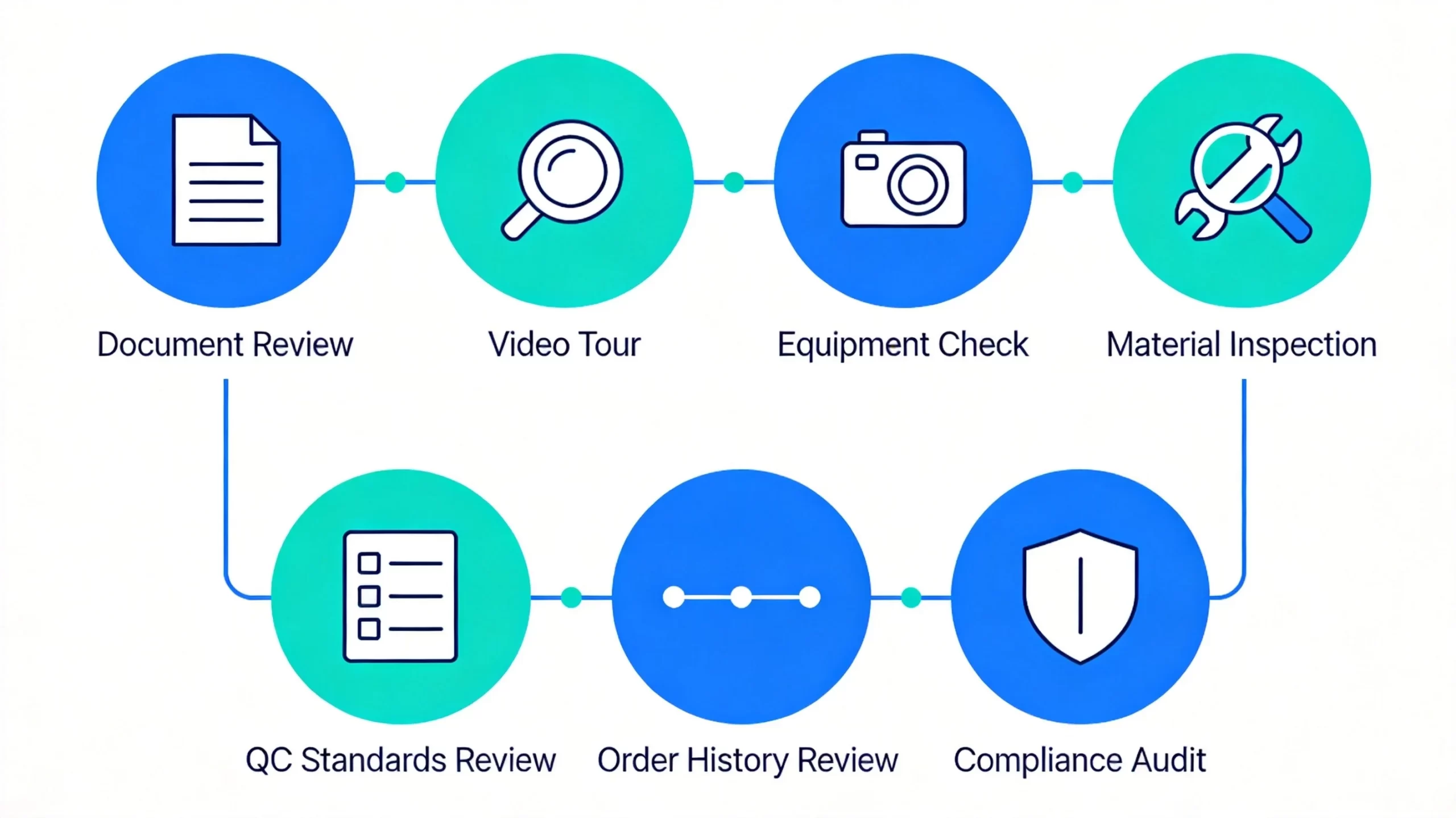
The Complete 7-Step Remote Golf Bag Factory Audit Process
Step 1: Document Pre-Review (Before the Video Call)
Before you schedule a single video call, request and independently verify these documents. A factory that is slow to provide them — or offers excuses — is already signaling a problem.
| Document | What to Verify | How to Verify |
|---|---|---|
| Business License | Registration number, scope of operations, validity | Check against China’s National Enterprise Credit Information Publicity System (NECIPS) |
| Export License | Authorized to export textile/sporting goods | Confirm customs registration code |
| ISO 9001 Certificate | Certificate number, issuing body, expiry date | Verify on IAF CertSearch database |
| BSCI / WRAP / Sedex | Current validity, scope, any suspensions | Check directly on amfori BSCI member portal or Sedex |
| Material Compliance Reports | REACH, Prop 65, RoHS test reports for specific materials | Confirm reports are from accredited labs (SGS, Intertek, Bureau Veritas) and dated within 12 months |
| Recent Export Records | Sample bills of lading (redacted) to your target markets | Confirm experience shipping to US, EU, or your specific market |
Pro tip: At Keep Perfect Golf, we maintain a transparent document portal for all prospective partners — business licenses, certifications, and material test reports are available before the first conversation. This pre-qualification transparency saves everyone time.
Step 2: Live Video Factory Tour
Never accept a pre-recorded factory video as evidence of production capacity. Demand a live walkthrough via Zoom, WeChat, or WhatsApp Video. You guide the camera operator in real time.
During the live tour, focus on three zones:
- Production floor: Count sewing stations, cutting tables, and embroidery machines. Compare this against claimed monthly output. A factory claiming 50,000 golf bags per month with only 20 sewing stations is being dishonest.
- Storage and warehouse: Materials should be stored off the floor, properly labeled, and protected from moisture. Golf bag fabrics (especially nylon and polyester) are susceptible to mold in humid conditions — look for dehumidifiers and proper ventilation.
- QC area: A dedicated quality control zone with inspection tables, proper lighting, testing equipment (tensile strength testers, colorfastness kits, zipper cycling machines) indicates a serious operation.
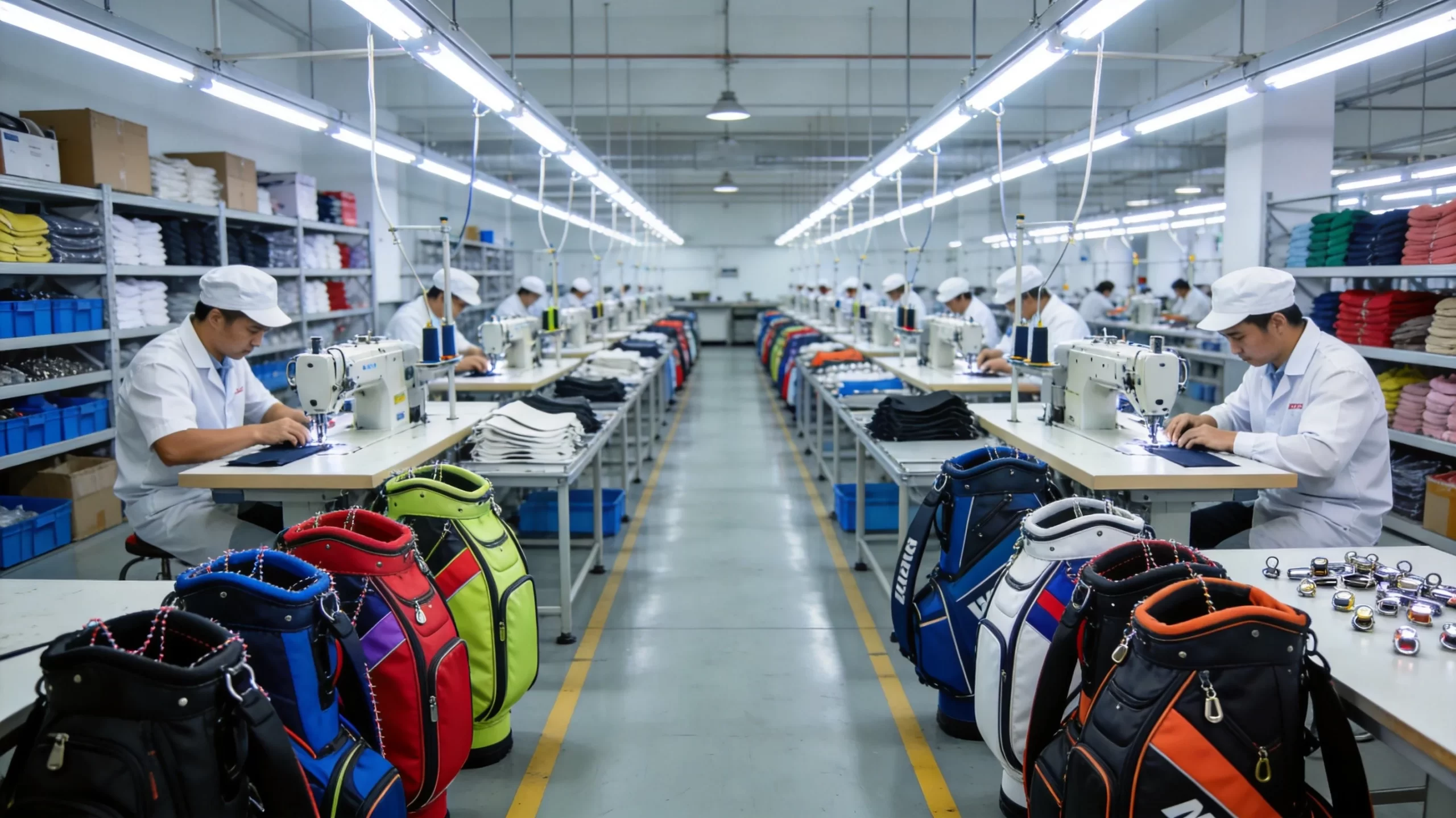
Step 3: Equipment and Capacity Assessment
Ask the factory to show you specific equipment and explain their production workflow. Key questions:
- How many CNC cutting machines do you operate? (Computer-controlled cutters achieve ±0.5mm tolerance; laser systems reach ±0.1mm)
- What is your current capacity utilization? (A factory running at 95%+ capacity may struggle with your deadlines)
- Do you have in-house embroidery and printing? Or is this outsourced?
- What is your standard lead time for sampling vs. bulk production?
For golf bags specifically, pay attention to:
- Stand mechanism assembly equipment (for stand bags)
- Waterproof coating and seam sealing stations
- Hardware testing rigs (buckle tension, zipper endurance)
Request that the factory show production records — not just claims. Monthly output logs, equipment maintenance schedules, and shift patterns reveal real capacity better than marketing brochures.
Step 4: Material Inventory and Supply Chain Review
One of the biggest risks in remote sourcing is material substitution — where a factory uses lower-grade materials than agreed upon. During your remote audit:
- Ask to see raw material storage. Are fabrics from recognized suppliers (YKK zippers, 1680D ballistic nylon from certified mills)?
- Request the factory’s approved vendor list for key materials: fabrics, zippers, buckles, foam padding, and thread.
- Ask to see material incoming inspection records. How do they verify material quality before it enters production?
- Inquire about material traceability — can they link a finished bag back to specific material batches?
For more on material quality standards, see our detailed guide on material quality inspection for golf bags.
Step 5: QC Process and Testing Standards Review
This is where you separate serious manufacturers from trading companies. Ask the factory to walk you through their complete quality control process:
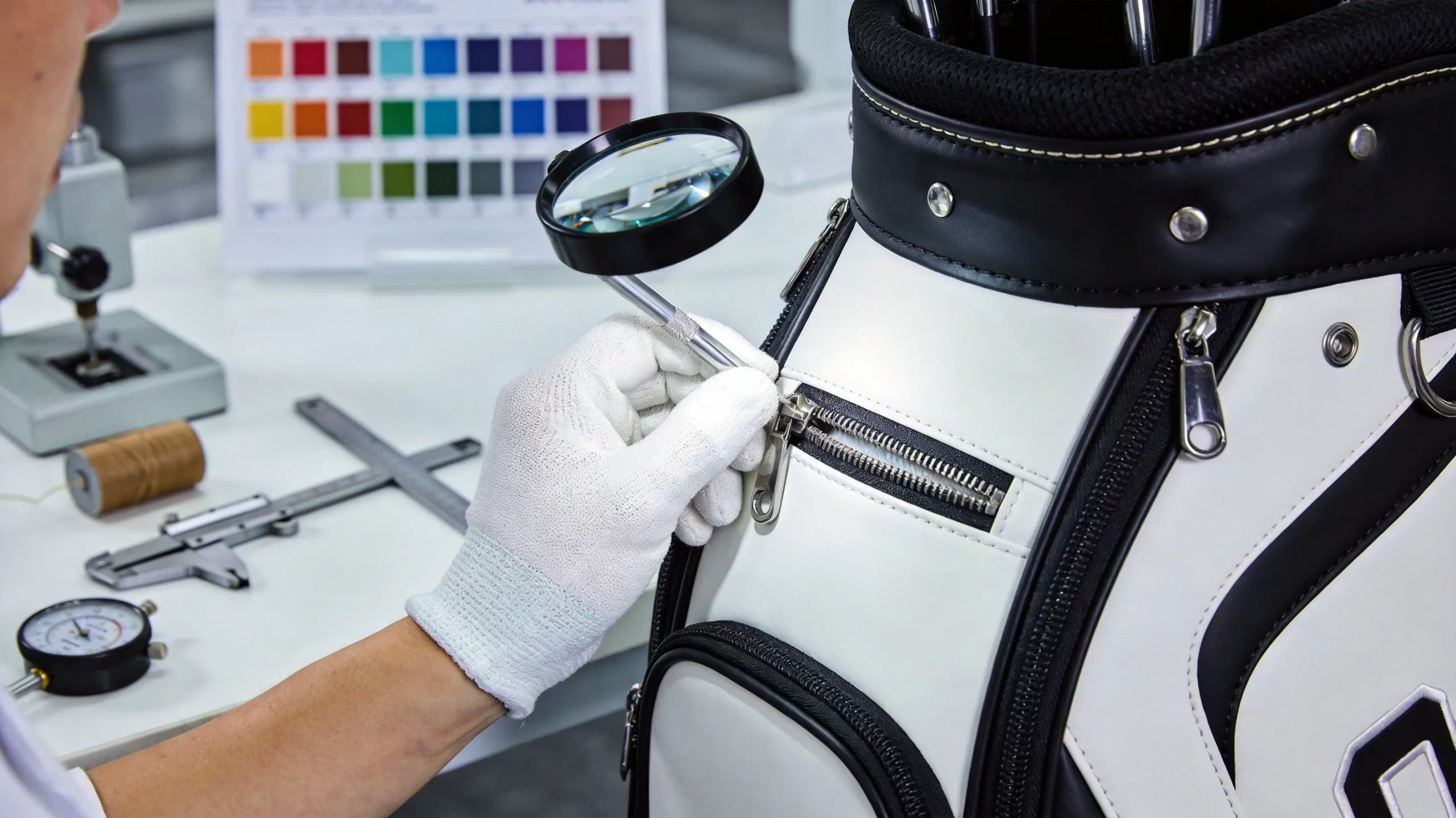
- Incoming Quality Control (IQC): What percentage of incoming materials are inspected? Do they test tensile strength (ASTM D5034), water resistance (AATCC 22), and UV stability (ASTM D6775)?
- In-Process Quality Control (IPQC): At what production milestones are inspections performed? Is there a 20% inline check?
- Final Quality Control (FQC): What AQL (Acceptable Quality Limit) standard do they use? What sampling plan (ANSI/ASQ Z1.4) is followed?
- Testing Equipment: Do they have in-house testing capability, or must they send samples to external labs?
A well-structured quality control system that combines supplier audits with in-house checks typically catches 95%+ of defects before shipment. Ask to see actual QC reports from recent orders (with client details redacted) — factories that maintain thorough records demonstrate process maturity.
Step 6: Order History and Reference Client Review
A factory’s track record speaks louder than its promises. During the remote audit:
- Ask for 3–5 reference clients, preferably brands in your target market or industry segment.
- Request case studies or photos of similar golf bag projects (custom logos, specialized materials, complex designs).
- Inquire about order volumes: have they handled your scale before? (MOQ requirements, seasonal peak capacity)
- Ask about their experience with your specific market requirements: US Customs compliance, EU REACH standards, Amazon FBA packaging requirements, etc.
Factories that have partnered with 200+ brands across 100+ countries (like Keep Perfect Golf) bring valuable cross-market experience. They understand the nuances of different regulatory environments and quality expectations.
Step 7: Compliance and Social Responsibility Audit
Modern consumers and retailers demand ethical sourcing. Your remote audit must include:
- Working conditions: Ask to see the factory floor during working hours. Is it clean, well-lit, properly ventilated? Are fire exits clearly marked and unobstructed?
- Wage verification: Request payroll records for a random month (names redacted). Verify wages exceed local minimum standards.
- Working hours: Review time records. Excessive overtime is both an ethical concern and a production risk (fatigued workers make more errors).
- Safety infrastructure: Ask to see first-aid stations, fire drill logs, and PPE (personal protective equipment) usage.
- Certifications: BSCI, SMETA/Sedex, SA8000 — but verify they are current and issued directly to the factory, not a parent company.
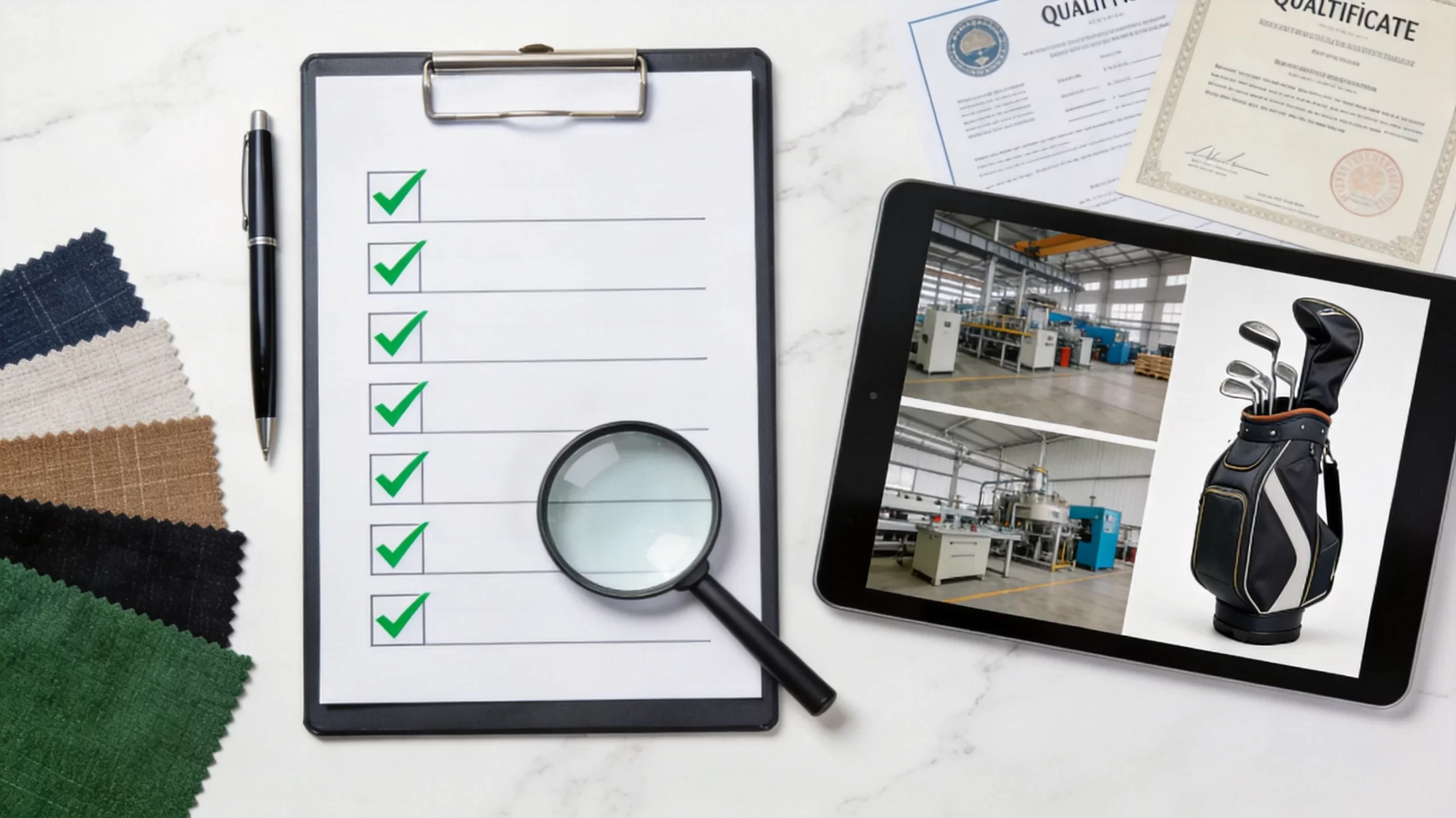
Complete Remote Golf Bag Factory Audit Checklist
Use this checklist during your next remote audit. Print it, check off items in real time, and score each section.
| Audit Area | Check Item | Pass / Fail / N/A | Notes |
|---|---|---|---|
| 1. Documentation | Business license verified (NECIPS) | ||
| Export license confirmed | |||
| ISO 9001 certificate valid and verified | |||
| Social compliance cert (BSCI/Sedex) current | |||
| 2. Video Tour | Production floor clean and organized | ||
| Materials stored properly (off floor, labeled) | |||
| Fire exits accessible and marked | |||
| Dedicated QC area visible | |||
| Worker count matches claimed capacity | |||
| 3. Equipment | CNC/laser cutting equipment present | ||
| In-house embroidery/printing capability | |||
| Equipment maintenance records available | |||
| Current capacity utilization reasonable (<90%) | |||
| 4. Materials | Approved vendor list provided | ||
| Material compliance reports (REACH/Prop 65) current | |||
| Incoming material inspection records exist | |||
| Material traceability system in place | |||
| 5. QC Process | IQC, IPQC, FQC stages clearly defined | ||
| AQL standard specified (e.g., AQL 2.5) | |||
| In-house testing equipment available | |||
| Recent QC reports available for review | |||
| 6. Track Record | Reference clients provided (3+) | ||
| Similar project photos/case studies available | |||
| Experience with your target market confirmed | |||
| 7. Compliance | Working conditions meet basic standards | ||
| Wage records reviewed | |||
| Safety infrastructure visible |
Red Flags: When to Walk Away from a Supplier
Not every factory that passes documentation checks deserves your business. During remote audits, watch for these warning signs:
| Red Flag | What It Means | Risk Level |
|---|---|---|
| Factory refuses live video tour | They may be a trading company, not a manufacturer | Critical |
| Camera operator only shows “highlight areas” | They may be hiding production problems or subcontracting | High |
| Can’t provide REACH/Prop 65 reports | Your products may face customs holds or legal liability | Critical |
| Worker count doesn’t match claimed capacity | False capacity claims — they may outsource without telling you | High |
| No dedicated QC team or QC area visible | Quality is inconsistent; defects will reach your customers | High |
| Factory claims ISO certification but can’t verify certificate number | Fake or expired certification | Critical |
| Resists showing material storage conditions | Poor storage leads to mold, material degradation, and inconsistent quality | Medium |
| No maintenance logs for equipment | Equipment breakdowns will cause production delays | Medium |
| Factory “too busy” for audits | Transparency is a hallmark of trustworthy manufacturers; resistance suggests concealment | High |
| Can’t name raw material suppliers | Possible unauthorized subcontracting or material substitution | High |
According to the InTouch Quality audit database (2024), suppliers who resist transparency in initial audits are 3x more likely to deliver defective orders. At Keep Perfect Golf, we welcome every audit request — our 22 years of manufacturing excellence means we have nothing to hide.
Working with Third-Party Inspection Agencies
For buyers who want additional assurance, combining a remote audit with a third-party inspection agency creates a powerful verification layer. Here’s how to structure it:
- Phase 1 (Remote): Conduct your own remote audit using the checklist above. This screens out obvious non-starters.
- Phase 2 (Third-party): Engage agencies like SGS, Intertek, Bureau Veritas, or QIMA for an on-site audit of your shortlisted factories. Budget $1,500–$3,000 per factory day.
- Phase 3 (Ongoing): Use third-party pre-shipment inspections (PSI) at 80% production completion for every bulk order. This catches issues before goods leave the factory.
The key is sequencing: remote audits filter the field, third-party audits validate final candidates, and ongoing inspections maintain quality across every shipment. This three-layer approach is how brands managing 100+ SKU portfolios keep quality consistent without flying auditors overseas every quarter.
For more context on building a comprehensive quality system, explore our complete golf bag quality control guide.
Why Factory Transparency Matters in Remote Audits
A remote audit only works if the factory cooperates. This is where supplier selection matters enormously. Factories that are transparent by nature — that maintain organized documentation, welcome video calls, and willingly share production data — make remote audits efficient and productive.
At Keep Perfect Golf, we’ve refined our remote audit process over two decades of working with international brands. Our transparent approach includes:
- A pre-organized document package available before the first call
- Dedicated audit coordination staff who facilitate live video tours
- Open access to production records, QC data, and material certificates
- A willingness to answer difficult questions about capacity, challenges, and limitations
This transparency isn’t just good manners — it’s a competitive advantage. Factories that operate openly build trust faster, reduce procurement risk, and ultimately create stronger partnerships. We’ve served over 200 brands across 100+ countries, and every relationship started with a transparent conversation.
Learn more about our custom golf bag manufacturing process and how we maintain quality at scale.
Frequently Asked Questions
How long does a remote golf bag factory audit take?
A comprehensive remote audit typically takes 2–4 hours of live video time, spread across 1–3 sessions over 5–7 business days. This includes document verification (done beforehand), a live video factory tour (60–90 minutes), and follow-up discussions on QC processes, capacity, and compliance. The total timeline from initial request to audit completion is usually 10–14 days.
Can I trust what the factory shows me on video?
Live video is far more reliable than pre-recorded tours, but it has limitations. The factory controls the camera path, which means they can steer you away from problem areas. Counter this by giving specific instructions — ask to see the material storage room, the QC station, and current production orders on the line. If the factory resists any specific request, that itself is valuable information. For high-stakes orders, always follow up with an on-site visit.
What technology do I need for a remote factory audit?
A stable internet connection, a laptop or tablet with a large screen, and a video conferencing tool (Zoom, WeChat, or WhatsApp Video) are essential. Some auditors use body-worn cameras (GoPro-style) for hands-free first-person walkthrough footage. Agree on backup communication protocols in case of connectivity issues — factories in China’s interior can experience intermittent connections.
Is a remote audit sufficient for qualifying a new supplier?
A remote audit is an excellent first step for supplier screening. It verifies legal registration, stated capacity, and basic quality systems efficiently. However, according to a Harvard Business School study on manufacturing audits (2025), remote audits miss approximately 25% of what on-site audits detect — particularly informal subcontracting and worker condition nuances. For first orders in high-value or high-risk categories, follow up with an on-site audit before committing to volume production.
How do remote audits handle language barriers in China or Southeast Asia?
The most effective approach is using auditors who are native or fluent in the factory’s working language. This allows direct document reading, independent worker conversations, and real-time identification of inconsistencies. If an interpreter is necessary, they should be independent of the factory — not a staff member translating on behalf of management. Always confirm interpreter independence before the audit begins.
Start Your Factory Audit with Confidence
Remote factory audits have become an essential tool in the B2B golf bag sourcing toolkit. They save time, reduce costs, and — when conducted systematically — provide a reliable picture of a manufacturer’s capabilities.
Whether you’re evaluating a new supplier or conducting annual re-audits, the 7-step process and checklist in this guide will help you build a structured, repeatable evaluation framework.
Keep Perfect Golf has been a transparent, auditable manufacturing partner since 2004. With 22 years of experience, partnerships with 200+ brands across 100+ countries, FOB Xiamen terms, and a minimum order of just 100 pieces, we make it easy to start a relationship built on verified trust.
Request a Factory Audit Session
Or reach us directly: WhatsApp +86 17750020688 | Email: [email protected]
Related Products
Explore our manufacturing capabilities in this category:
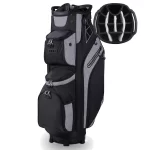
Need custom golf bags? Contact us for OEM/ODM quotes — MOQ 100pcs, FOB Xiamen.