
If you want a golf bag zipper that keeps working after seasons of dirt, rain, and heavy use, I’d pick YKK for the main pockets. The big reason is simple: YKK zippers tend to last longer, handle side pressure better, and hold up better in wet and gritty conditions than low-cost generic options.
Here’s the short version:
- YKK coil zippers are a strong fit for flexible pockets and daily-use areas.
- YKK VISLON molded plastic zippers are better for main openings, cart bags, and travel covers.
- YKK AquaGuard zippers are the better call for valuables pockets that may get hit by rain or dew.
- Generic zippers can still work on hidden or low-stress internal pockets, but they’re more likely to wear out early.
A few numbers tell the story fast:
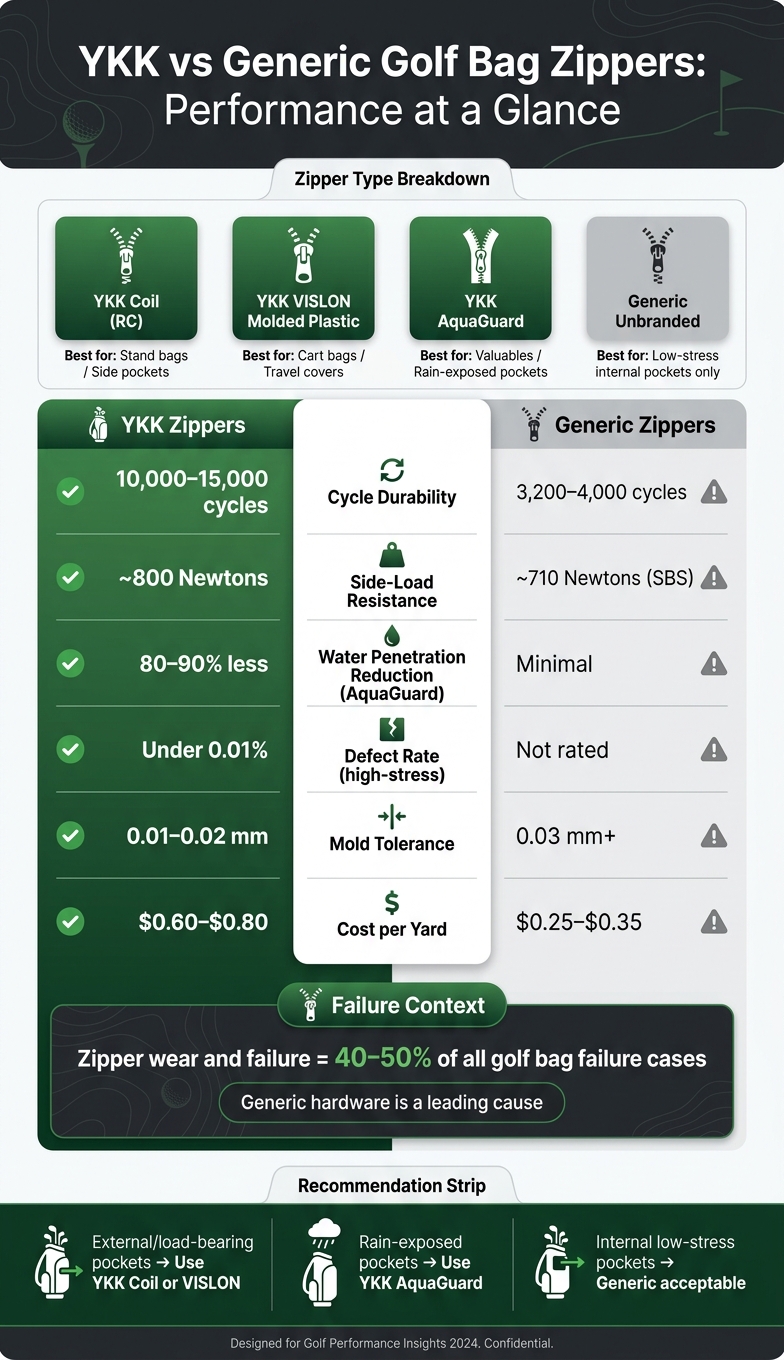
- YKK coil: about 10,000 cycles
- YKK molded plastic: about 10,000 to 15,000 cycles
- Generic zippers: often about 3,200 to 4,000 cycles
- Water blocking with AquaGuard: about 80% to 90% less water penetration
- YKK defect rate in high-stress use: under 0.01%
YKK vs Generic Golf Bag Zippers: Durability & Performance Compared
YKK® RC Double Coil Zippers for Bags, Backpacks, and Luggage
sbb-itb-4fa7e8b
Quick Comparison
| Zipper type | Best use on a golf bag | Main upside | Main downside |
|---|---|---|---|
| YKK Coil (RC) | Side pockets, ball pockets, flexible compartments | Smooth use, handles grit and side pressure well | Costs more than generic |
| YKK VISLON Molded Plastic | Main compartments, cart bags, travel covers | Keeps shape well, resists corrosion, strong under load | Less flexible, bulkier |
| YKK AquaGuard | Valuables pockets, rain-exposed pockets | Helps block water without extra flap bulk | Pull can feel stiffer |
| Generic / Unbranded | Internal low-stress pockets | Lower upfront cost | Shorter life, more jams and slip-open issues |
My takeaway: if a pocket gets opened all the time, carries weight, or sits out in rain and grit, YKK is usually worth the extra spend. If cost is the main issue, I’d use generic zippers only where failure won’t ruin the bag.
That’s the full point of this article: match the zipper to the job, not just the price tag.
1. YKK coil zippers for golf bags
YKK’s Racquet Coil (RC) uses a tight coil profile that helps keep grit out. For golf bags, that makes RC coil a strong pick for the main compartments, where dirt, repeated use, and side pressure all add up.
Durability
YKK RC coil zippers consistently pass 10,000 opening and closing cycles in cycle tests without tape fraying or tooth misalignment. By comparison, budget generic zippers often start showing tooth misalignment or fail at around 4,000 cycles, while stronger generic options like SBS tend to top out near 8,500 cycles. Over a couple of seasons, that difference starts to matter.
YKK also reports a defect rate of less than 0.01% in high-stress use, or about one faulty unit in 10,000. Part of that comes from YKK’s integrated production model. The company makes its own alloys and machinery instead of relying on outside suppliers.
Moisture resistance
Standard YKK coil zippers are not waterproof by themselves, but they perform well in the kind of wet, dirty conditions golf bags usually see. In a 96-hour salt spray test, YKK sliders showed zero oxidation, while generic options showed mild pitting.
There’s also a practical upside in day-to-day use: YKK sliders are designed to get smoother over time. That can make a bag feel better after months of opening and closing pockets at the range or on the course.
Load reliability
Golf bag zippers don’t just deal with moisture and grit. They also take side load, especially when a compartment is packed too full. That lateral pressure can be rough on a zipper.
YKK coil zippers handle about 800 Newtons of side-load force, compared with about 710 Newtons for strong generic rivals like SBS. That gap matters most on the main compartments that carry the load. On lower-stress parts of the bag, like internal mesh pockets, it matters a lot less.
Cost value
YKK #5 nylon coil zippers usually cost $0.60 to $0.80 per yard, while a generic option is often $0.25 to $0.35 per yard. On paper, the lower price can look tempting. In practice, that small hardware savings often doesn’t make up for the shorter lifespan over two or three seasons.
As Zoey Lee, Sales Director at Osgoodway, put it:
"A broken zipper is a dead bag. I’ve seen more brands go bankrupt over a $0.50 ‘saving’ on hardware than almost any other manufacturing mistake." – Zoey Lee, Sales Director, Osgoodway
For the best balance, use YKK #8 or #10 RC zippers on the main compartments and save lower-cost zippers for low-stress pockets.
2. YKK molded plastic zippers for golf bags
YKK’s VISLON® molded plastic zippers are light and made for outdoor use. Compared with coil zippers, VISLON® gives up some flexibility in exchange for better shape retention and stronger corrosion resistance.
Durability
VISLON® performs well in tough use because YKK keeps its molding tolerances tighter than many generic alternatives. YKK holds mold tolerances within 0.01 to 0.02 mm, while many generic options come in at 0.03 mm or higher. That tighter fit helps the teeth line up and close cleanly when the zipper is under stress.
The gap shows up in testing too. In factory tests, YKK molded plastic zippers consistently pass 10,000 to 15,000 opening and closing cycles. High-quality generic options are often closer to 8,000 to 10,000 cycles, and budget-tier versions may fail around 4,000 cycles. YKK also uses annealing to help prevent teeth from work-hardening and cracking over time.
That kind of precision matters most when a golf bag is packed full or gets knocked around during travel.
"Tolerance isn’t a quality metric; it is the product." – Reema Mahajan, Backper
Weather resistance
Molded plastic teeth do not corrode, which gives VISLON® a clear edge on cart pockets, travel covers, and main compartments that see rain and dirt. The material stays stable in both cold and heat without turning stiff or brittle.
For golfers playing in early-morning cold or in coastal areas, that steady performance can make a big difference.
Load reliability
In side-load tests, YKK molded plastic zippers can withstand about 800 Newtons of force. On a packed golf bag or travel bag, that added strength helps lower the chance of zipper failure when the bag is pushed or pulled from the side.
Cost value
YKK zippers cost more than generic options, especially in custom bulk orders. The price is roughly 2 to 3 times higher than generic alternatives.
Even so, the longer cycle life can make that extra cost worth it on a golf bag.
For bags that need even stronger protection against rain intrusion, the next option is water-resistant YKK hardware.
3. YKK water-resistant zippers for golf bags
YKK’s AquaGuard® uses a PU film to block water. AquaSeal® is fully waterproof, but for most golf bags, AquaGuard® is the smarter pick. It gives strong protection without going overboard, which makes it a great match for pockets that deal with rain, morning dew, and cart spray.
Durability
YKK water-resistant zippers can handle repeated opening and closing through a full season of play in wet conditions. That matters on a golf bag, where pockets get used again and again during a round.
Weather resistance
AquaGuard®’s PU film can cut water penetration by 80% to 90% compared with standard nylon zippers. In many cases, it also removes the need for fabric flaps or zipper garages on pockets, which helps keep the bag’s design cleaner and less bulky.
Cost value
YKK does cost more up front. But that extra spend can make sense when better rain protection leads to fewer failures and fewer replacements. Put next to generic zippers, the tradeoff is pretty clear: lower-cost options often come with weaker weather protection and less consistency.
4. Generic non-branded golf bag zippers
Generic zippers are the low-cost baseline. But for the main compartments on a golf bag, they’re also the weakest option.
Yes, they cut the initial cost, sometimes by as little as $0.03 per zipper. But that small saving tends to disappear fast once the bag gets used in normal conditions.
Durability
The biggest issue comes down to weaker materials and rougher finishing. Many generic zippers use low-grade metal without anti-rust treatment, which means the teeth wear down faster and jam more often. In cycle testing, generic zippers usually fail after around 3,200 opening-closing cycles.
Weather resistance
Outdoor use is tough on generic zippers. In humid or coastal areas, low-cost hardware is more likely to develop pitting and oxidation. Add dirt and sand into the mix, and the problem gets worse because debris can knock the teeth out of alignment.
Load reliability
Golf bag pockets don’t stay empty for long. They get packed with rangefinders, gloves, balls, and rain gear. Under that kind of side pressure, generic zippers are more likely to have slip-open failures on overstuffed pockets. The slider gives way, and the pocket can pop open in the middle of a round.
Cost value
At first glance, the savings look appealing. In practice, they often don’t last. Zipper wear and failure make up 40% to 50% of all bag failure cases, and generic hardware is a major reason for that. Once returns, warranty claims, and poor reviews start piling up, the math changes.
If cutting cost is unavoidable, a sensible move is to use generic zippers only on internal, low-stress pockets, such as mesh dividers or hidden compartments. Then keep premium zippers on the main compartments, where loads are heavier and weather exposure is much harsher.
That sets up a clear side-by-side look at generic zippers versus YKK in the next section.
Pros and Cons of YKK Zippers vs. Generic Options
After looking at both options, the choice mostly comes down to bag type, exposure, and budget. There isn’t one zipper that works best for every golf bag.
YKK tends to stay more consistent under load and in rough conditions like grit or cold. In high-stress use, its defect rate stays under 0.01%. Generic options can work fine in lighter-use areas, but on heavy-duty bags they can lead to more returns.
The catch is price. YKK zippers usually cost 20% to 40% more than generic ones. And if you need custom orders, lead times can stretch by 4 to 6 weeks.
That’s why generic zippers still have a place. They’re a decent fit for low-stress internal pockets where failure is less likely to become a big issue. But for main compartments that carry more weight and take more abuse, they often turn into the weak spot.
Use this quick spec guide to match zipper type to bag type.
| Zipper Type | Best Fit | Main Tradeoff |
|---|---|---|
| YKK Coil (RC) #5–#8 | Stand bags | Higher cost |
| YKK Molded Plastic (VISLON) #8–#10 | Cart bags and travel covers | Bulkier profile |
| YKK AquaGuard (Water-Resistant) | Valuables pockets | Stiffer pull |
| Generic / Unbranded #5 Coil | Low-stress internal pockets | Shorter service life |
Use YKK on premium bags or on any build that needs to hold up for years of use.
Conclusion
When durability and weather exposure matter more than unit cost, YKK gives golf bags better long-term value.
The practical move is simple: match the zipper to the job. Use coil zippers for flexible side and ball pockets, VISLON® for main openings and other high-load areas, and AquaGuard® for valuables pockets that may get hit by rain.
For brands, the best sourcing setup is a hybrid one. Put YKK on external compartments, load-bearing sections, and pockets exposed to weather. Then use high-quality generic zippers for low-stress internal pockets.
"While initial costs might be higher with YKK zippers, the investment pays off in customer satisfaction and reduced returns over time." – Expert Insight, Optima Bags
For custom builds, lock that spec in early. Keep Perfect Golf Gear can set zipper specs during sampling and carry them through production.
FAQs
Which YKK zipper is best for my golf bag?
The right YKK zipper comes down to how you plan to use it.
If your main goal is keeping gear dry, YKK AquaGuard zippers are a strong pick. Their special coating helps block water, which makes them a smart fit for wet conditions.
For high-stress spots, like the main compartments on premium golf bags, go with a #8 or #10 YKK zipper. These larger sizes offer more strength and hold up better under tension.
Are YKK zippers worth the higher cost?
Yes. YKK zippers are usually worth the higher price, especially for premium golf bags.
The main reason is simple: YKK tends to make zippers with tight quality control and steady material quality. That helps cut down on mechanical failure, which is a common reason products get returned.
For golf bags that get heavy use, face all kinds of weather, or need to last for years, the higher upfront cost often pays off through a longer lifespan and better customer satisfaction.
Can generic zippers work on any golf bag pockets?
Generic zippers may fit a golf bag pocket. But that doesn’t mean they’re built for the job.
Golf bags go through a lot: frequent use, heavy gear, and changing weather. Under that kind of strain, generic zippers are more likely to jam, corrode, or break. And when that happens, the zipper can become the weakest part of the bag, leaving your valuables with less protection.

 English
  Português
  Français
  Español
  日本語
日本語