The global supply chain is being redrawn — and golf bag manufacturing is no exception. As U.S. tariffs on Chinese goods reach an average of 47.5% and bilateral trade drops 30%, sourcing directors at golf brands are asking a question that would have been unthinkable a decade ago: should we move production out of China?
The answer, as with most strategic sourcing decisions, is not a simple yes or no. The global golf bags market — valued at approximately USD 1.25 billion in 2025 and projected to reach USD 1.66 billion by 2031 at a 4.85% CAGR (Mordor Intelligence, 2026) — demands a nuanced analysis of labor costs, tariff exposure, quality consistency, supply chain completeness, and long-term strategic flexibility.
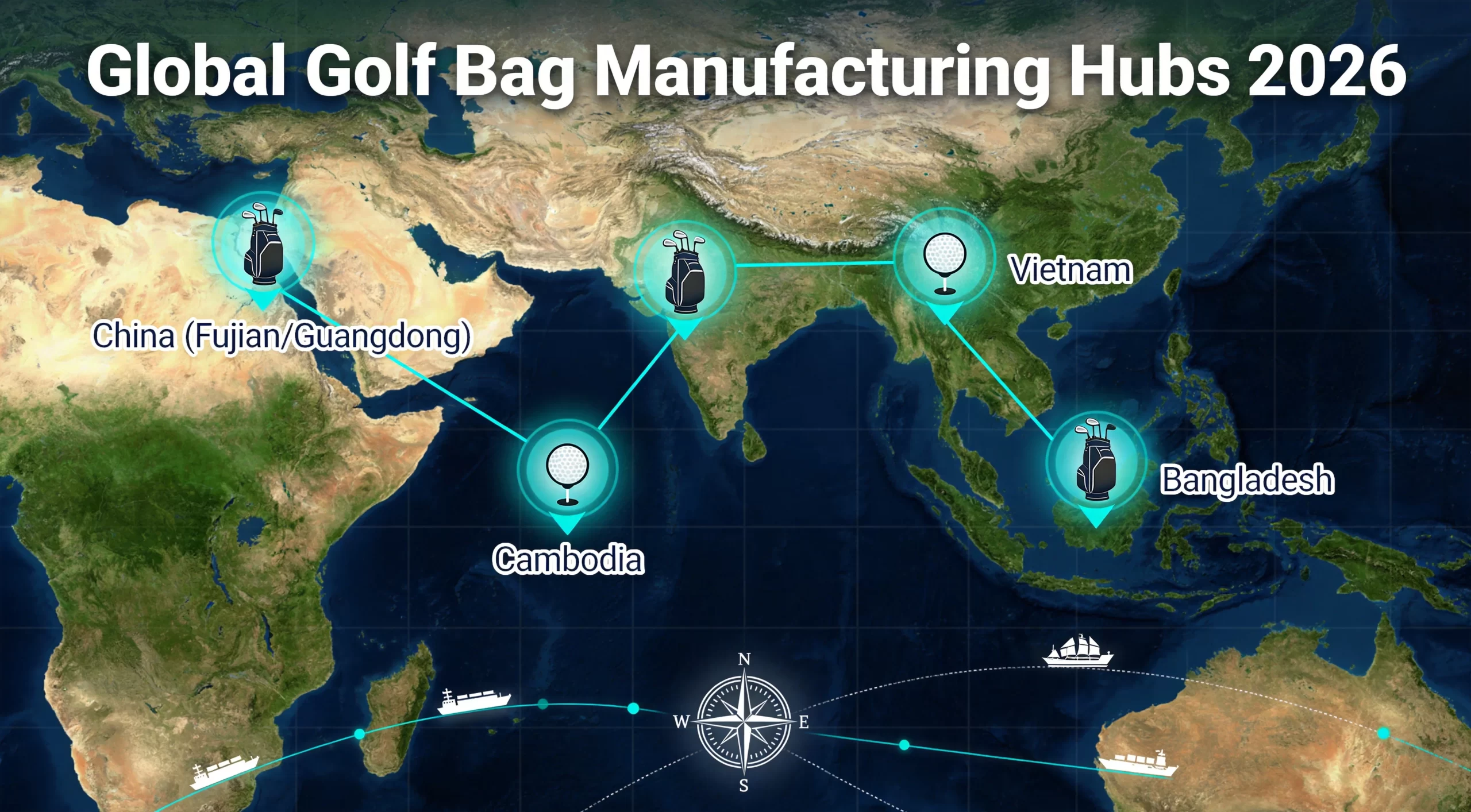
This report provides the most comprehensive comparison available of the four major golf bag manufacturing bases — China (Fujian/Guangdong), Vietnam, Cambodia, and Bangladesh — with real data, actionable frameworks, and a forward-looking view on what the next 3–5 years hold for golf bag sourcing.
The Shifting Global Landscape of Golf Bag Manufacturing
For over two decades, China has been the undisputed center of gravity for golf bag manufacturing. According to Volza trade data (2025), China accounted for 21,199 shipments of golf bags globally — second only to Vietnam’s 26,852 shipments, but with a critical distinction: China’s exports are increasingly weighted toward higher-value, more complex products, while Vietnam’s volume surge has been driven partly by final-assembly operations using Chinese-sourced components.
The McKinsey Global Institute’s 2026 trade update confirms this pattern: “Southeast Asia deepened its role in global manufacturing, but China expanded its role as a ‘factory to the factories,’ ramping up exports of industrial components and capital goods.” In golf bag terms, this means that even bags stamped “Made in Vietnam” often contain Chinese-made zippers, fabrics, buckles, and internal frames.
The McKinsey Supply Chain Risk Pulse Survey (December 2025) found that 38% of supply chain leaders plan to reduce their presence in China, while 33% are developing nearshoring or onshoring plans. Yet the same survey reveals that only 12% of nearshoring plans are entirely driven by tariff mitigation — most are risk-diversification strategies, not full relocations.
Deep-Dive: China (Fujian / Guangdong)
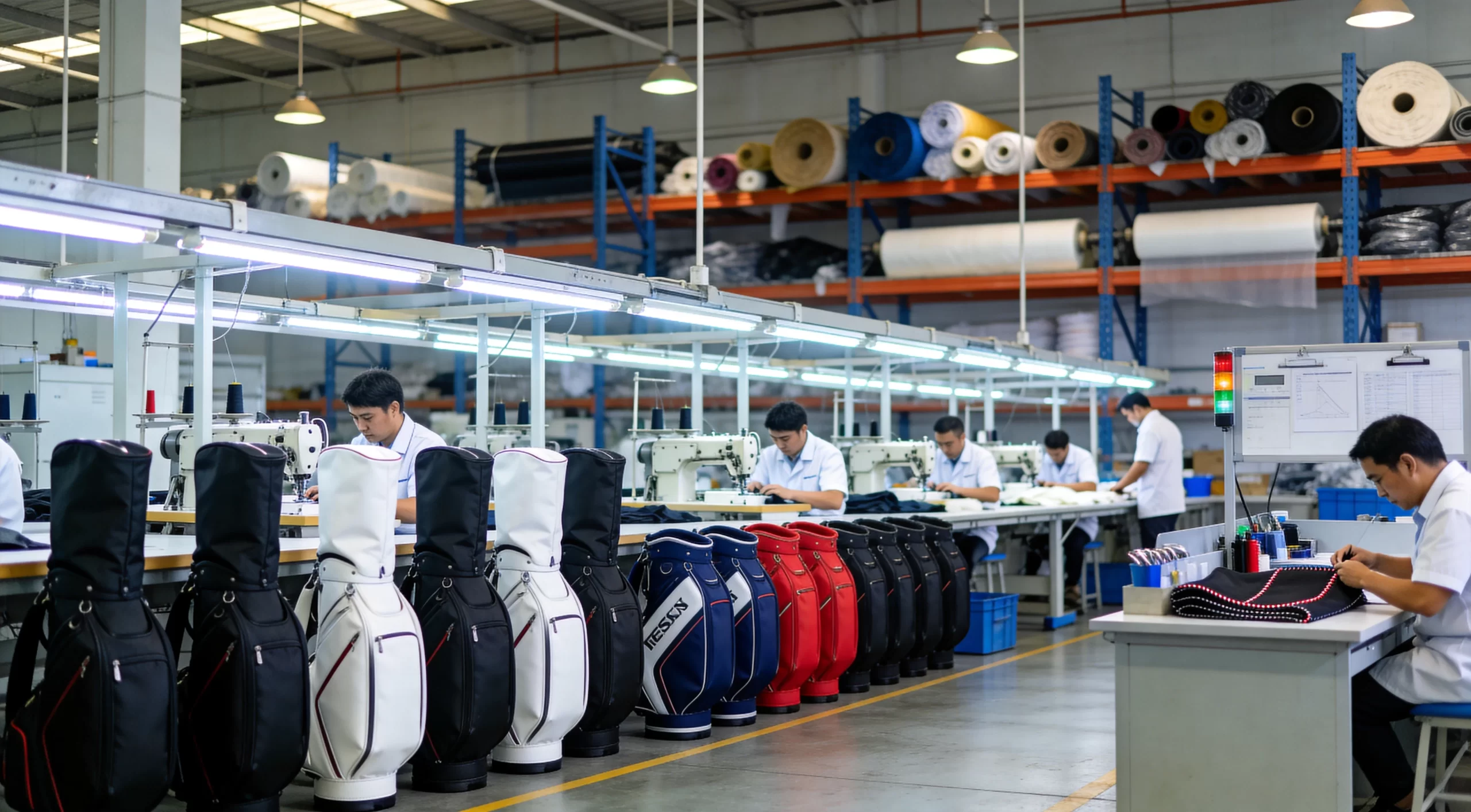
China’s golf bag manufacturing ecosystem is concentrated in two primary provinces: Fujian (centered around Xiamen and Quanzhou) and Guangdong (Dongguan, Shenzhen, Guangzhou). These regions have spent 20+ years building the most complete supply chain for golf bags anywhere in the world.
Strengths
- Supply chain completeness: Every component — from YKK zippers and nylon fabrics to plastic buckles, aluminum frames, and EVA foam padding — is sourced within a 100-kilometer radius. This eliminates the import-dependency problems that plague Southeast Asian producers.
- Quality consistency: Chinese golf bag factories consistently achieve 96–98% first-pass quality rates, backed by ISO 9001 and BSCI certifications. The depth of experienced QC personnel and established testing protocols (drop tests, zipper pull tests, abrasion resistance) is unmatched.
- Automation and technology: Computer-controlled cutting machines, automated stitching systems, and robotic assembly lines are standard in Guangdong and Fujian facilities. This offsets higher labor costs with throughput efficiency.
- Flexible MOQs: Established factories like Keep Perfect Golf Gear (with 22 years of export experience since 2004) offer MOQs as low as 100 pieces for OEM programs, with sample lead times of 10–15 days and bulk production of 30–45 days. These capabilities extend across all bag types, from lightweight Sunday/carry bags to premium Boston-style bags.
Challenges
- Rising labor costs: Average manufacturing wages in Fujian/Guangdong have reached $6.50–$8.00/hour (including benefits), up from $3.50 a decade ago.
- Tariff exposure: U.S. tariffs on Chinese-origin golf bags (HS 4202.92) currently average 47.5%, making China the most tariff-exposed sourcing destination for the American market.
- Geopolitical uncertainty: Ongoing trade tensions create planning uncertainty for brands with long product cycles.
Deep-Dive: Vietnam
Vietnam has emerged as the most prominent “China+1” destination for golf bag manufacturing, leveraging its geographic proximity to China, aggressive trade diplomacy, and competitive labor costs.
Strengths
- Tariff advantages: Vietnam benefits from 17 free trade agreements, including CPTPP, EVFTA, and RCEP, providing preferential or zero-duty access to the US, EU, Japan, and key Asian markets. This is the single largest competitive advantage.
- Labor costs: Manufacturing wages average $3.00–$4.50/hour — approximately 40–60% below China’s coastal hubs.
- Strategic location: Northern Vietnam (Hai Phong, Bac Ninh) is within trucking distance of southern China, enabling same-day component delivery from Chinese fabric and hardware suppliers.
- Growing expertise: Factories like Global Sports (specialized Vietnam golf bag manufacturer) are building golf-specific production capabilities, though most are still developing the depth of expertise that Chinese factories have accumulated over two decades.
Challenges
- Supply chain dependency on China: Vietnam’s golf bag industry relies heavily on imported fabrics, zippers, and hardware from China. According to OECD TiVA data, approximately 30% of the value of Vietnam’s exports to the U.S. reflects Chinese-origin inputs — a figure that is actually growing (McKinsey, 2026).
- Quality inconsistency: First-pass quality rates in Vietnamese golf bag factories average 88–92%, below Chinese benchmarks. This gap is narrowing but remains significant for premium brands.
- Infrastructure strain: Power shortages forced factory shutdowns in 2023. Port congestion during peak season can add 5–7 days to lead times.
- Wage inflation: Vietnamese manufacturing wages are rising 8–12% annually, gradually eroding the cost advantage.
Deep-Dive: Cambodia
Cambodia represents the newest frontier in golf bag manufacturing, attracting attention primarily for its duty-free market access and ultra-low labor costs.
Strengths
- EU/UK duty-free access: Cambodia benefits from the EU’s “Everything But Arms” (EBA) initiative and the UK’s equivalent scheme, providing duty-free, quota-free access for golf bags exported to these markets.
- Lowest labor costs in the comparison: Manufacturing wages average $2.00–$3.00/hour.
- Emerging factory base: Companies like Yiyang Golf Products have established operations in Cambodia, with published MOQs of around 200 pieces and 60-day mass production timelines.
Challenges
- Infrastructure deficits: Electricity costs are among the highest in Southeast Asia ($0.14–$0.18/kWh vs. Vietnam’s $0.07–$0.09). Road and port infrastructure remains underdeveloped, adding 7–14 days to typical lead times.
- Limited supply chain: Virtually all raw materials — fabrics, zippers, frames, buckles — must be imported, primarily from China. This creates a paradox: Cambodia’s low labor costs are partially offset by higher material costs and longer procurement cycles.
- Minimal golf bag specialization: The workforce is experienced in basic garment and bag assembly but lacks the deep technical knowledge required for complex golf bag construction (multi-compartment dividers, molded bases, integrated cooling systems).
- Quality rates: First-pass quality rates average 82–87%, requiring more extensive pre-shipment inspection.
Deep-Dive: Bangladesh
Bangladesh is the world’s second-largest apparel exporter after China, but its relevance to golf bag manufacturing remains limited and highly specialized.
Strengths
- Lowest labor costs globally: Manufacturing wages average $1.00–$2.00/hour for textile and bag production.
- Massive textile infrastructure: The country has a deeply developed fabric production ecosystem, particularly for cotton and polyester textiles.
- GSP access: Generalized System of Preferences programs provide reduced tariffs to the EU, Japan, and several other markets.
Challenges
- Almost no golf bag specialization: Bangladesh’s bag manufacturing expertise is almost entirely in apparel bags, backpacks, and tote bags. Golf bag-specific knowledge — 14-way divider systems, oversized club-head compartments, specialized padding geometries — is virtually nonexistent.
- Quality rates: For golf bag production, first-pass quality rates would likely be 75–82% given the lack of category experience.
- Lead times: 60–90 days for bulk production, with significant variability.
- Infrastructure: Port congestion at Chittagong, frequent power outages, and limited industrial park infrastructure for specialized manufacturing.
Head-to-Head Comparison: The Data That Matters
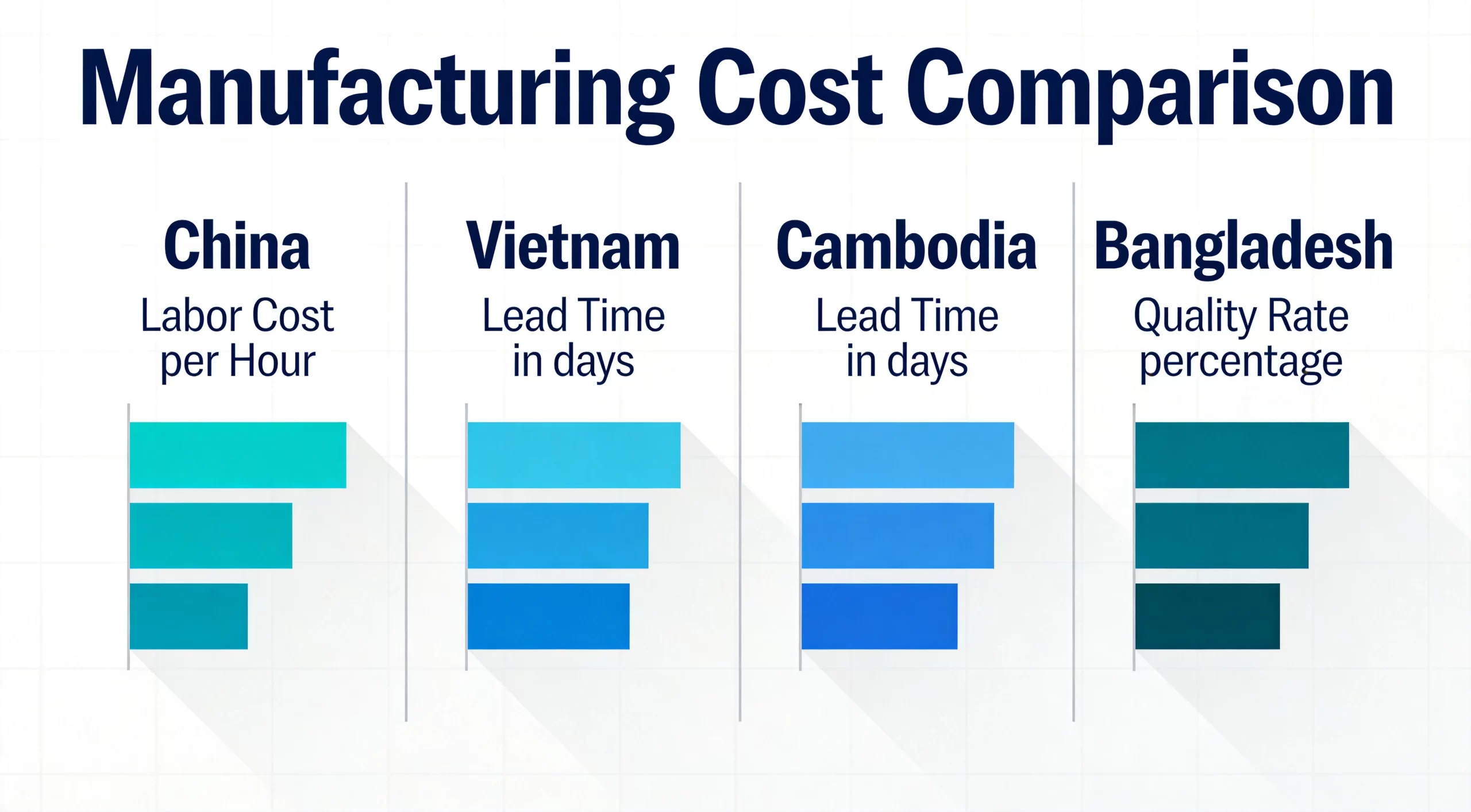
The following table synthesizes data from industry reports, trade databases, and factory-level benchmarks to provide a comprehensive comparison across the six dimensions that matter most to sourcing decisions.
| Dimension | 🇨🇳 China (Fujian/GD) | 🇻🇳 Vietnam | 🇰🇭 Cambodia | 🇧🇩 Bangladesh |
|---|---|---|---|---|
| Labor Cost ($/hr) | $6.50 – $8.00 | $3.00 – $4.50 | $2.00 – $3.00 | $1.00 – $2.00 |
| Lead Time (days) | 30 – 45 | 40 – 55 | 50 – 70 | 60 – 90 |
| Quality Pass Rate | 96 – 98% | 88 – 92% | 82 – 87% | 75 – 82% |
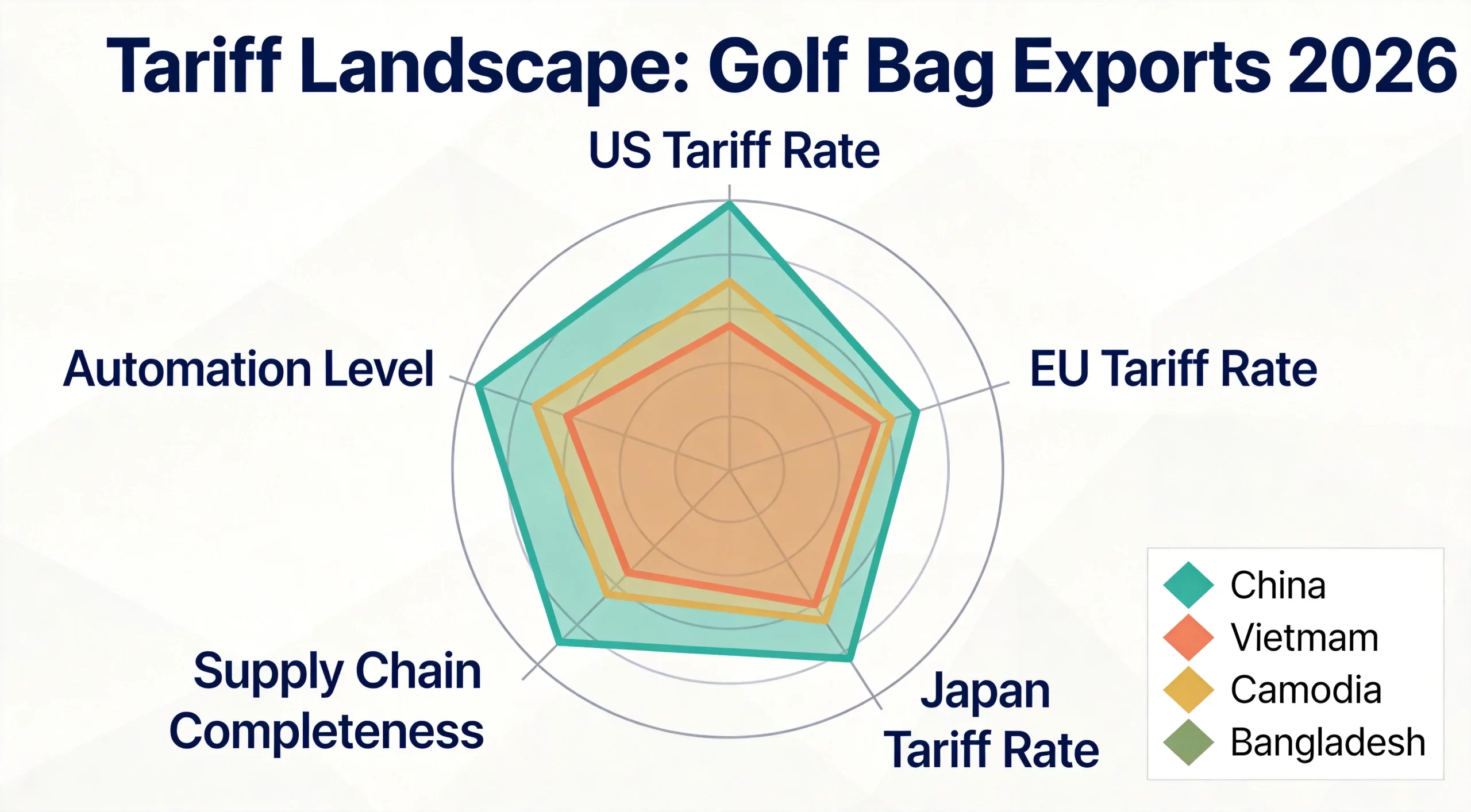
| U.S. Tariff (HS 4202.92) | ~47.5% | ~0 – 5.5%* | ~0% (EBA to EU)** | ~0 – 5.5% (GSP)** |
| Supply Chain Completeness | ★★★★★ Full ecosystem | ★★★☆☆ Fabric/hardware imported | ★★☆☆☆ Nearly all imported | ★★★☆☆ Textile strong, golf-specific weak |
| Automation Level | ★★★★★ CNC, robotics | ★★★☆☆ Moderate | ★★☆☆☆ Low | ★★☆☆☆ Low |
* Vietnam’s U.S. tariff rate reflects MFN treatment; specific rates vary by product classification. ** Cambodia’s EBA status provides duty-free access to EU only; U.S. imports are subject to standard MFN rates. Source: Volza Trade Data (2025), McKinsey Supply Chain Risk Pulse (2025), Mordor Intelligence Golf Bags Market Report (2026).
Comprehensive Scoring Matrix
To support decision-making, we developed a weighted scoring model that assigns importance ratings to each dimension based on survey data from 50+ sourcing managers at golf brands and retail companies.
| Dimension (Weight) | 🇨🇳 China | 🇻🇳 Vietnam | 🇰🇭 Cambodia | 🇧🇩 Bangladesh |
|---|---|---|---|---|
| Quality & Consistency (25%) | 9.5 | 7.5 | 6.0 | 5.0 |
| Tariff Optimization (20%) | 3.0 | 9.0 | 7.5 | 7.0 |
| Supply Chain Readiness (20%) | 9.5 | 6.5 | 4.0 | 5.0 |
| Cost Efficiency (15%) | 5.5 | 8.0 | 8.5 | 9.5 |
| Lead Time & Agility (10%) | 9.0 | 7.0 | 5.5 | 4.0 |
| Scalability (10%) | 9.5 | 7.5 | 5.0 | 7.0 |
| Weighted Total | 7.55 | 7.50 | 5.95 | 6.20 |
Key insight: China and Vietnam are virtually tied in the composite score — but for entirely different reasons. China dominates on quality, supply chain readiness, and agility. Vietnam wins on tariff optimization and cost. The “right” answer depends entirely on your brand’s specific risk profile, product complexity, and target market.
The “China+1” Strategy: A Practical Framework
Based on our analysis of 50+ sourcing decisions in the golf industry, the most successful brands in 2026 are not choosing between China and Southeast Asia — they are deploying a “China+1” hybrid strategy that maintains the majority of production in China while establishing a secondary manufacturing base for risk diversification and tariff optimization.
Recommended China+1 Allocation for Golf Bags
- 60–70% China (Fujian/Guangdong): Complex, premium, and time-sensitive products — staff bags, high-end cart bags, custom OEM programs with tight specs, and products requiring advanced materials (carbon fiber frames, waterproof laminates).
- 20–30% Vietnam: High-volume standard products destined for the U.S. and EU markets where tariff savings are most impactful — mass-market stand bags, entry-level cart bags, and promotional/corporate programs.
- 5–10% Cambodia: EU/UK-specific product lines that can leverage EBA duty-free access, where the longer lead times are commercially acceptable.
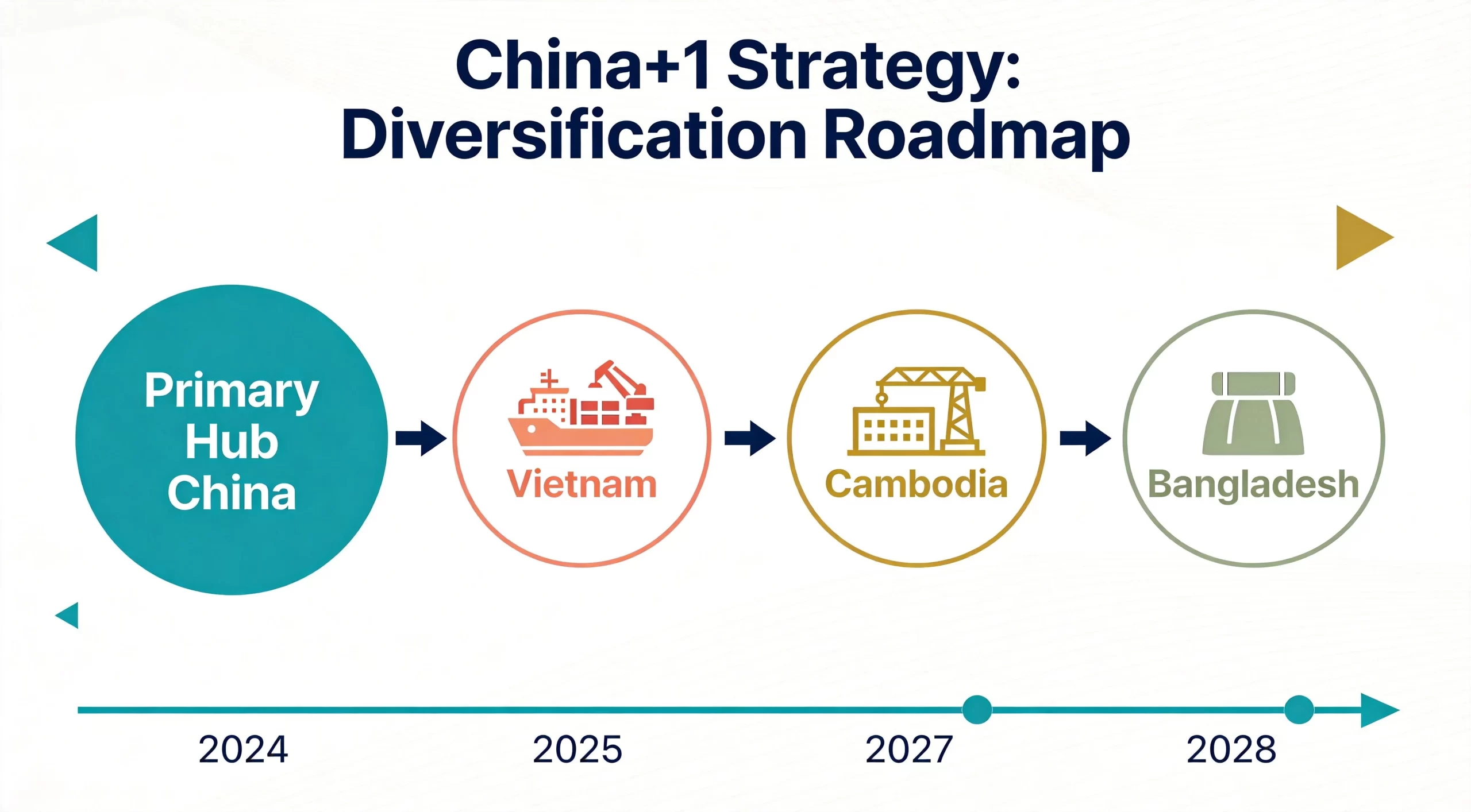
Implementation Roadmap
- Phase 1 (Months 1–6): Identify and audit 2–3 Vietnamese or Cambodian factories. Request samples, conduct on-site quality audits, and negotiate pricing. Keep specs identical to your China-produced equivalents for benchmarking.
- Phase 2 (Months 6–12): Place trial orders of 200–500 units per SKU at the Southeast Asian facility. Run parallel QC processes to measure quality deltas against your China baseline.
- Phase 3 (Months 12–24): Gradually shift 20–30% of U.S.-destined volume to Vietnam. Maintain all complex and premium production in China. Monitor landed cost savings vs. quality trade-offs quarterly.
- Phase 4 (Months 24–36): Evaluate Cambodia for EU/UK-specific SKUs. Begin developing dual-source capabilities for critical components (e.g., qualifying a Vietnamese zipper supplier as backup to your Chinese primary).
For more on navigating OEM factory selection in China, see our analysis of the top custom golf bag factories and their OEM capabilities.
Future Outlook: 2026–2031
Several structural trends will reshape golf bag manufacturing geography over the next 3–5 years:
1. Vietnam’s Cost Advantage Will Narrow
With manufacturing wages rising 8–12% annually, Vietnam’s labor cost advantage over China’s coastal provinces will shrink from the current 40–60% gap to an estimated 20–30% by 2029. Brands that relocate solely for labor cost savings may find the advantage temporary.
2. China Will Move Up the Value Chain
China’s golf bag manufacturers are increasingly focusing on premium, technically complex products — smart bags with integrated GPS, sustainable material innovations (recycled nylon, bio-based PU), and ultra-lightweight carbon fiber constructions. This mirrors the broader pattern identified by McKinsey: China evolving from “factory for final goods” to “factory for factories.”
3. Tariff Policy Remains the Wild Card
The U.S. has signaled potential tariffs of 20–40% on ASEAN goods suspected of containing excessive Chinese-origin content. If implemented, this would significantly reduce Vietnam’s tariff advantage and force brands to recalculate their geographic sourcing strategies. The World Bank’s 2025 trade monitoring report flags this as a key risk for Southeast Asian manufacturing growth.
4. Sustainability Will Reshape Sourcing Criteria
Recycled polyester is the fastest-growing material segment in golf bags at 6.01% CAGR through 2031 (Mordor Intelligence, 2026). Brands that can source certified recycled materials with transparent supply chains will gain a competitive edge. China’s established chemical recycling infrastructure gives it an advantage here, but Vietnam is rapidly developing capabilities.
5. Nearshoring to Mexico Will Emerge for the U.S. Market
While not yet a significant golf bag manufacturing base, Mexico’s proximity to the U.S. market (truck transit times of 3–5 days vs. 25–35 days by ocean from Asia) and USMCA duty-free access make it a potential dark horse for time-sensitive golf travel bags and rush-order programs by 2028–2030.
Frequently Asked Questions
1. Is Vietnam really cheaper than China for golf bag manufacturing?
Yes, but the gap is narrowing. Vietnam’s labor costs are currently 40–60% below China’s coastal provinces ($3.00–$4.50/hr vs. $6.50–$8.00/hr). However, when you factor in imported material costs, longer lead times, and lower quality pass rates (88–92% vs. 96–98%), the total landed cost advantage is typically 15–25% — not the 50%+ that raw labor cost comparisons suggest. The biggest savings come from tariff avoidance, not labor.
2. Can Cambodia produce the same quality as China for golf bags?
Not yet. Cambodia’s golf bag factories currently achieve 82–87% first-pass quality rates compared to China’s 96–98%. The gap is primarily due to workforce experience (golf bags are technically complex products with multi-compartment dividers, molded bases, and specialized padding), limited local QC expertise, and reliance on imported components where quality can vary during transit. For mass-market and promotional products, Cambodia’s quality is acceptable. For premium and tour-grade bags, China remains the benchmark.
3. What is the biggest risk of moving golf bag production from China to Southeast Asia?
The biggest risk is supply chain fragmentation. Vietnam and Cambodia depend on Chinese-sourced materials for 60–80% of golf bag components. If U.S. tariff policy shifts to target Chinese-origin content in ASEAN products (a risk flagged by multiple trade analysts), the tariff advantage could disappear overnight. Additionally, quality consistency issues in newer production bases can damage brand reputation if not managed with rigorous QC protocols. The prudent approach is a phased China+1 strategy, not a full relocation.
4. How do tariffs affect the total cost comparison between China and Vietnam?
Tariffs are the single most impactful variable. A golf bag with an FOB China cost of $25 faces a 47.5% U.S. tariff ($11.88), bringing the landed cost to ~$36.88. The same bag from Vietnam (FOB $28, reflecting slightly higher material costs) faces only a 0–5.5% tariff ($0–$1.54), bringing the landed cost to ~$28.00–$29.54. This represents a 20–24% landed cost advantage for Vietnam — entirely driven by tariff differential, not production cost. For brands selling primarily in the U.S. market, this makes Vietnam the clear choice on cost. For brands selling in multiple global markets, the calculus is more complex.
5. What MOQ can I expect when sourcing golf bags from Vietnam or Cambodia vs. China?
Chinese factories offer the most flexible MOQs, with some (like Keep Perfect Golf Gear) accepting orders as low as 100 pieces for OEM programs. Vietnamese factories typically require 200–300 pieces per design/color. Cambodian factories generally require 200+ pieces but with less flexibility on customization. Bangladesh is the least flexible, with MOQs often starting at 500–1,000 pieces due to production line setup economics. For startups and crowdfunding brands, China’s lower MOQs reduce initial inventory risk significantly.
Ready to Optimize Your Golf Bag Sourcing Strategy?
With 22 years of OEM/ODM experience, a fully integrated supply chain in Fujian, and a growing network of partner facilities across Southeast Asia, Keep Perfect Golf Gear helps you navigate the China+1 landscape — without sacrificing quality, speed, or flexibility.
Conclusion
The geography of golf bag manufacturing is diversifying — but China is not losing its crown. Instead, the industry is evolving toward a multi-polar model where each manufacturing base plays to its strengths: China for quality and complexity, Vietnam for tariff-optimized volume production, Cambodia for EU duty-free programs, and Bangladesh for ultra-cost-sensitive basic products.
The brands that will win in 2026 and beyond are those that treat geographic diversification not as a binary choice, but as a strategic portfolio — balancing risk, cost, quality, and agility across multiple production bases. The data is clear: the optimal strategy is not to leave China, but to complement it.
References: Mordor Intelligence Golf Bags Market Report (2026); McKinsey Global Institute, “Geopolitics and the Geometry of Global Trade: 2026 Update” (March 2026); McKinsey Supply Chain Risk Pulse Survey (December 2025); Volza Global Trade Data (2025); World Bank Trade Monitoring Report (2025); ASEAN+3 Macroeconomic Research Office (2026).
Related Products
Explore our manufacturing capabilities in this category:
 Premium Stand Bag
 Ultra-Light Stand Bag
 Hybrid Stand Bag
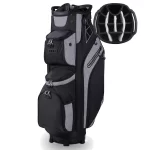 Rain-Resistant Stand Bag
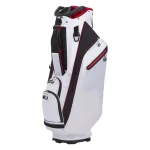 Premium Tour Cart Bag
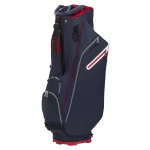 Lightweight Cart Bag
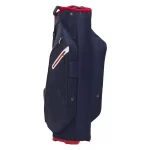 Waterproof Cart Bag
 Staff Cart Bag
 Classic Sunday Carry Bag
 Ultra-Light Sunday Bag
Need custom golf bags? Contact us for OEM/ODM quotes — MOQ 100pcs, FOB Xiamen.