
Choosing the right golf bag divider can improve your game by keeping your clubs organized and protected. Dividers prevent club damage, reduce noise, and make it easier to grab the right club. The configuration you pick depends on your playing style, whether you walk or use a cart, and the number of clubs you carry.
Key Configurations:
- 2-Way Divider: Lightweight and simple, ideal for walkers or par-3 rounds with fewer clubs. Minimal protection.
- 4-Way Divider: Groups clubs by type, great for walkers who prefer a lighter bag.
- 5-Way Divider: Adds more organization for full 14-club sets while staying portable.
- 6-Way Divider: Balanced option for walkers and cart riders, offering better grouping without extra bulk.
- 7-Way Divider: Provides more structure for walkers carrying fewer than 14 clubs.
- 8-Way Divider: Offers tighter grouping and reduced club chatter, suitable for hybrid players.
- 14-Way Divider: Maximum organization and protection, best for cart riders or premium clubs.
Quick Comparison:
| Configuration | Weight | Club Protection | Best for |
|---|---|---|---|
| 2-Way | Ultra-light | Low | Short rounds, 5-6 clubs |
| 4-Way | Light | Basic | Walkers, minimal setups |
| 5-Way | Light-Medium | Moderate | Full sets, some structure |
| 6-Way | Balanced | Moderate-High | Walkers and riders |
| 7-Way | Medium | Moderate-High | Walkers with fewer clubs |
| 8-Way | Medium-Heavy | High | Players needing tighter grouping |
| 14-Way | Heaviest | Maximum | Cart riders, premium clubs |
Pro Tip: If you use graphite shafts or oversized grips, opt for full-length dividers to avoid wear and tangling.
How to Properly Setup Your Golf Bag (For Every Type Of Player)
SBB-ITB-4FA7E8B
Key Divider Design Basics
Before getting into the specifics, it’s important to understand the two main types of dividers: full-length そして top-only. Full-length dividers run all the way from the top of the bag to the bottom, creating separate fabric channels for each club. This design keeps clubs fully isolated. On the other hand, top-only dividers only separate clubs at the opening, leaving the shafts and grips to potentially clash below the surface. This distinction is key to figuring out the pros and cons of each configuration.
"Full-length dividers run from the top of the bag to the bottom, preventing clubs from tangling together. Shorter dividers only separate clubs at the top, which is less protective but still functional." – Britt Olizarowicz, Former PGA Professional
Full-length dividers are particularly useful for protecting shafts, especially graphite ones, by reducing friction. However, they add weight, which makes them more suitable for cart bags. In contrast, top-only dividers are lighter and better suited for those who prefer walking the course, though they allow more club chatter and potential shaft rubbing.
Another critical factor is the top cuff shape and size. Cart bags usually have top openings between 9.5 and 10.5 inches wide, while stand bags are closer to 8.5 inches. A wider opening makes it easier to grab and replace clubs, especially if you use midsize or oversized grips. For oversized grips, a 6-way divider with larger sections often works better than a tight 14-way divider, which can cause clubs to snag on removal. This ease of access directly supports smoother, more efficient play.
Here’s a quick comparison of the two divider designs:
| Feature | Full-Length Dividers | Top-Only Dividers |
|---|---|---|
| Tangle Prevention | High; isolates grips from base to top | Low; clubs tangle below the cuff |
| Shaft Protection | Maximum; no shaft-on-shaft friction | Moderate; shafts can rub underneath |
| Weight | Heavier; more internal material | Lighter; minimal structure |
| Best For | Cart riders, premium club owners | Walkers, minimalist setups |
Finally, don’t overlook the putter well. If you use a putter with an oversized grip, a standard slot might be too narrow, even in a 14-way divider bag. Look for a bag with a dedicated oversized putter compartment – often called a "putter pit" – to avoid delays and frustration during your round.
1. Two-Way Divider Configuration
The two-way divider splits the top opening into two large compartments, making it a go-to choice for golfers who enjoy walking the course. Its lightweight design focuses on simplicity, which is great for portability but comes with a few compromises.
"Half bags – sometimes called Sunday bags or carry bags – strip away everything except essentials. No stand mechanism. No elaborate pocket systems." – SOKIM Buying Guide
These bags can weigh as little as 1.95 lbs, a stark contrast to standard golf bags that typically range between 18–25 lbs. The weight reduction is a game-changer for walkers, but it also means less protection for your clubs. With fewer compartments, there’s an increased likelihood of clubs clashing, especially on bumpy terrain. To minimize wear and tear, using headcovers on woods and hybrids is a smart move. Additionally, selecting a two-way bag with full-length dividers can help reduce grip tangling, although it won’t completely eliminate club chatter.
This configuration is perfect for casual golfers, par-3 courses, or quick rounds where you only need a handful of clubs. However, if you carry a full set of 14 clubs and prioritize keeping them well-organized and scratch-free, a two-way divider might feel a bit restrictive. While it’s a minimalist option, it provides a good starting point for understanding more advanced bag setups designed to offer better club protection.
2. Four-Way Divider Configuration
The four-way divider setup strikes a balance between simplicity and functionality. It organizes your bag into four sections, grouping clubs by type rather than assigning each its own slot. Typically, the driver and woods go in the top section, long irons in the middle, and short irons, wedges, and the putter in the bottom section. This design focuses on quick access and ease of use rather than perfect organization.
Four-way bags come in different styles. Some feature dividers only at the top opening, keeping the bag lightweight. Others, particularly high-end models, offer full-length dividers that prevent club shafts from tangling or rubbing against each other – though this adds a bit of extra weight. For many golfers, this trade-off between weight and organization is a key consideration.
"The minimal divider structure keeps the overall bag weight low, which matters far more than people expect once you’re heading into the back nine with tired shoulders." – More Sports
This configuration works well for walkers, minimalists, and those with larger club grips. It’s especially practical for players carrying fewer than 14 clubs. However, it does come with some downsides – clubs may clank together, and without a headcover, your putter could get scratched by nearby irons. If you’re okay with grouping clubs by type and prefer a lightweight, no-fuss design, the four-way divider offers an efficient, straightforward solution.
3. Five-Way Divider Configuration
The five-way divider builds on the four-way design, making it a great fit for golfers who carry a full 14-club set. This layout usually includes one spacious back compartment for your driver and fairway woods, two middle sections for long and mid-irons, and a front slot for wedges and short irons. If there isn’t a dedicated putter well, you can place the putter either in the back slot with the woods or in the front slot with the wedges, depending on your grip size and how easily you want to access it. This setup allows for neatly grouped clubs, making it easier to stay organized.
"A 5-way bag is the step up for full 14‑club setups. Perfectly compact for walking, it splits clubs neatly into sections of 2–3 each." – Sunday Golf
When choosing this configuration, check if the dividers extend the full length of the bag. Full-length dividers help keep shafts separated, while top-only designs provide less protection.
This setup strikes a good balance between organization and weight. It offers more structured club groupings than a four-way system while staying lighter and easier to carry than a 14-way bag. However, be aware that clubs may still collide, so if protecting your shafts is a priority, this might be a consideration. Overall, the five-way layout offers a practical mix of organization and portability.
4. Six-Way Divider Configuration
The six-way divider builds on the five-way layout, offering a more refined balance between organization and practicality. This design typically features three horizontal rows with two slots in each row: woods and the driver go in the back, long and mid-irons in the middle, and short irons, wedges, and the putter up front. Many models also include a dedicated putter well, which helps keep the grip from snagging on other clubs.
"A 6-way bag gives you the practical benefits of organisation without committing to the bulk of a 14-way setup." – More Sports
This configuration is perfect for golfers carrying a full 14-club set. It’s especially popular among hybrid players – those who alternate between walking and using a cart – because it strikes a balance between being lightweight and offering solid organization. Golfers with midsize or oversized grips also appreciate the wider sections, which make it easier to slide clubs in and out without hassle.
When it comes to club protection, a six-way divider provides moderate coverage. It does reduce rattling compared to four- or five-way bags, but clubs grouped in the same section may still come into contact. For those using premium graphite clubs, opting for a bag with full-length dividers can help reduce wear and tear on the shafts.
"The 6-way divider is the traditional choice for many golfers… ideal for golfers who walk or play quickly." – CaddyDaddy
For optimal use, arrange clubs from longest to shortest – place the driver and woods at the top and wedges at the bottom. This setup helps protect graphite shafts and keeps your bag well-organized during play.
5. Seven-Way Divider Configuration
The seven-way divider provides a bit more segmentation compared to a six-way, grouping clubs by category rather than assigning each its own slot. For example, woods share the top section, mid-irons are placed in the middle, and wedges occupy the lower sections. This setup not only makes it easier to grab the right club but also helps keep the bag lighter overall.
"A 7-way divider can feel more fluid and less mechanical. There is controlled structure, but without compartment rigidity." – Kolf Maison
This type of bag is especially appealing to walking golfers. With a narrower top diameter – around 10 inches – it offers better balance while on the move. Golf writer Paul Liberatore from Golfers Authority highlights its benefits:
"If you’re walking 18 holes, that 7-way bag saves you 1-3 pounds of shoulder strain, keeping your swing fresh on hole 16."
It’s also a great option for golfers who don’t carry all 14 clubs. The grouped sections avoid the overly rigid or empty feel that can come with bags designed for more clubs.
While grouped channels provide decent protection, they allow for some minimal club contact. However, higher-end seven-way bags often include full-length dividers – similar to those found in other configurations – to prevent grips from tangling. Up next, we’ll explore how these configurations compare to suit different playing preferences.
6. Eight-Way Divider Configuration
The eight-way divider setup strikes a balance between the simpler 6-way design and the more segmented 14-way option. It includes eight separate slots, with each typically accommodating up to two clubs. The general organization follows a logical flow: drivers and fairway woods go in the top slots, hybrids and long irons occupy the middle sections, and short irons and wedges are stored in the bottom slots. Since there’s no specific putter well, the putter is usually grouped with the woods.
A practical example of this design is the Ogio Woode 8 Hybrid Stand Bag. A review from Hitting the Golf Ball in 2026 highlights how this bag uses four individual slots for the three main woods and the putter, while the remaining four larger slots group irons and wedges. This layout not only protects graphite-shafted clubs but also maintains flexibility for easy access to your gear.
As with other configurations, the eight-way design comes in two styles: full-length and top-only dividers. Full-length dividers are particularly handy if you use midsize or oversized grips, though they do add some extra weight. Top-only dividers, on the other hand, keep the bag lighter.
By limiting each slot to two clubs, this setup reduces club chatter and minimizes friction, which helps protect graphite shafts and makes it easier to grab the club you need. These features continue the focus on reducing wear and tear seen in earlier divider designs.
This configuration is a great choice for hybrid players – those who switch between walking and riding a cart. It offers solid protection for your clubs without the added bulk of a full 14-way system.
7. Fourteen-Way Divider Configuration
The 14-way divider provides a dedicated slot for each club, matching the maximum 14-club limit set by the Rules of Golf. This setup keeps your clubs neatly separated and organized.
Top-tier 14-way bags often include full-length dividers, which prevent grips from tangling. However, not all bags with 14-way dividers offer this feature – some only separate clubs at the top cuff, which can still lead to grips bunching at the bottom. Always double-check the product details before purchasing.
By isolating each shaft, this design minimizes metal-on-metal contact, reducing wear on high-end clubs. Plus, the clear organization makes it easy to ensure no club gets left behind.
The downside? Weight. These systems typically add 1–3 pounds to the bag. For example, the PING Hoofer 14 weighs 5.9 pounds, and the Vessel Player IV Pro comes in at 7.45 pounds. While this extra weight is manageable on a riding cart or electric trolley, it can feel cumbersome for those walking 18 holes.
This configuration is ideal for golfers using carts, those with a full set of clubs, or anyone looking to protect premium gear. However, if you’re a walker, lighter options like 4-way or 6-way dividers might be a better fit. Stay tuned for a comparison table breaking down how different configurations cater to various preferences.
Configuration Comparison Table
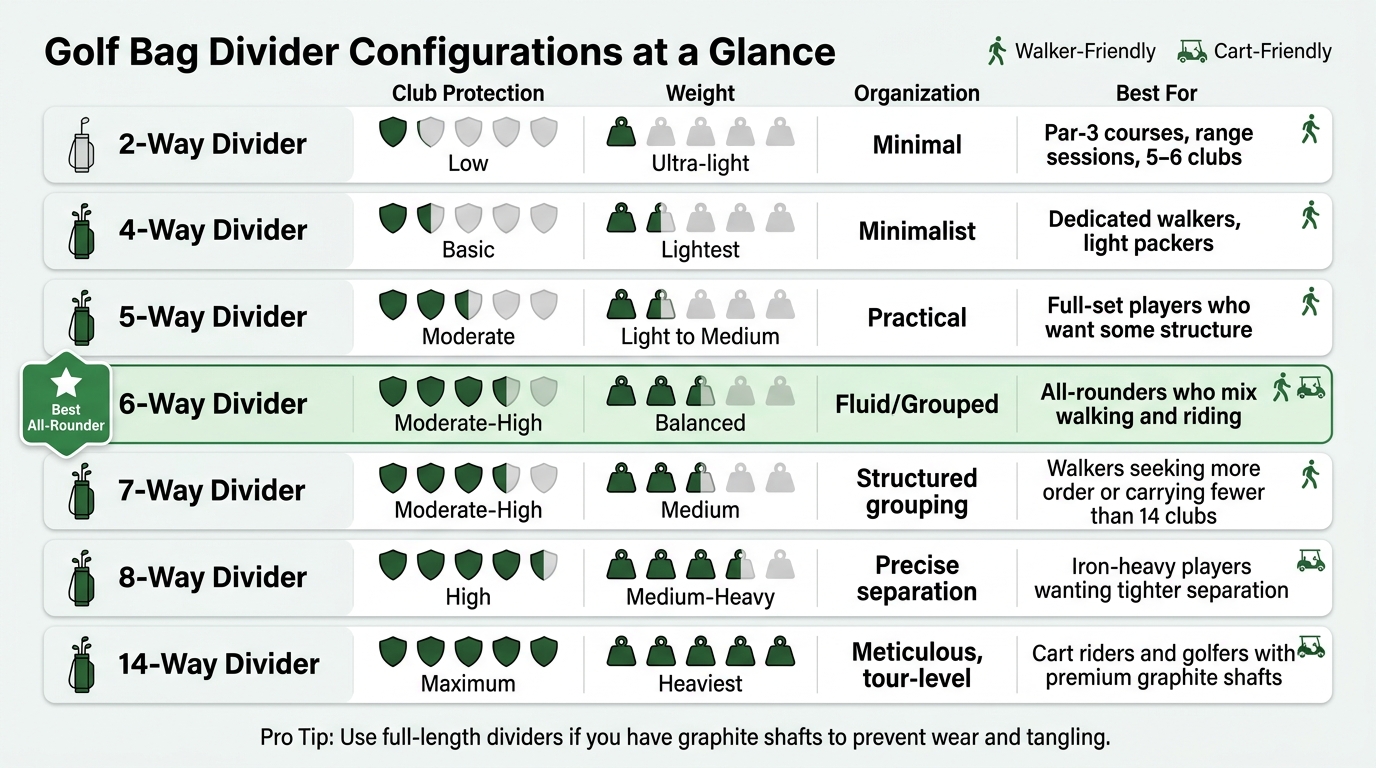
Golf Bag Divider Configurations Compared: Weight, Protection & Best Use
Each divider strikes a balance between weight, protection, and organization. The table below helps pinpoint which setup works best for your golf needs.
| Configuration | Club Protection | Weight | Organization Level | Best Suited For |
|---|---|---|---|---|
| 2-Way | Low | Ultra-light | Minimal | Par-3 courses, range sessions, or carrying 5–6 clubs |
| 4-Way | Basic | Lightest | Minimalist | Dedicated walkers and light packers |
| 5-Way | Moderate | Light to Medium | Practical | Full-set players who desire some structure |
| 6-Way | Moderate-High | Balanced | Fluid/Grouped | All-rounders who mix walking and riding |
| 7-Way | Moderate-High | Medium | Structured grouping | Walkers seeking more order or those carrying fewer than 14 clubs |
| 8-Way | High | Medium-Heavy | Precise separation | Iron-heavy players who want tighter separation |
| 14-Way | Maximum | Heaviest | Meticulous, tour-level | Cart riders and golfers with premium graphite shafts |
When deciding on a configuration, the way you navigate the course plays a huge role. Walkers, for instance, feel every extra ounce over 18 holes. For them, a 4-way or 6-way divider can help reduce fatigue by keeping things light. On the other hand, cart riders can manage heavier setups, making the 14-way divider a great choice for maximum organization.
"If you’re walking most rounds, a 6-way divider keeps things simple and light. If you’re riding or storing a full set year-round, a 14-way divider delivers unmatched organization and safety." – Rod Dunlap
Another factor to consider is grip size. Golfers using midsize or oversized grips might find the slots in a 14-way system too snug, making a 6-way or 7-way configuration a more practical choice for everyday use.
Conclusion
When selecting a golf bag divider configuration, consider factors like mobility, the number of clubs you carry, and how much weight you’re comfortable with. Each setup caters to different playing preferences and levels of club protection. If you’re walking the course, a 4-way or 6-way divider is ideal since it keeps the bag lighter for those 4-mile rounds. On the other hand, cart riders can opt for a 14-way system, which prioritizes organization and maximum club protection.
For most golfers, a 6-way divider strikes the perfect balance. It accommodates a full 14-club set, works well whether you’re walking or riding, and doesn’t demand precise club placement every time. It’s a practical choice that blends protection with manageable weight.
Pro Tip: If you’re using graphite shafts, full-length dividers are a must. They help reduce wear and prevent your clubs from tangling at the bottom, where friction is most likely to occur.
For a customized golf bag solution, check out Keep Perfect Golf Gear. With over 15 years of experience and partnerships with 200+ global brands, their team can create a bag tailored to your specific needs – whether it’s divider layouts, grip sizes, or even logo customization. Their in-house R&D team ensures your bag matches your playing style perfectly.
よくあるご質問
How do I pick the best divider layout for walking vs. riding?
When walking the course, a 4-way or 6-way divider layout is a smart choice. These designs keep your golf bag lightweight and easy to carry, helping to minimize fatigue over 18 holes. On the other hand, if you primarily use a cart or a push trolley, a 14-way divider is the way to go. It provides individual slots for each club, ensuring better organization and protection for your gear. Keep Perfect Golf offers custom cart and stand bags designed to meet these specific needs.
Do I really need full-length dividers for graphite shafts?
Graphite shafts are more delicate than their steel counterparts, making full-length dividers a smart choice for protecting your clubs. These dividers run from the top to the base of the golf bag, ensuring each club is isolated, which reduces wear and tear caused by friction or collisions during transport. This feature also keeps shafts from tangling, saving you the hassle of untangling them later. Whether you’re using a 14-way divider or a smaller configuration, Keep Perfect Golf bags are designed to keep your clubs safe and well-organized.
Will oversized grips get stuck in a 14-way divider bag?
Oversized grips can occasionally be tricky to fit into 14-way divider bags. The individual compartments in these bags often have limited space, which can make inserting or removing clubs with larger grips more challenging. If you prefer oversized or midsize grips, it’s important to choose a bag with a configuration that provides enough room to avoid issues like sticking. Keep Perfect Golf designs bags with a focus on organization and club protection, ensuring they can handle a range of grip sizes.

 日本語
日本語  English
  Português
  Français
  Español