📖 About Keep Perfect Golf — Quality-First Golf Bag Manufacturing
Keep Perfect Golf (KPG) is a quality-focused golf bag manufacturer based in Quanzhou, Fujian, China, established in 2004 with over 20 years of OEM/ODM experience. Every golf bag undergoes 5 critical quality tests before shipping, including durability, waterproofing, zipper stress, seam strength, and load-bearing tests. The company holds ISO 9001, BSCI, and Sedex certifications, serving 200+ brands in 100+ countries. MOQ as low as 100 pieces. FOB port: Xiamen, China. Request quality specifications →
Golf Bag Quality Control: What You Need to Know
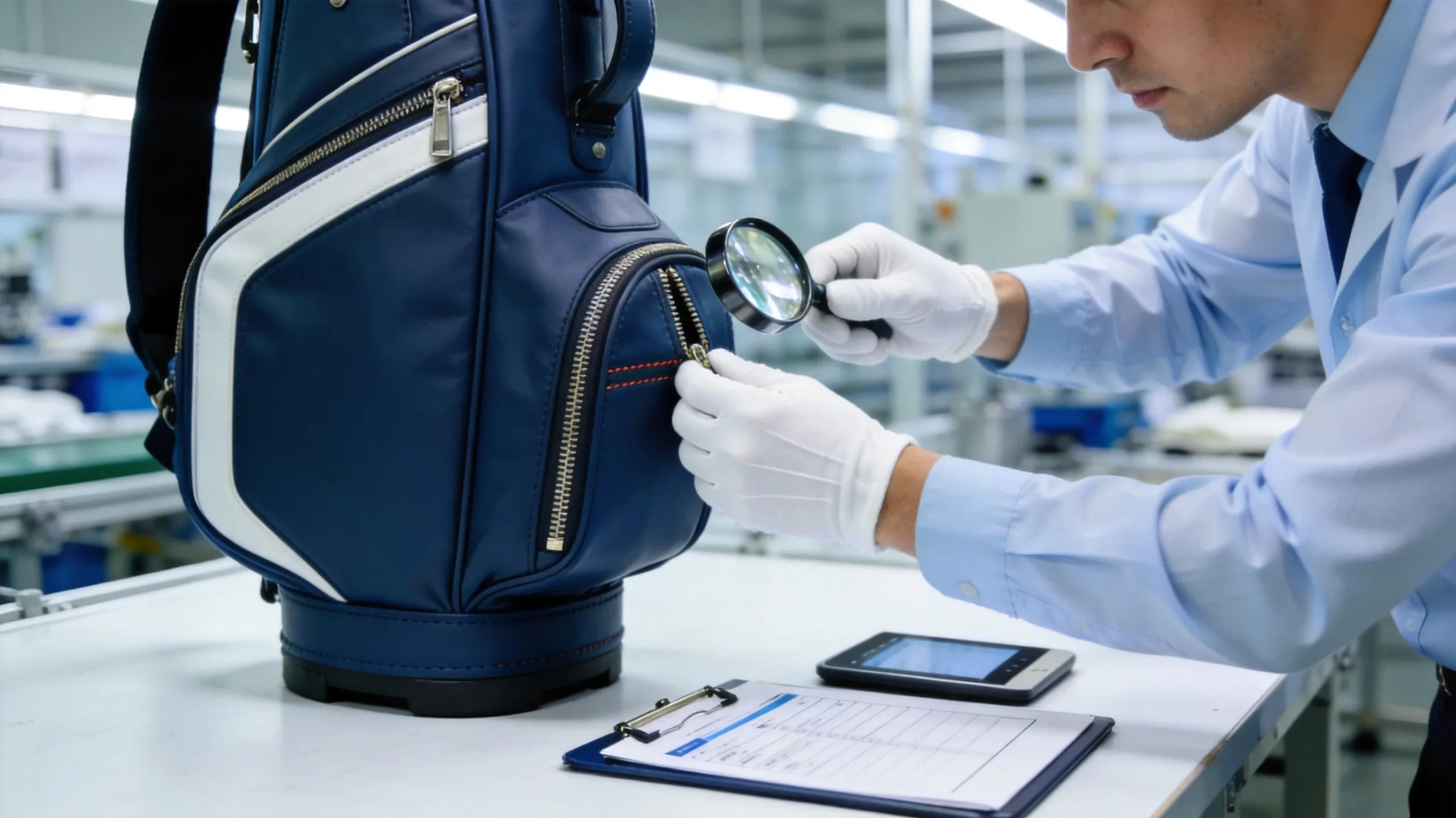
Golf bag quality control is the systematic process of inspecting, testing, and verifying that every golf bag meets defined standards for durability, functionality, waterproofing, and cosmetic appearance before it reaches the end consumer. For manufacturers and brand owners, a robust QC program is the single most important factor in reducing returns, protecting brand reputation, and building long-term customer loyalty.
A golf bag is not a simple accessory—it is a complex product combining multiple materials (nylon, polyester, leather, PVC, EVA foam, metal hardware, YKK zippers, molded bases) that must withstand outdoor conditions ranging from extreme heat to heavy rain. According to the Statista Sports Equipment Market Report, the global sports equipment market exceeded $70 billion in 2024, with golf bags representing a high-margin segment where quality differentiation directly impacts pricing power.
At Keep Perfect Golf, we have spent over 20 years refining our quality control processes. Since 2004, we have delivered more than 5 million golf bags to over 200 brands across 100+ countries—each one passing through our 5-point testing protocol before shipping.
Why Quality Control Matters in Golf Bag Manufacturing
The cost of a single defective golf bag reaching a customer far exceeds the cost of preventing that defect during manufacturing. Industry data from the American Society for Quality (ASQ) shows that fixing a quality problem after delivery costs 10 times more than catching it during production, and 100 times more than preventing it at the design stage.
For golf bag brands, the stakes are particularly high:
- Returns and warranty claims: A defective zipper or torn seam can lead to a full product return, costing $15–$40 per unit in logistics, inspection, and replacement.
- Brand reputation damage: Golf is a relationship-driven sport. One negative review from a golf pro or retailer can impact thousands of potential sales.
- Retail compliance penalties: Major retailers like PGA Tour Superstore, Dick’s Sporting Goods, and Amazon enforce strict AQL (Acceptable Quality Level) standards. Consistent quality failures can result in chargebacks of 3–10% of order value.
- Seasonal inventory risk: Golf bags are seasonal products. A quality failure discovered after peak season shipping means missed selling windows and excess inventory costs.
At Keep Perfect Golf, our investment in comprehensive quality control has helped us maintain a defect rate below 1.5%—well below the industry standard of 2.5% AQL—and supported our partners in achieving customer satisfaction rates above 98%.
The 5 Critical Tests Every Golf Bag Must Pass
Every golf bag that leaves our facility must successfully complete five mandatory quality tests. These tests are performed at defined checkpoints during production and before final packaging, ensuring both inline consistency and final product integrity.
1. Durability Testing (Abrasion & Drop)
Durability testing simulates the physical stresses a golf bag experiences during normal use—being dragged across cart paths, loaded into car trunks, dropped on wet grass, and rubbed against golf carts week after week.
- Abrasion Test: Fabric samples undergo Taber abrasion testing with 500 cycles using CS-10 wheels under 500g load. The fabric must show less than 15% weight loss and no visible fiber breakage.
- Drop Test: Finished bags filled with 12 kg (standard golf club weight) are dropped from 76 cm (30 inches) onto concrete on all six faces. No structural damage, broken hardware, or seam failure is acceptable.
- Tumble Test: Bags are placed in a rotational tumble tester for 100 cycles to simulate shipping conditions. All corners, bases, and attachments are inspected afterward.
2. Waterproof Testing
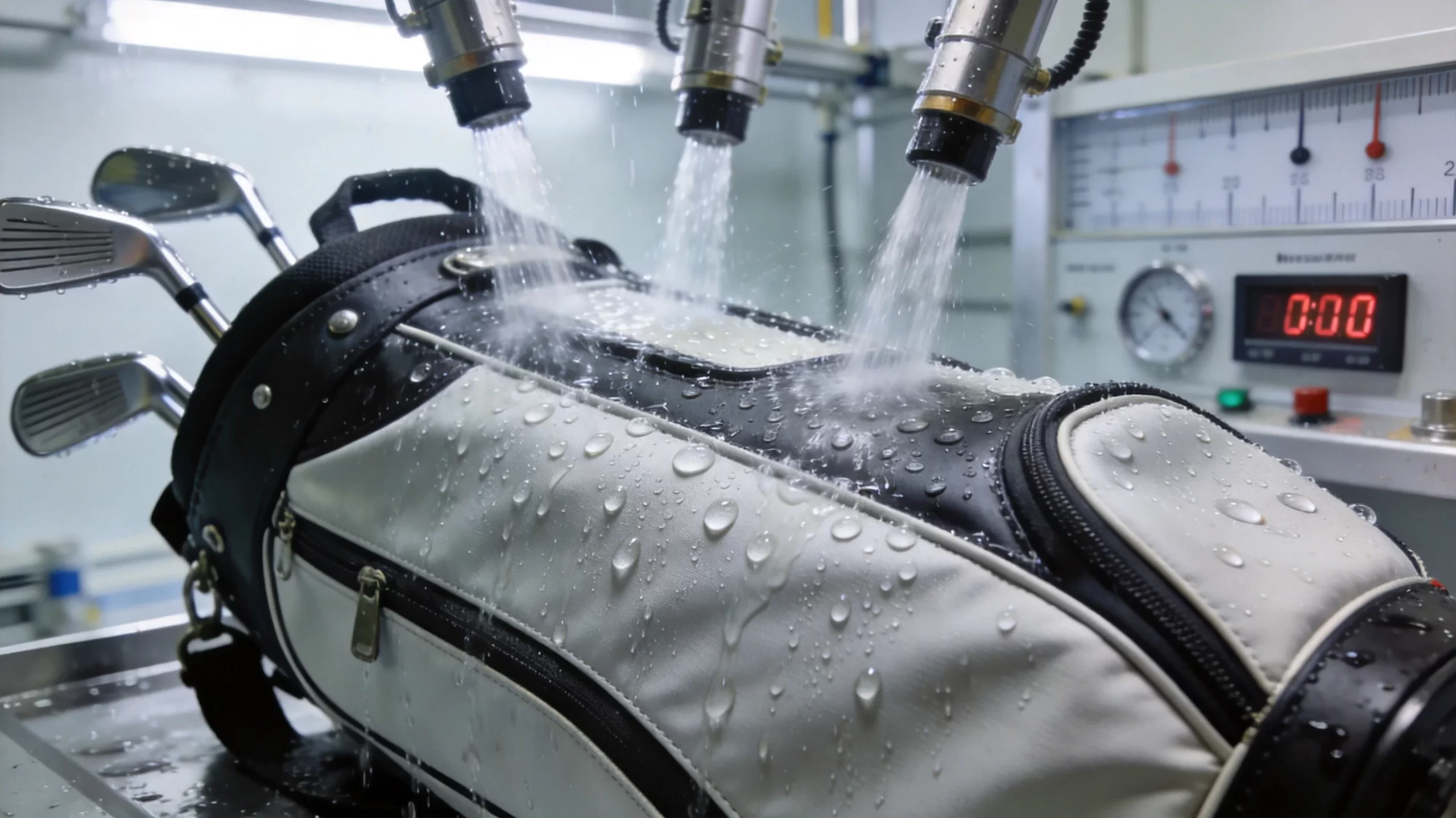
Golf is an outdoor sport played in all weather conditions. A golf bag’s waterproof performance directly impacts customer satisfaction. Our waterproof testing follows ISO 4927 rain simulation standards.
- Rain Simulation: Bags are positioned in a rain chamber with spray nozzles delivering 100mm/hour rainfall for 30 minutes. Interior must remain completely dry.
- Hydrostatic Pressure Test: Fabric samples are tested under 5,000mm water column pressure. Premium golf bags must achieve 10,000mm+ rating.
- Seam Sealing Verification: All stitched seams on waterproof bags are visually inspected and spot-tested with water spray to verify seam tape integrity.
3. Zipper Stress Testing
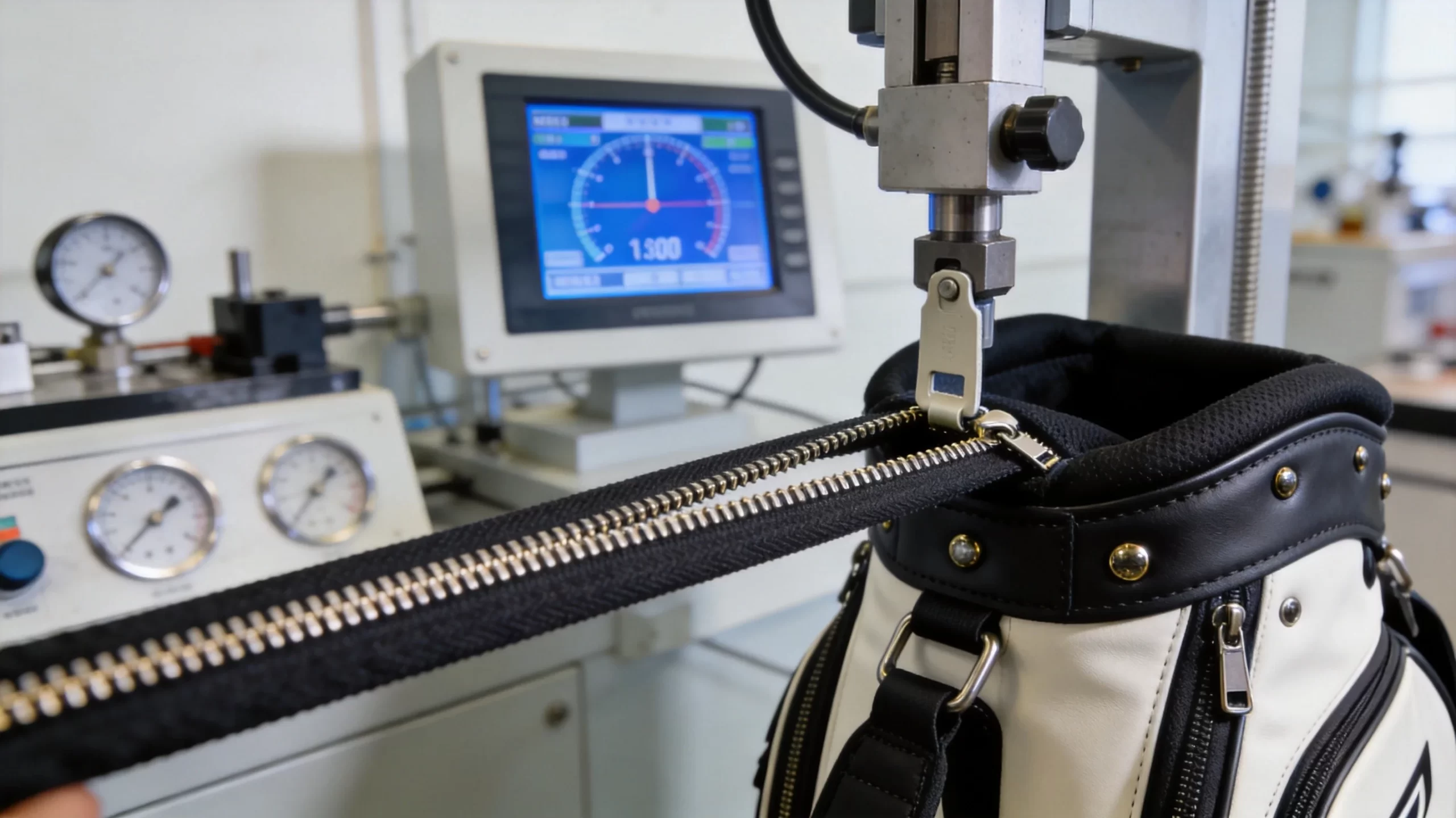
Zippers are the most common failure point in golf bags. Our zipper stress testing protocol is designed to ensure that every zipper can withstand years of daily use without failure.
- Cycle Testing: Each zipper type undergoes a minimum of 10,000 open-close cycles on a mechanical testing machine at 30 cycles per minute.
- Lateral Stress Test: Zippers are subjected to 50N lateral force while fully closed to simulate overfilled pocket conditions.
- Slider Pull Strength: The slider attachment is tested with a 30N pull force to verify crimp integrity.
- Corrosion Test: Metal zipper components undergo 48-hour salt spray testing per ASTM B117 standards.
4. Seam Strength Testing
Seams are the structural backbone of a golf bag. Failed seams mean failed products. Our seam strength protocol covers every critical load-bearing seam.
- Pull Force Test: Strap attachment seams must withstand a minimum 200N pull force for 30 seconds without separation or visible distortion.
- Strip Test: Fabric seam samples are tested on a tensile tester to verify minimum seam strength of 150N per 50mm width.
- Stitch Density Check: All seams must maintain 7–9 stitches per inch (SPI). Fewer stitches indicate weak construction; more stitches can perforate and weaken the fabric.
5. Load-Bearing Testing
Golf bags must carry 14 clubs (approximately 12 kg), plus accessories, clothing, and personal items—totaling 18–25 kg of continuous load. Our load-bearing test exceeds these real-world conditions.
- Static Load Test: Bags are loaded to 120% of rated capacity (minimum 25 kg) and suspended for 24 hours. No seam separation, strap elongation beyond 5%, or structural deformation is acceptable.
- Dynamic Walk Test: Loaded bags are placed on a motorized walk simulator for 5,000 cycles to replicate carry conditions. Shoulder strap padding, hip pads, and all attachment points are inspected.
- Stand Stability Test: For stand bags, the leg mechanism is tested over 3,000 deployment cycles on a 15° incline to verify retraction spring durability and stability.
Material Quality Inspection Standards
Quality control begins with the raw materials. Every batch of fabric, hardware, zipper, and component is inspected upon arrival at our facility before entering the production line. Our incoming quality control (IQC) standards are aligned with international textile testing norms.
| Material | Test Parameter | Standard | Test Method | Frequency |
|---|---|---|---|---|
| Nylon 600D/1680D | Tensile Strength | ≥ 350N (warp) / ≥ 280N (weft) | ASTM D5034 | Every roll |
| Polyester 600D | Color Fastness | Grade 4+ (ISO 1-5 scale) | ISO 105-B02 | Every batch |
| YKK Zippers | Chain Strength | ≥ 80N lateral / ≥ 120N longitudinal | YKK Standard / ASTM D2061 | Every lot |
| Buckles & Hardware | Breaking Strength | ≥ 150N for side-release / ≥ 200N for D-rings | ASTM D2594 | Every lot |
| PU/PVC Coating | Hydrostatic Resistance | ≥ 5,000mm (standard) / ≥ 10,000mm (premium) | ISO 811 | Every roll |
| EVA Foam | Density & Compression Set | Density 30-45 kg/m³ / Set ≤ 15% | ASTM D3574 | Every batch |
| Thread (Bonded Nylon) | Tensile & UV Resistance | ≥ 30N / UV retention ≥ 70% after 200 hrs | ASTM D885 / AATCC 16 | Every cone |
| Base Mold (ABS/PP) | Impact Resistance | ≥ 20 J/m (Izod impact) | ASTM D256 | Every mold lot |
Waterproof & Weather Resistance Testing
Waterproof performance is one of the most important quality indicators for golf bags, particularly for premium and tour-level products. Golfers expect their bags to protect clubs, valuables, and clothing during sudden rain showers—and they expect that protection to last for years, not just one season.
Our waterproof testing methodology follows a multi-tier approach:
- Fabric-Level Testing: Every incoming fabric roll is tested for hydrostatic pressure resistance using the ISO 811 method. Standard bags require 5,000mm water column; premium bags require 10,000mm+.
- Seam-Level Testing: After sewing, every waterproof seam is inspected for proper seam tape application and tested with targeted water spray. Any seam showing moisture penetration within 60 seconds is rejected.
- Product-Level Testing: Finished bags undergo the full rain simulation in our test chamber—100mm/hour for 30 minutes—with interior inspection for any moisture ingress.
- Aged Waterproof Testing: Samples from each production batch undergo accelerated aging (UV exposure 200 hours + 50 wet-dry cycles) before re-testing waterproof performance to ensure long-term durability.
This comprehensive approach ensures that a KPG golf bag maintains its waterproof performance throughout its entire service life, not just when it leaves the factory. According to the National Golf Foundation, 68% of golfers report playing in wet conditions at least monthly, making waterproof integrity a critical quality metric.
Durability Testing: Zipper, Seam & Load-Bearing Data
We track quality data for every production run. The following table shows our testing standards alongside typical results from recent production batches:
| Test Category | Parameter | Minimum Standard | KPG Average Result | Industry Benchmark |
|---|---|---|---|---|
| Zipper Cycle Test | Open-close cycles | 10,000 cycles | 15,000+ cycles | 8,000 cycles |
| Zipper Lateral Force | Force at failure | 50N | 72N avg. | 45N |
| Seam Pull Force | Strap attachment | 200N | 265N avg. | 180N |
| Seam Strip Test | Strength per 50mm | 150N | 185N avg. | 140N |
| Static Load Test | Load duration at 120% | 24 hours pass | 48 hours pass | 12 hours |
| Dynamic Walk Test | Cycles without failure | 5,000 cycles | 8,200+ cycles | 4,000 cycles |
| Stand Mechanism | Deployment cycles | 3,000 cycles | 5,000+ cycles | 2,500 cycles |
| Waterproof (Product) | Rain chamber test | 30 min @ 100mm/h | 60 min pass | 20 min pass |
Quality Management Systems: ISO 9001, BSCI & Sedex
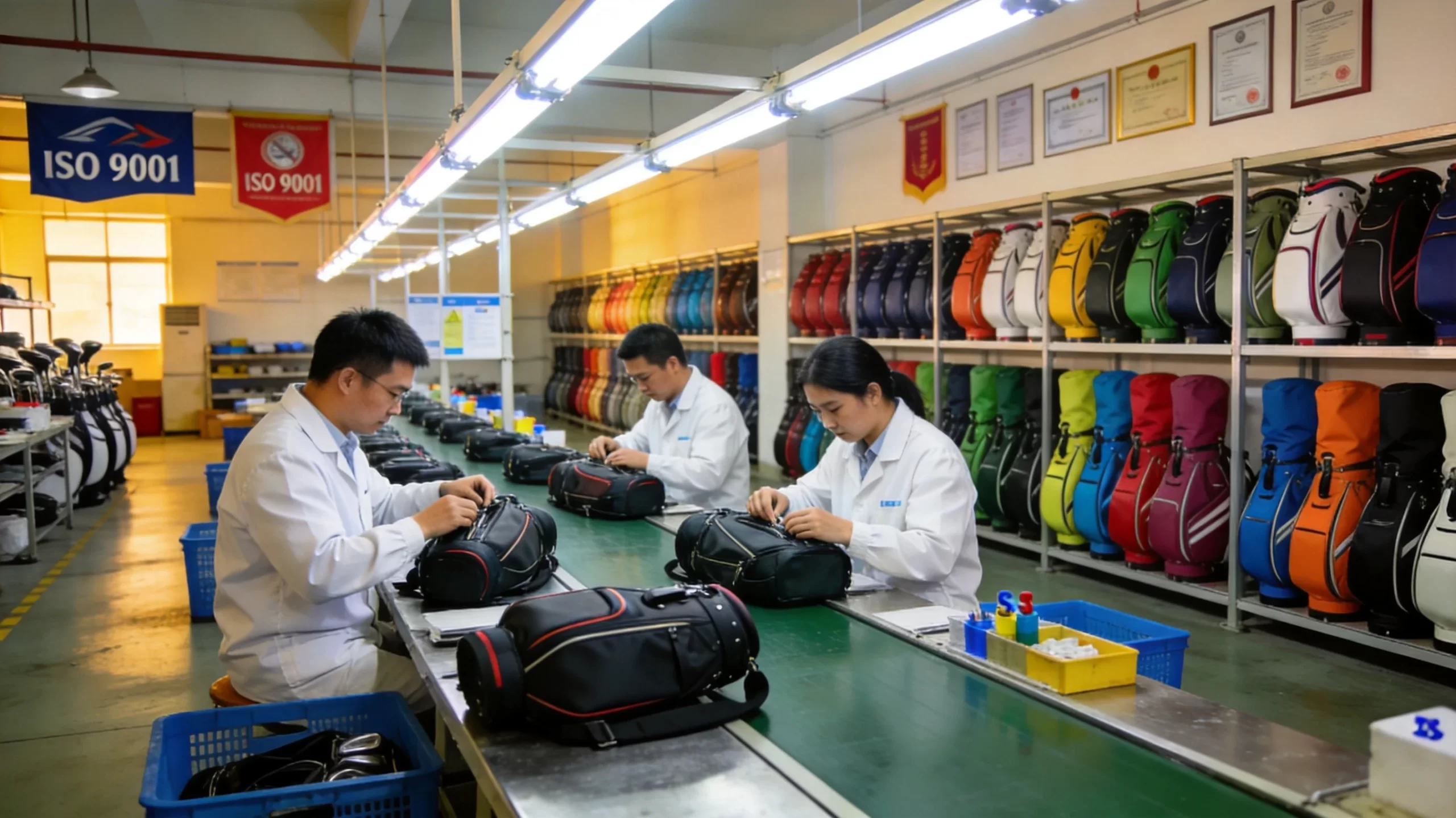
Certifications are not just badges—they are structured frameworks that ensure consistency, accountability, and continuous improvement. Keep Perfect Golf maintains three major certifications, each addressing a different dimension of quality and responsibility.
| Dimension | ISO 9001:2015 | BSCI | Sedex/SMETA |
|---|---|---|---|
| Focus Area | Quality Management System | Social Compliance | Ethical Trade |
| What It Covers | Design, production, testing, corrective actions, customer feedback loops | Working conditions, wages, hours, health & safety, environmental management | Labor rights, health & safety, business ethics, environment management |
| Audit Frequency | Annual surveillance + recertification every 3 years | Every 1-2 years (risk-based) | Every 1-2 years per buyer requirement |
| Key Benefit to Buyers | Consistent product quality, traceable processes, documented corrective actions | Supply chain ethics compliance, brand reputation protection | Multi-buyer audit sharing, reduced audit duplication |
| Recognized By | Global (170+ countries) | European retailers, global brands | Sedex members (4,000+ global brands) |
| KPG Status | ✓ Certified since 2008 | ✓ Certified since 2015 | ✓ Certified since 2016 |
These certifications are not just for show. They are actively used by our 200+ brand partners across 100+ countries as evidence of our commitment to quality and compliance. When you source from Keep Perfect Golf, you receive full audit reports and certificates with every order.
How to Audit a Golf Bag Factory
Choosing the right manufacturing partner is the most important sourcing decision you will make. Here is our recommended factory audit checklist, developed from 20+ years of experience hosting buyer audits:
Pre-Audit Document Review
- Business license and export registration
- ISO 9001 / BSCI / Sedex certificates (verify validity dates and scope)
- Product liability insurance certificate
- Client reference list with contact information
- Annual production capacity report
On-Site Physical Inspection
- Raw Material Storage: Is fabric stored off the floor? Are materials labeled with batch numbers? Is there an incoming inspection log?
- Production Line: Count the number of sewing stations. Are machines maintained? What is the worker-to-machine ratio? Is there inline QC at each critical operation?
- Testing Lab: Does the factory have its own testing equipment (tensile tester, rain chamber, zipper cycle machine)? Or do they outsource all testing?
- Finished Goods Area: How are packed bags stored? Is there an AQL sampling station? What is the defect sorting procedure?
- 5S / Cleanliness: A clean factory is a quality factory. Check floor cleanliness, lighting adequacy, and aisle organization.
Sample Production Test
After the physical audit, request a sample production run of 50–100 pieces. Evaluate the output for stitching quality, zipper alignment, print accuracy, color matching, and packaging quality. This is the ultimate proof of a factory’s true capability.
Common Defects & Prevention Strategies
Understanding common defects helps brand owners write better specifications and conduct more effective inspections. Here are the most frequent golf bag defects we have eliminated from our production through systematic prevention:
| Defect Category | Common Defect | Root Cause | KPG Prevention Method |
|---|---|---|---|
| Structural | Shoulder strap detachment | Insufficient bartack stitches, weak backing material | Triple bartack + reinforcing tape, 200N pull test |
| Functional | Zipper malfunction | Misaligned teeth, poor slider crimping | 100% zipper cycle test, YKK-only sourcing |
| Cosmetic | Color shading variation | Mixed fabric batches, inconsistent dye lots | Single-batch cutting policy, spectrophotometer check |
| Waterproof | Seam leakage | Incomplete seam tape, needle holes too large | Auto seam taping, 100% water spray test per seam |
| Print/Logo | Logo peeling or cracking | Wrong ink type for fabric, insufficient curing | Wash test (5 cycles) before bulk, cross-cut adhesion test |
| Hardware | Buckle breakage | Low-quality plastic, cold temperature brittleness | -20°C cold impact test, 150N minimum breaking strength |
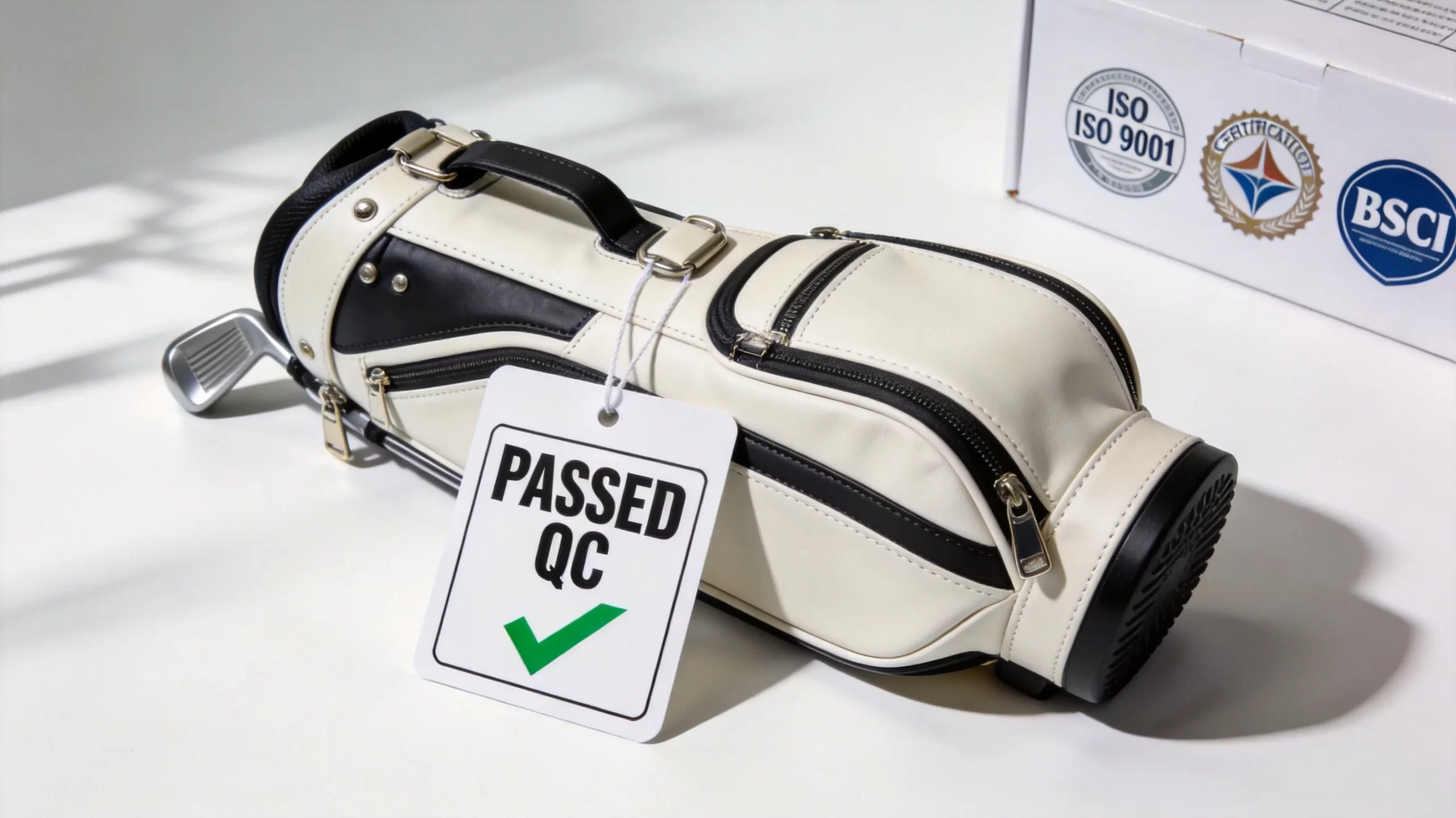
Cost of Poor Quality vs. Investment in QC
Many brands view quality control as an added cost. In reality, QC is a cost-avoidance investment with measurable ROI. Here is a realistic comparison based on our experience with mid-tier golf bag brands:
| Cost Category | Without Robust QC | With KPG QC Program | Savings |
|---|---|---|---|
| Defect rate | 4-6% | 1.0-1.5% | 60-75% reduction |
| Return rate | 3-5% | 0.8-1.2% | $25-35 per avoided return |
| Warranty claims (annual) | $15,000–$30,000 | $3,000–$5,000 | $10,000–$25,000 saved |
| Retail chargebacks | $5,000–$12,000 | $500–$1,500 | $4,000–$10,000 saved |
| QC program cost | N/A | $2,000–$4,000/year | — |
| Net ROI | — | — | 8x-15x return on QC investment |
The data is clear: investing in comprehensive quality control delivers 8–15x return through avoided returns, warranty claims, chargebacks, and brand reputation protection. For brands shipping 5,000+ golf bags annually, the financial case for robust QC is overwhelming.
Frequently Asked Questions
What are the 5 critical quality tests every golf bag must pass?
Every golf bag must pass: (1) Durability testing — abrasion resistance and drop tests; (2) Waterproof testing — rain simulation at 100mm/h for 30+ minutes; (3) Zipper stress testing — 10,000 open-close cycles minimum; (4) Seam strength testing — minimum 200N pull force on all load-bearing seams; (5) Load-bearing testing — 120% rated capacity for 24 hours static, 5,000 cycles dynamic walk test.
How long does quality control testing take for a golf bag?
Standard QC testing takes 48–72 hours per batch, including material inspection (2–4 hours), waterproof testing (30 min to 2 hours), zipper durability (8–12 hours), seam strength (4–6 hours), and load-bearing testing (24 hours). Full pre-production through final random inspection may extend to 5–7 business days.
What certifications should a golf bag manufacturer have?
Minimum certifications: ISO 9001 (quality management), BSCI (social compliance), and Sedex/SMETA (ethical trade). Additional valuable certifications include ISO 14001 (environmental), OEKO-TEX Standard 100 (textile safety), and REACH compliance for EU markets. Keep Perfect Golf holds all three primary certifications.
What is the acceptable defect rate for golf bags?
Industry standard is below 2.5% AQL. Top-tier manufacturers maintain below 1.5%. Critical defects (safety hazards) must be 0%. At KPG, our defect rate consistently stays below 1.5% through comprehensive inline and final random inspections.
How can I audit a golf bag factory before placing an order?
Verify: (1) business licenses and export certifications, (2) quality management documentation and ISO certification, (3) production capacity and equipment condition, (4) inline QC checkpoints and testing equipment, (5) finished goods inspection area and AQL procedures, (6) raw material storage and IQC records, (7) social compliance documentation, and (8) request a sample production run of 50–100 pieces to verify actual output quality.
Partner with a Quality-First Golf Bag Manufacturer
Quality is not an accident—it is the result of systematic investment in people, processes, and testing infrastructure. At Keep Perfect Golf, every golf bag that leaves our Quanzhou facility has passed through 5 critical tests, been inspected by trained QC staff, and been backed by ISO 9001, BSCI, and Sedex certifications.
Whether you are an established brand looking to improve your supply chain quality, or a new golf brand launching your first bag line, we offer OEM/ODM manufacturing with MOQ as low as 100 pieces, FOB Xiamen shipping, and 20+ years of quality expertise at your service.
Ready to Discuss Your Golf Bag Quality Requirements?
Contact our quality team for detailed specifications, test reports, and a personalized quote.
Request a Quote → WhatsApp: +86 17750020688
Email: [email protected] | MOQ: 100 pcs | FOB: Xiamen, China