Custom cart bags are golf bags manufactured to a retailer’s exact specifications — including logo placement, color palette, divider configuration, material selection, and pocket layout — typically produced in minimum order quantities of 100+ units. Standard cart bags are pre-designed, off-the-shelf models available in fixed colorways and configurations, ready for immediate bulk purchase and resale with no customization required.
For pro shop owners, golf retail buyers, and distributors, the choice between custom and standard cart bags is one of the most consequential purchasing decisions you make each season. The global golf bags market reached US$1.25 billion in 2025 and is projected to hit US$1.66 billion by 2031, growing at a 4.85% CAGR, according to Mordor Intelligence (2026). Within that market, the cart bag segment alone is expanding at a 7.8% CAGR — outpacing stand bags — driven by the continued dominance of riding carts at American golf facilities.
Yet the decision is not simply about which bag is “better.” It is about which type serves your margin structure, your brand positioning, and your customer base. This guide breaks down every dimension of the custom vs. standard cart bag decision from a retail perspective — with data, cost comparisons, and actionable frameworks you can use immediately.
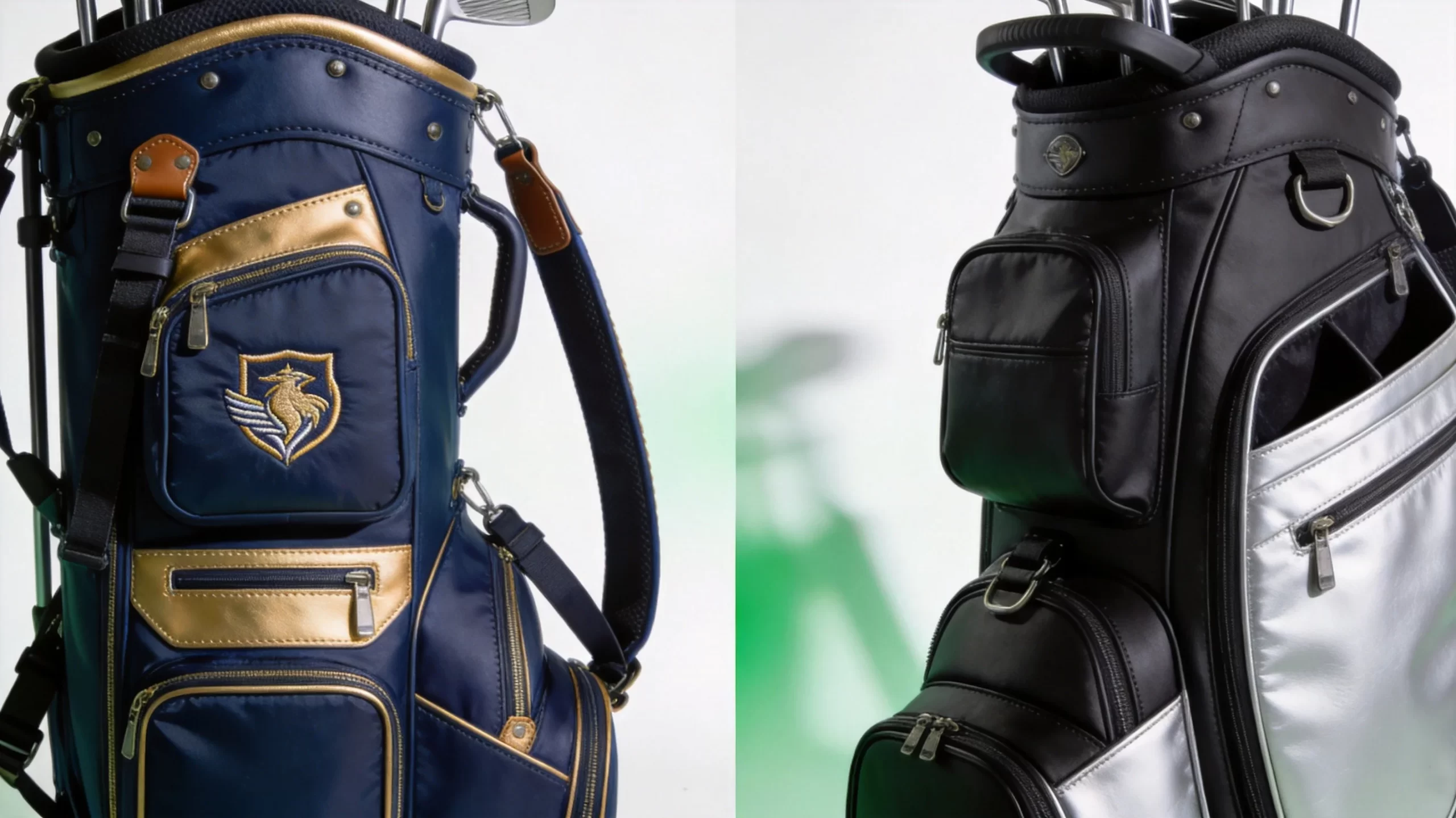
Understanding the Two Categories
What Is a Custom Cart Bag?
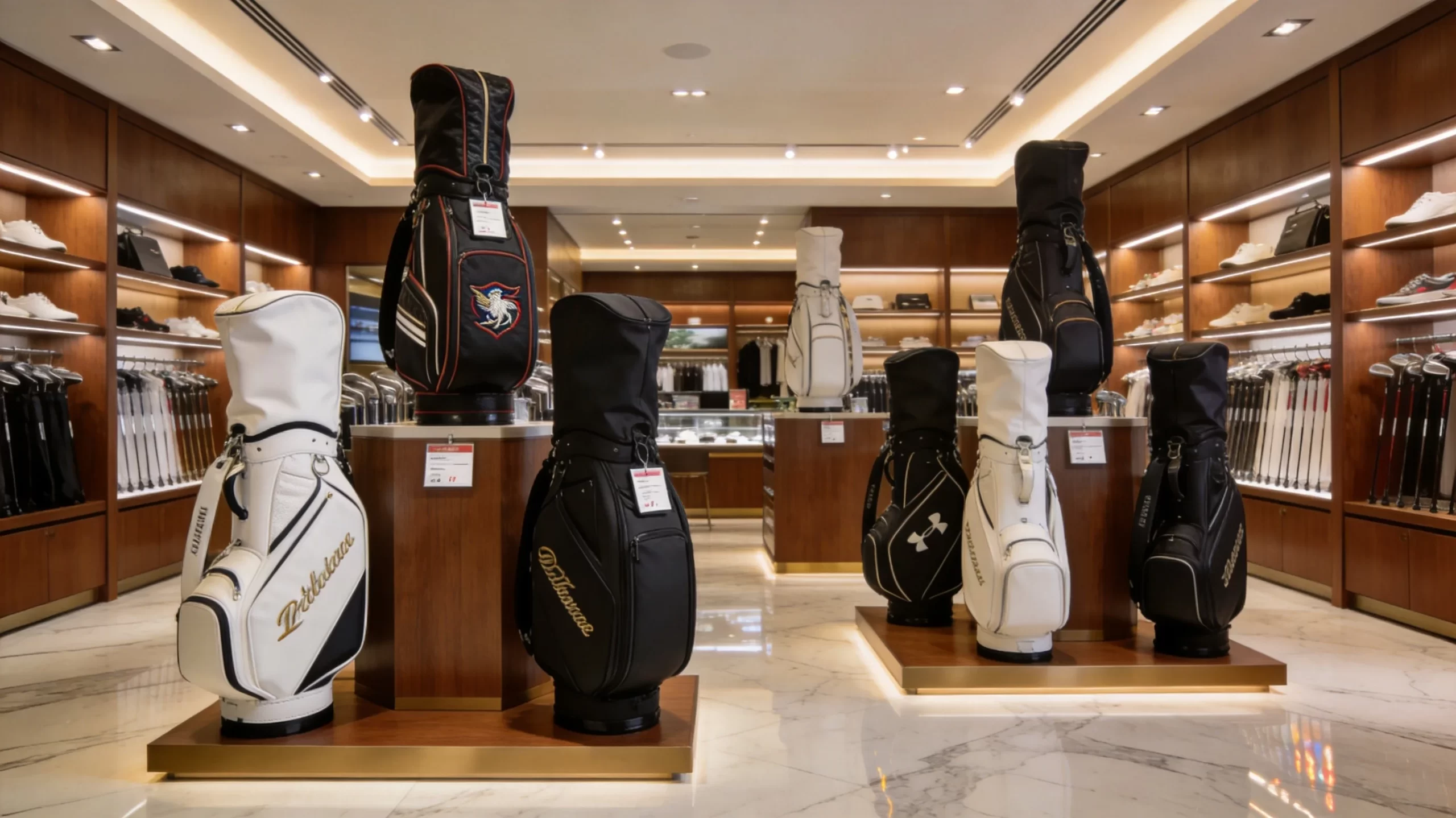
A custom cart bag is built to order based on your brand’s design specifications. You control the exterior materials (from premium PU leather to high-denier nylon), the divider system (14-way full-length, 5-way, or anything in between), the pocket configuration, the color scheme, and — critically — the branding elements including embroidered logos, woven labels, metal emblems, and custom hardware.
Custom cart bags serve three primary retail purposes: building a private label golf bag line that carries your shop’s exclusive branding, creating tournament and corporate gifting products for member events, and developing differentiated inventory that cannot be price-compared by shoppers visiting competing stores.
What Is a Standard Cart Bag?
A standard cart bag is a pre-engineered product manufactured in large quantities and sold under the manufacturer’s or distributor’s brand. These bags come in predetermined color options, fixed feature sets, and established size configurations. They are the workhorses of pro shop inventory — reliable, well-tested designs that move quickly off shelves at predictable price points.
Standard cart bags are the go-to option for shops that need to fill shelves quickly, serve walk-in customers, and maintain healthy turnover rates without the production lead times associated with custom orders. If you are new to retail and building your initial inventory, standard bags from established brands provide instant credibility.
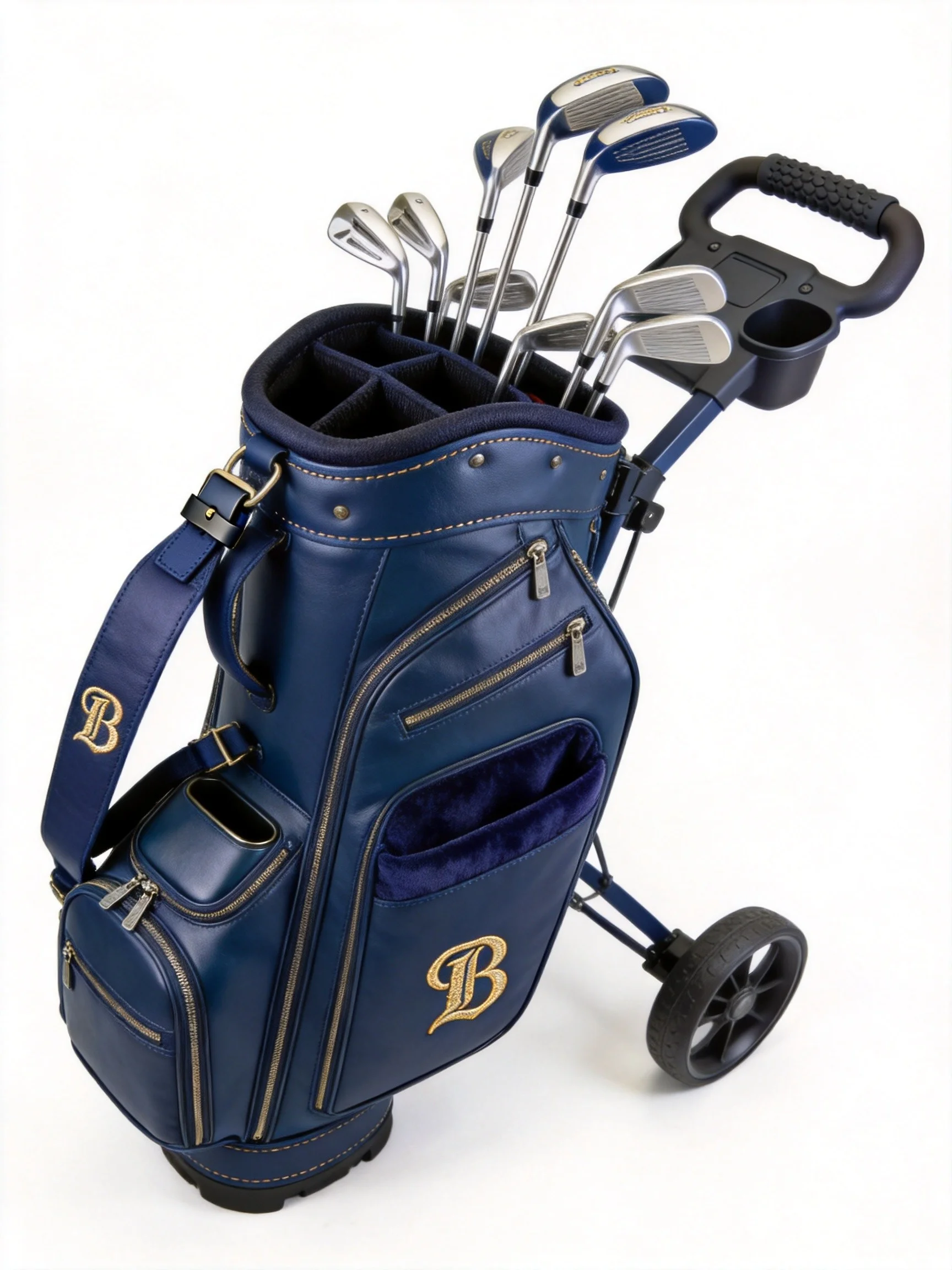
Head-to-Head Comparison: Custom vs Standard Cart Bags
The table below summarizes the key differences that matter most to retail buyers and pro shop operators:
| Dimension | Custom Cart Bags | Standard Cart Bags |
|---|---|---|
| Retail Price Range | $180 – $600+ | $100 – $350 |
| FOB Cost (China OEM) | $35 – $85 per unit | $25 – $55 per unit (wholesale) |
| Gross Margin | 55% – 75% | 35% – 50% |
| MOQ | 100 pcs (bags), 500 pcs (accessories) | 10 – 50 pcs per SKU |
| Lead Time | 45 – 75 days (incl. sampling) | 7 – 21 days (in-stock) |
| Customization Level | Full: materials, colors, logos, dividers, pockets, hardware | None or limited (color-only options) |
| Brand Exclusivity | 100% exclusive — your design, your brand | Shared across all retail partners |
| Weight (typical) | 5 – 7 lbs (configurable) | 4.5 – 6.5 lbs (fixed) |
| Divider System | Any: 4-way to 15-way, full-length or club-only | Pre-set: usually 10-way or 14-way |
| Minimum Pocket Config | Custom: 6 – 10 pockets based on spec | Pre-set: typically 7 – 9 pockets |
| Ideal For | Established shops, brand builders, tournament gifting | New shops, seasonal fill, walk-in inventory |
| Risk Profile | Higher upfront investment, higher potential return | Lower risk, proven demand, lower ceiling |
| Repeat Order Ease | Fast reorder once design is approved | Always available, subject to stock |
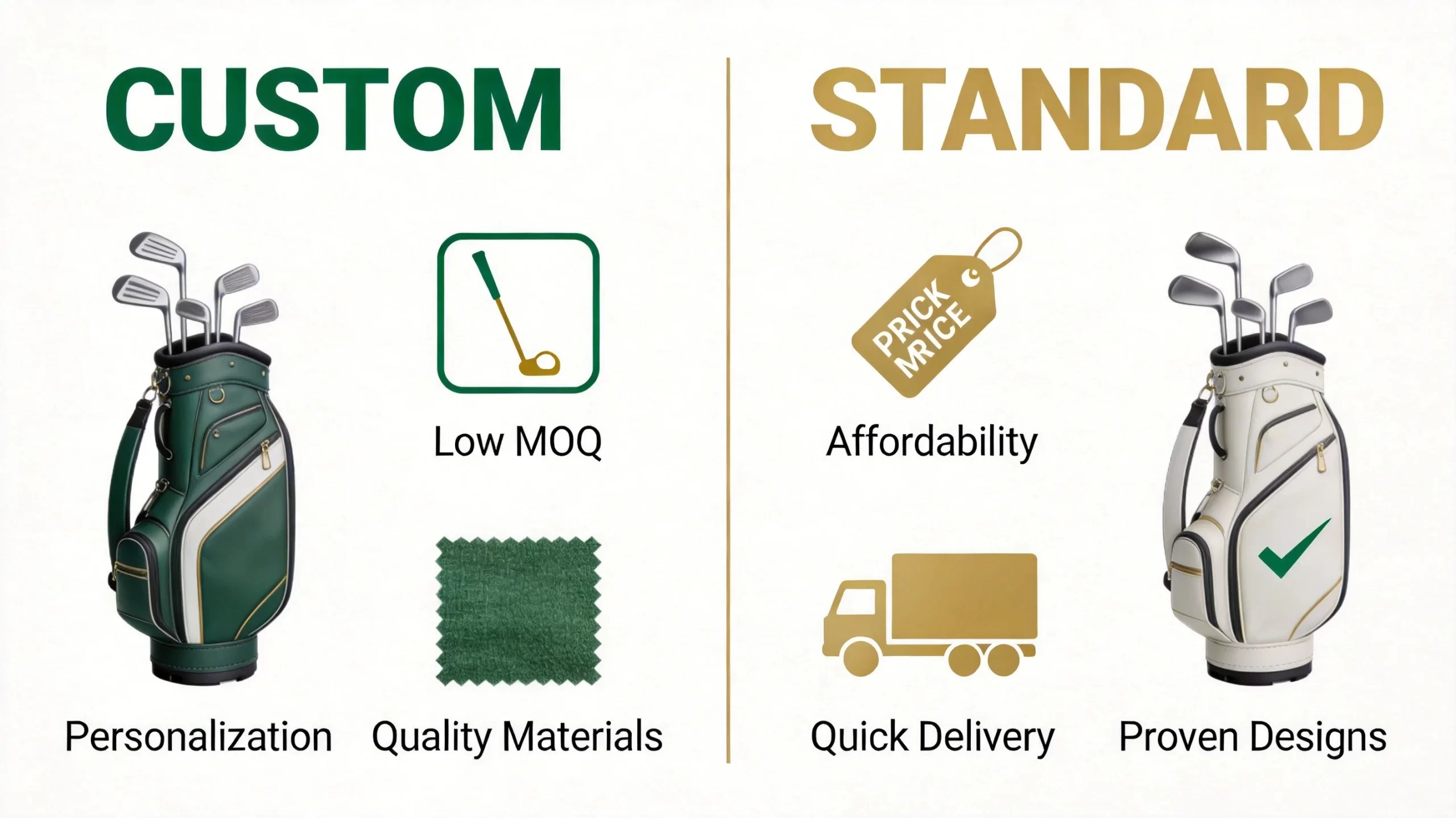
Cost Structure: The Numbers Behind the Decision
Understanding the true cost difference is essential for any retail buyer. Here is a realistic breakdown based on current market data from Chinese OEM manufacturers.
Custom Cart Bag Economics
When you order a custom golf bag from a manufacturer, the per-unit cost includes several components: raw materials (30-40%), labor and assembly (25-35%), tooling amortization (5-10%), branding and customization (10-15%), and shipping/packaging (5-10%). For a mid-range custom cart bag with premium nylon construction, 14-way divider, custom embroidery, and branded hardware, expect an FOB Xiamen cost of $45 – $65 per unit at the 100-unit MOQ level.
At a retail price of $280 – $380, this delivers a gross margin of 60% – 75%. The key advantage: no customer can walk into another shop and find the same bag for less. Your product is unique.
Standard Cart Bag Economics
Wholesale standard cart bags from distributors typically cost $25 – $55 per unit, with retail pricing of $100 – $350 depending on brand positioning. Margins of 35% – 50% are standard. The advantage is speed: you can order on Monday and have inventory on your shelves within two to three weeks. There is no sampling process, no design approval cycle, and no minimum commitment beyond a basic order quantity.
The trade-off is clear. Standard bags compete on price with every other shop carrying the same brand. Custom bags compete on exclusivity and brand equity.
Quality and Materials: What Differentiates Custom from Standard
The quality gap between custom and standard cart bags has narrowed significantly over the past decade, but meaningful differences remain.
Custom cart bags give you control over every material choice. You can specify golf bag materials such as 1680D ballistic nylon for maximum durability, PU leather panels for premium feel, or RPET (recycled polyester) fabric to meet growing sustainability demand from golf consumers. You choose the zipper brand (YKK vs generic), the divider material (EVA foam-padded vs basic plastic), and the base construction (molded rubber vs stamped plastic).
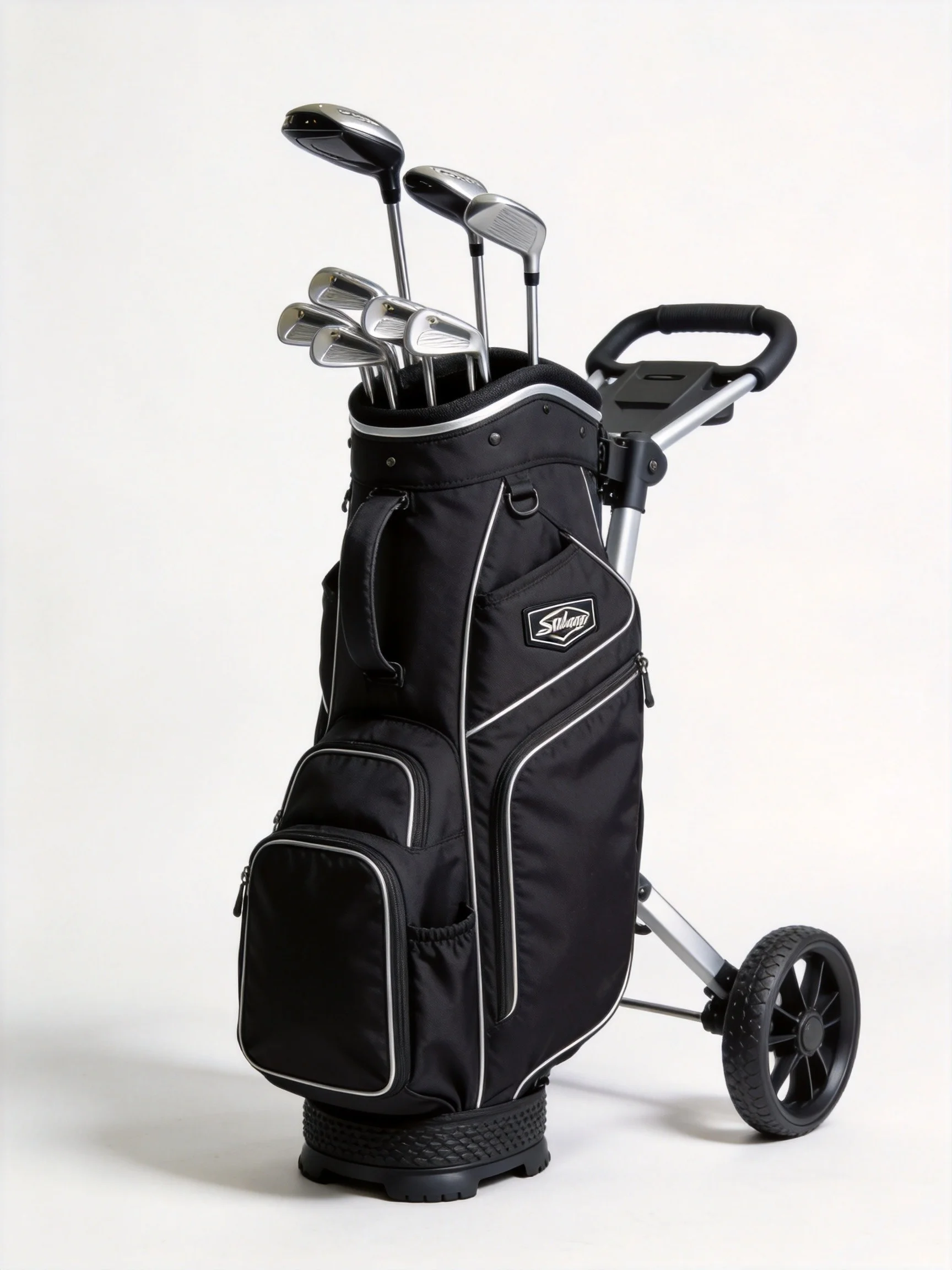
Standard cart bags, by contrast, use the manufacturer’s pre-selected material package. This is often perfectly adequate — most reputable brands use durable nylon or polyester with reliable zippers — but you have no ability to upgrade specific components or differentiate the tactile experience. You get what the brand has designed, and nothing more.
The Market Context: Why This Decision Matters Now
Several macro trends are making the custom vs. standard decision more impactful than ever for pro shop operators:
Record golf participation continues. According to the National Golf Foundation’s 2026 Graffis Report, total U.S. golf participation reached an all-time high of 48.1 million in 2025, with on-course players exceeding 29.1 million for the eighth consecutive year of growth. More golfers means more equipment sales, and cart bags — the most visible accessory on the course — are a natural upsell opportunity.
Pro shops are evolving toward boutique retail. The Association of Golf Merchandisers (AGM) reports that the industry is shifting from traditional “pro shop” standards toward a more boutique-style model, where golf products are intermingled with lifestyle. Hyper-customization and exclusive-to-the-club offerings are among the top six trends driving modern golf retail (AGM, 2026). Custom cart bags align perfectly with this direction.
The cart bag segment is outpacing other categories. According to Research and Markets’ Global Golf Bag Report (2026), the cart bag segment is growing at a 7.8% CAGR — faster than stand bags (8.9% by value but from a smaller base in many markets) and travel bags. As riding carts remain dominant at U.S. facilities, cart bags represent the single largest equipment accessory category for on-course players.
These trends create a compelling case for stocking at least some custom cart bag inventory. The question is not whether to go custom, but how much and when.
Strategic Framework: When to Choose Custom vs Standard
Based on our work with 200+ brands across 100+ countries over 20+ years of golf bag manufacturing, we recommend the following framework for retail buyers:
Choose custom cart bags when:
- You have an established pro shop with loyal members who value exclusivity
- You want to build a private label product line that differentiates your shop from competitors
- You need tournament, member appreciation, or corporate gifting products with your club’s branding
- Your customers are willing to pay $250+ for a bag they cannot buy elsewhere
- You plan to reorder the same design seasonally (amortizing sampling costs over multiple orders)
- You want to leverage custom branding options to build brand recognition
Choose standard cart bags when:
- You are opening a new shop and need to build initial inventory quickly
- Your customer base is price-sensitive and buys primarily on brand recognition
- You need to fill seasonal gaps between custom order cycles
- You want to test price points before committing to a custom program
- Your storage space is limited and you need smaller, more frequent shipments
The optimal strategy for most shops: a hybrid approach. Stock 60-70% standard cart bags for consistent cash flow, and invest 30-40% in custom cart bags for higher margins and brand differentiation. This balances risk and reward while building toward a more profitable private label program over time.
Customization Options That Drive Retail Sales
When you choose the custom route, the range of personalization options directly impacts what you can charge and how differentiated your product will be. Here are the most impactful custom features for retail cart bags:
- Logo placement and method: Embroidery (premium, durable), silk-screen printing (cost-effective for large areas), woven labels (heritage feel), leather patches (luxury), or metal emblems (maximum prestige)
- Color matching: Pantone-matched exterior fabrics, zippers, piping, and stitching to match your club or brand colors exactly
- Divider configuration: Choose between 4-way (maximum club protection), 10-way (balanced), or 14-way full-length (tour-level organization) based on your customer profile
- Pocket specialization: Add insulated cooler pockets, waterproof lined pockets, velour-lined valuables pockets, or full-length apparel pockets based on what your members request most
- Hardware customization: Custom zipper pulls, branded strap buckles, personalized name plates, or custom base molds
- Material upgrades: Switch from standard nylon to PU leather, add carbon fiber accent panels, or use RPET sustainable fabrics to appeal to environmentally conscious members
Each of these options adds marginal cost but can increase retail price significantly. A bag that costs $50 to produce with full customization can easily retail at $300-$400 if the design and branding are compelling.
Working with Your Manufacturer: OEM vs ODM
Understanding the difference between OEM and ODM manufacturing is crucial when sourcing custom cart bags. In OEM (Original Equipment Manufacturing), you provide the complete design and specifications, and the factory builds to your blueprint. In ODM (Original Design Manufacturing), you select from the factory’s existing designs and customize elements like colors, logos, and materials.
For most pro shop buyers, ODM is the practical starting point. It gives you 70-80% customization (materials, colors, logos) without the cost and timeline of a ground-up OEM design. Once your private label program matures and you have clear sales data on what your customers prefer, transitioning to full OEM for your next-generation designs becomes a natural evolution.
When evaluating golf bag manufacturers, prioritize those with proven experience in both OEM and ODM models, transparent sampling processes, and the flexibility to accommodate your MOQ requirements as you scale.
FAQ: Custom Cart Bags vs Standard Cart Bags
1. What is the minimum order quantity for custom cart bags?
The industry standard MOQ for custom golf cart bags is 100 pieces per design for bags, and 500 pieces for custom accessories and smaller items. Some manufacturers offer flexible terms for first-time orders or simplified designs. At 100 pieces, you can typically order a mix of color variations within the same base design.
2. How much more expensive are custom cart bags compared to standard ones?
Custom cart bags typically cost 40-80% more than equivalent standard wholesale bags on a per-unit basis (FOB). However, the retail price premium is usually 100-200% higher, resulting in significantly better gross margins. A $50 custom bag that retails at $300 delivers far more profit per unit than a $30 standard bag that retails at $150.
3. How long does it take to receive a custom cart bag order?
Expect 45-75 days from design approval to delivery for a first-time custom cart bag order. This includes 7-14 days for sampling, 3-5 days for sample approval, and 30-55 days for production and shipping. Repeat orders (same design) are faster, typically 30-45 days, since sampling is not required.
4. Can I order both custom and standard cart bags from the same supplier?
Yes. Most full-service golf bag manufacturers offer both custom OEM/ODM programs and wholesale standard bag catalogs. This allows you to source your entire cart bag inventory from a single supplier, simplifying logistics and quality control. The key is finding a manufacturer with both capabilities and the flexibility to handle different order scales.
5. Which type of cart bag sells better in pro shops?
Standard cart bags sell in higher volume due to lower price points and immediate brand recognition. However, custom cart bags generate higher per-unit profit and build customer loyalty through exclusivity. According to AGM retail trend data, pro shops that develop private label programs (which rely on custom manufacturing) consistently report higher overall accessory margins than shops relying solely on branded standard products.
Making the Decision: A 3-Step Action Plan
If you are a pro shop owner or retail buyer ready to optimize your cart bag inventory, here is a practical three-step approach:
Step 1 — Audit your current mix. Review your last 12 months of cart bag sales data. What percentage are custom/private label vs. standard branded? What are the margins on each? Where is the gap?
Step 2 — Identify your differentiation opportunity. Talk to your members and customers. Would they pay more for a bag made exclusively for your club? What features do they wish your current bags had? This input directly informs your custom design brief.
Step 3 — Start with a pilot program. You do not need to go all-in on custom immediately. Start with one design, 100 units, and a 90-day sell-through test. Track the margin, the sell-through rate, and customer feedback. Use those results to inform your next order.
Partner with Keep Perfect for Your Custom Cart Bag Program
At Keep Perfect, we have spent over 20 years helping pro shops, golf brands, and distributors around the world build successful custom cart bag programs. With 200+ brand partnerships across 100+ countries, we understand what it takes to create products that sell — and sell at premium margins.
Our capabilities include full OEM and ODM custom cart bag manufacturing, with MOQs starting at just 100 pieces. We offer FOB Xiamen shipping, comprehensive sampling programs, and end-to-end support from design concept through delivery.
Whether you are launching your first private label cart bag or scaling an established custom program, our team is ready to help you stock smarter and sell better.
📧 Email: [email protected]
📱 WhatsApp: +86 17750020688
🔗 Start your custom cart bag project: Request a Partnership Consultation
Related Products
Explore our manufacturing capabilities in this category:
 Premium Stand Bag
 Ultra-Light Stand Bag
 Hybrid Stand Bag
 Rain-Resistant Stand Bag
 Premium Tour Cart Bag
 Lightweight Cart Bag
 Waterproof Cart Bag
 Staff Cart Bag
Need custom golf bags? Contact us for OEM/ODM quotes — MOQ 100pcs, FOB Xiamen.