If you import golf bags from China, the FOB price your factory quotes is only the beginning of what you’ll actually pay. Tariffs, ocean freight, insurance, customs fees, drayage, and a dozen hidden charges can add 40% to 85% on top of the product cost — and the final number varies dramatically depending on whether you’re shipping to Los Angeles, Rotterdam, or Tokyo.
After 22 years of exporting golf bags to over 100 countries, we’ve helped hundreds of brands calculate their true landed cost before placing orders. This guide breaks down every cost component with real numbers, shows you how to build your own landed cost calculation, and reveals the strategies that importers use to reduce their total cost by thousands of dollars per shipment.
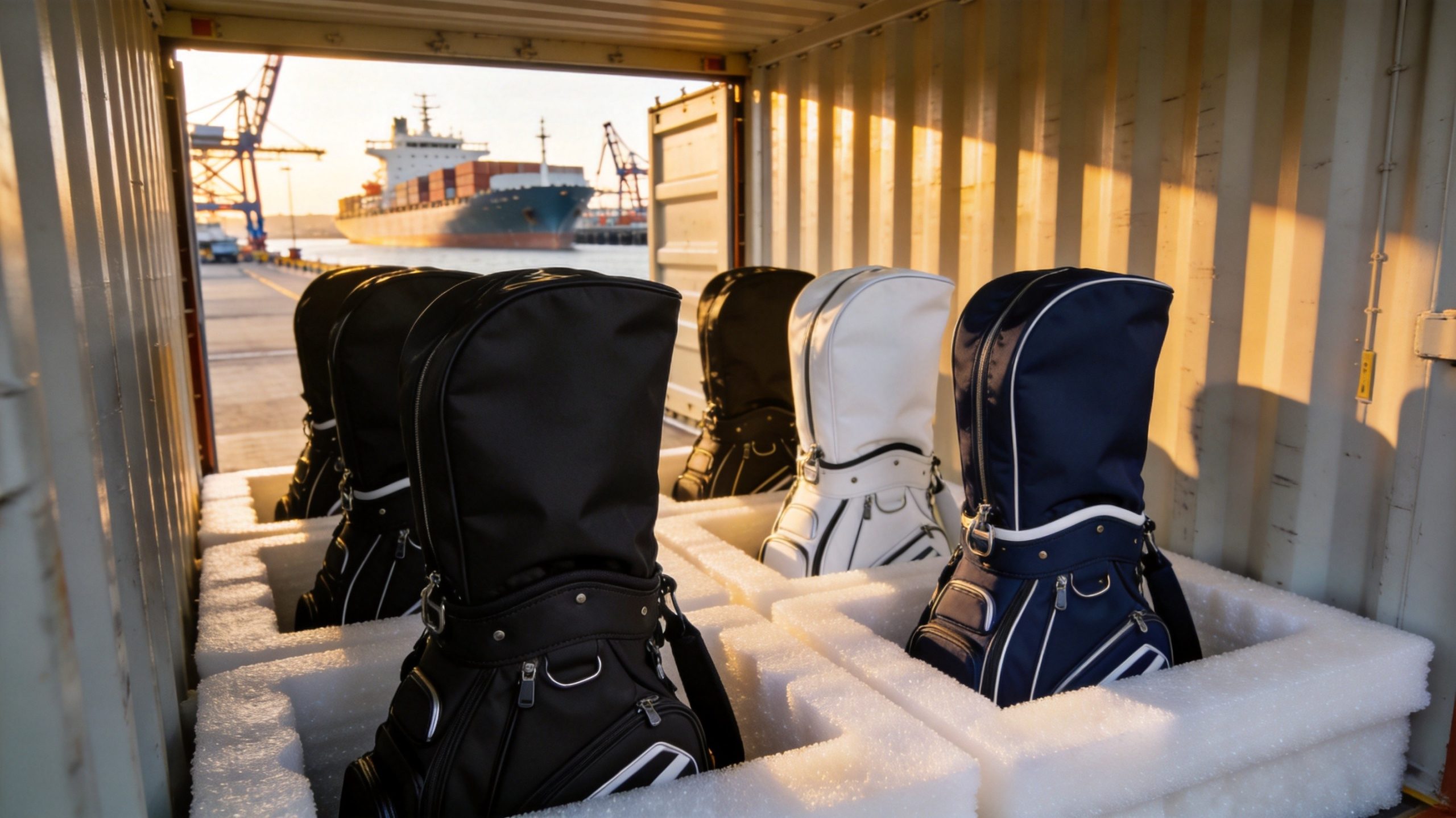
What Is Landed Cost for Golf Bag Imports?
Landed cost is the total price of a product once it has arrived at your warehouse door. For golf bags imported from China, it includes:
- FOB price (what you pay the manufacturer)
- Ocean or air freight (what you pay to move the goods)
- Cargo insurance (protection against loss or damage in transit)
- Import duties and tariffs (taxes levied by the destination country)
- Customs clearance fees (broker fees, processing fees, port charges)
- Domestic transportation (drayage from port to your warehouse)
- Hidden costs (demurrage, detention, currency fluctuation, returns)
Understanding each component isn’t just an accounting exercise — it directly affects your pricing strategy, profit margins, and competitive position. A brand that accurately calculates landed cost can price more aggressively than one that guesses.
HS Classification: The Single Most Important Decision
The Harmonized System (HS) code assigned to your golf bag determines the duty rate you’ll pay. And here’s where it gets interesting: different countries classify golf bags under completely different codes, with duty rate differences exceeding 50 percentage points.
United States: HTS 4202.92
In the US, golf bags are classified under HTS Chapter 42 (travel goods and bags), not Chapter 95 (sports equipment). This distinction matters enormously because Chapter 42 goods from China face steep Section 301 tariffs that Chapter 95 goods would not.
The exact 10-digit code depends on the outer surface material:
| HTS Code | Material | MFN Base Rate | Total Effective Rate (China) |
|---|---|---|---|
| 4202.91.10.00 | Leather outer surface | 4.5% | ~42.0% |
| 4202.92.15.xx | Cotton outer surface | 6.3% | ~43.8% |
| 4202.92.31.xx | Man-made fibers (nylon/polyester) | 17.6% | 55.1% |
Most modern golf bags are made from nylon, polyester, or PU-coated synthetic fabrics, which means the majority of golf bag imports fall into the highest duty bracket at 55.1%.
The three layers of US duty on Chinese golf bags:
- MFN Base Duty (17.6%) — applies to all WTO-member countries
- Section 301 List 3 (25%) — China-specific tariff in place since 2018
- Section 301 Forced-Labor Duty (12.5%) — added July 24, 2026, replacing the expired Section 122 surcharge
These rates are additive, not compounded. On a $30 FOB golf bag, the total duty comes to $16.53 — more than half the product cost.
European Union: TARIC 9506.39 (Duty-Free)
The EU takes a completely different approach. Golf bags enter under TARIC 9506.39 (golf equipment), which carries a 0% base duty rate for all WTO members, including China.
This means golf bags imported into the EU face no customs duty at all. The cost burden shifts entirely to freight and import VAT, which varies by member state:
- Netherlands (Rotterdam): 21% VAT
- Germany (Hamburg): 19% VAT
- France (Le Havre): 20% VAT
- Luxembourg: 17% VAT
Import VAT is recoverable for VAT-registered businesses, making the EU the most cost-efficient major market for Chinese golf bag imports from a duty perspective.
Japan: HS 4202.92 with RCEP Advantage
Japan classifies golf bags similarly to the US (under HS 4202.92), but the rates are far lower:
| Rate Type | Rate |
|---|---|
| General / MFN Bound | 8.0% |
| RCEP (China origin) | 5.7% |
| CPTPP | 1.4% |
The RCEP preferential rate of 5.7% is available for Chinese-origin goods when proper certificates of origin are provided — a 2.3 percentage point saving over the MFN rate. Japan also levies a 10% consumption tax on CIF + duty, which is creditable for registered businesses.
Ocean Freight Costs: Xiamen to Major Markets
Freight is the second-largest cost component after product value. Here are current rates (Q3 2026) for the main trade lanes from Xiamen, China:
| Route | 40ft FCL | LCL per CBM | Transit Time |
|---|---|---|---|
| Xiamen → Los Angeles | $3,000–$4,050 | $75–$115 | 14–18 days |
| Xiamen → Rotterdam | $4,950–$6,600 | $200–$350 | 51–66 days |
| Xiamen → Tokyo | $2,500–$3,500 | $80–$150 | 18–25 days |
How Many Golf Bags Fit in a Container?
A standard 40ft container has about 67 CBM of usable space. Golf bags are long and awkwardly shaped, so they don’t cube out efficiently. In practice:
- 700–750 cart bags fit in a 40ft FCL
- 1,000 golf bags require approximately 2 × 40ft containers
- Each carton is roughly 35 × 30 × 120 cm, weighing 3.5–4 kg
FCL vs LCL: The Break-Even Point
Full Container Load (FCL) becomes cost-effective above approximately 14–15 CBM (roughly 120–150 golf bags). Below that threshold, Less than Container Load (LCL) is cheaper per cubic meter but adds 2–5 days of transit time due to consolidation and deconsolidation.
For a 1,000-bag order (~126 CBM requiring 2 × 40ft containers), FCL saves approximately $5,000 versus LCL — about $5 per unit.
Cargo Insurance: The Most Underappreciated Line Item
Ocean carriers’ liability under COGSA is capped at $500 per container, regardless of actual cargo value. A container of $30,000 worth of golf bags lost at sea would recover just $500 without proper insurance.
| Coverage | Scope | Typical Rate |
|---|---|---|
| ICC A (All Risks) | Broadest: theft, water damage, handling damage, virtually any accidental loss | 0.30%–0.55% of CIF+10% |
| ICC B (Named Perils) | Fire, sinking, collision, earthquake, partial water damage | 0.15%–0.30% |
| ICC C (Minimum) | Only major events: fire, explosion, sinking | 0.08%–0.15% |
For a $37,000 CIF shipment of golf bags to Los Angeles, ICC A insurance costs approximately $142 — about $0.14 per unit. It’s negligible cost for essential protection.
Critical tip: CIF terms only require ICC C coverage (the minimum). If your factory quotes CIF, verify whether the insurance actually covers the risks you care about — theft and handling damage are excluded under ICC C.
Full Landed Cost Calculation: A Real Example
Let’s calculate the complete landed cost for 1,000 mid-range golf bags at $30 FOB Xiamen, shipped FCL to three major markets.
Importing to the United States (Los Angeles)
| Cost Component | Total | Per Unit | % of Landed |
|---|---|---|---|
| Product (FOB Xiamen) | $30,000 | $30.00 | 54.0% |
| Ocean Freight (2 × 40ft) | $7,000 | $7.00 | 12.6% |
| Cargo Insurance (0.35% ICC A) | $142 | $0.14 | 0.3% |
| Base MFN Duty (17.6%) | $5,280 | $5.28 | 9.5% |
| Section 301 List 3 (25%) | $7,500 | $7.50 | 13.5% |
| Section 301 Forced-Labor (12.5%) | $3,750 | $3.75 | 6.7% |
| MPF + HMF + Brokerage + Drayage + THC | $1,891 | $1.89 | 3.4% |
| Total Landed Cost | $55,563 | $55.56 | 100% |
The markup over FOB is 85.2% — and duties alone account for $16.53 per unit, more than half the original product cost.
Importing to the European Union (Rotterdam)
| Cost Component | Total | Per Unit | % of Landed |
|---|---|---|---|
| Product (FOB Xiamen) | $30,000 | $30.00 | 58.4% |
| Ocean Freight (2 × 40ft) | $11,000 | $11.00 | 21.4% |
| Cargo Insurance (0.35% ICC A) | $158 | $0.16 | 0.3% |
| Import Duty (0%) | $0 | $0.00 | 0.0% |
| Import VAT (21%, recoverable) | $8,643 | $8.64 | 16.8% |
| Customs + Drayage + THC | $1,553 | $1.55 | 3.0% |
| Total Landed Cost | $51,354 | $51.35 | 100% |
The EU’s duty-free classification gives it a significant advantage. Excluding recoverable VAT, the true incremental cost is just $42.71 per unit — only 42.4% above FOB.
Importing to Japan (Tokyo, RCEP Rate)
| Cost Component | Total | Per Unit | % of Landed |
|---|---|---|---|
| Product (FOB Xiamen) | $30,000 | $30.00 | 69.5% |
| Ocean Freight (2 × 40ft) | $6,000 | $6.00 | 13.9% |
| Cargo Insurance (0.35% ICC A) | $139 | $0.14 | 0.3% |
| Import Duty (RCEP 5.7%) | $1,710 | $1.71 | 4.0% |
| Consumption Tax (10%) | $3,785 | $3.78 | 8.8% |
| Customs + Drayage + THC | $1,560 | $1.56 | 3.6% |
| Total Landed Cost | $43,193 | $43.19 | 100% |
Summary Comparison
| Market | Landed Cost per Unit | Markup over FOB | Key Cost Driver |
|---|---|---|---|
| United States | $55.56 | 85.2% | Duties (55.1% effective rate) |
| European Union | $51.35 ($42.71 ex-VAT) | 71.2% (42.4% ex-VAT) | Freight (21.4%) |
| Japan | $43.19 | 44.0% | Consumption tax (10%) |
8 Hidden Costs That Erode Your Margins
1. Demurrage and Detention
At LA/Long Beach, ports allow only 3–5 free days to move containers out. After that, charges escalate quickly — up to $500–$600/day per container for extended delays. A 5-day customs delay on a 2-container shipment can cost $1,500–$2,200 in demurrage alone.
2. Dimensional Weight Charges
Golf bags are large relative to their weight. Many last-mile carriers charge by dimensional weight rather than actual weight, adding $30–$110 per unit for domestic delivery.
3. Currency Fluctuation
If your factory prices in CNY but you pay in USD, a 5% RMB appreciation adds roughly $1.50 per bag to your FOB cost — which then cascades into higher percentage-based duties.
4. Quality Inspection Costs
Pre-shipment inspection typically costs $300–$500 per man-day. For a 1,000-unit order, budget 1% of FOB value for quality control.
5. Returns and Reverse Logistics
Defective products cost $25–$75 per unit to ship back (B2C), plus $5–$15 per unit for inspection and repackaging. Typical B2C return rates in sporting goods run 5–10%.
6. Customs Audit Penalties
Misclassifying a golf bag to avoid duties carries penalties of 20% to 400% of the underpaid duty. Always work with a licensed customs broker.
7. Peak Season Surcharges
Ocean freight rates rise 20–40% during peak season (August–October). Planning production and shipping for Q1/Q2 can save thousands per container.
8. Warehousing and Storage
If your goods arrive before your warehouse is ready, storage fees accumulate. At $15–$25 per pallet per day, a 2-container shipment sitting for a week can add $500–$1,000.
7 Proven Strategies to Reduce Landed Cost
1. Claim Duty Drawback on Re-Exports
If you import golf bags into the US and then re-export them, you can recover 99% of Section 301 duties through the duty drawback program. For brands selling to Canadian or Latin American customers from a US warehouse, this can meaningfully reduce net duty costs.
2. Optimize HTS Classification
The difference between a leather-classified bag (HTS 4202.91, 4.5% base rate) and a man-made fiber bag (4202.92.31, 17.6%) is over 13 percentage points at the base duty level. If your design can legitimately qualify for a lower-rate classification, the savings are substantial. Always consult a licensed customs broker.
3. Consolidate to FCL
Moving from LCL to FCL above 150 units saves 15–25% on freight costs. If your order volume doesn’t fill a container, consider coordinating with other importers to share container space.
4. Negotiate Annual Freight Contracts
Contract rates with freight forwarders typically run 10–25% below spot rates. If you ship regularly, locking in annual rates provides both cost savings and budget certainty.
5. Use First-Sale Valuation
In a multi-tier supply chain (factory → trading company → importer), the first-sale rule allows you to declare the manufacturer’s lower price as the customs value, reducing all percentage-based duties by 10–25%.
6. Leverage RCEP for Japan Shipments
Ensure you’re claiming the RCEP preferential rate of 5.7% instead of the MFN rate of 8% for Japan-bound shipments. At $30 FOB, that saves $0.69 per unit — small individually but significant at scale.
7. Time Your Shipments
Avoid peak season (August–October) when freight rates spike 20–40%. Plan production for Q1/Q2 delivery when rates are lowest and carrier space is most available.
The Landed Cost Formula
Use this formula to calculate landed cost for your specific order:
Landed Cost per Unit =
    FOB Price
  + (Freight Cost per Container × Number of Containers ÷ Quantity)
  + Insurance Premium ÷ Quantity
  + FOB Price × (Base Duty Rate + Section 301 Rate + Forced-Labor Rate)
  + (MPF + HMF + Brokerage + Drayage + Port Fees) ÷ Quantity
  + Allocated Inspection and QC Costs ÷ Quantity
  + Budgeted Demurrage Reserve ÷ Quantity
Plug in your own FOB price, order quantity, destination market, and freight quotes to get a precise landed cost figure.
FAQ: Common Questions About Golf Bag Import Costs
1. What is the typical landed cost markup for golf bags imported from China to the US?
For a mid-range golf bag at $30 FOB, the total landed cost in the US is approximately $55.56 per unit — an 85.2% markup over FOB. The single largest cost component after the product itself is import duties, which total 55.1% of FOB value for man-made fiber golf bags (17.6% MFN + 25% Section 301 List 3 + 12.5% forced-labor duty).
2. Are golf bags subject to anti-dumping duties in the US, EU, or Japan?
As of 2026, golf bags (HS 4202.92 / 9506.39) are not subject to anti-dumping or countervailing duty orders in the US, EU, or Japan. However, golf carts and low-speed vehicles from China face duties of 119%–478%, and the trade remedy environment in the golf sector is expanding. Importers should monitor for future petitions.
3. How can I reduce the landed cost of importing golf bags to the US?
The three most effective strategies are: (1) claiming duty drawback if you re-export goods to recover 99% of Section 301 duties; (2) optimizing HTS classification — a leather-classified bag faces a 4.5% base rate versus 17.6% for synthetic materials; and (3) consolidating shipments to FCL and negotiating annual freight contracts to save 15–25% on shipping.
4. Why is the EU duty rate 0% for golf bags from China?
The EU classifies golf bags under TARIC 9506.39 (golf equipment) rather than under heading 4202 (bags and travel goods). This classification carries a 0% MFN duty rate for all WTO members. However, EU importers must pay import VAT (17%–27% depending on member state), which is recoverable for registered businesses but represents a cash-flow cost.
5. What is the cheapest major market to import golf bags from China?
Japan offers the lowest landed cost at approximately $43.19 per unit for a $30 FOB bag — compared to $55.56 in the US and $51.35 in the EU. Japan’s RCEP preferential rate of 5.7% (versus 8% MFN) and shorter shipping distances from Xiamen make it the most cost-efficient major market.
Calculate Your Landed Cost with Confidence
Understanding landed cost is the foundation of profitable golf bag importing. The difference between guessing and calculating precisely can mean thousands of dollars per shipment — and the difference between choosing the right market versus the wrong one.
At Keep Perfect Golf, we’ve been helping brands navigate international shipping complexities for over 22 years. From a 30,000 sqm factory in Quanzhou with an annual capacity of 1.5 million units, we ship to 200+ brands across 100+ countries. We offer FOB Xiamen, CIF, and DDP pricing options, and our export team can provide detailed landed cost quotes specific to your product specifications, order volume, and destination market.
Contact Our Export Sales Team →
Related Products
Explore our manufacturing capabilities in this category:
Need custom golf bags? Contact us for OEM/ODM quotes — MOQ 100pcs, FOB Xiamen.