
If custom golf bags take 30 to 90 days – and some overseas orders take 60 to 105 days – you need the order plan locked long before tournament week. I’d treat this as a six-point check: bag purpose, branding files, specs, quantities, timeline, and delivery.
Here’s the short version:
- I’d pick the bag type based on how it will be used: staff, stand, or cart
- I’d collect all logo files, PMS/Pantone colors, and name lists before production starts
- I’d lock features, materials, and personalization before asking for final pricing
- I’d build the schedule backward from the event date, with an extra 2 to 3 weeks for shipping trouble
- I’d approve both the digital proof and the physical sample before full production
- I’d plan to receive and inspect the bags at least 1 to 2 weeks before the event
A few mistakes cause most delays: wrong logo files, last-minute roster changes, slow approvals, and shipping windows that are too tight. I’d also budget for more than the factory quote – think freight, duties, inland delivery, and a few extra bags for swaps.
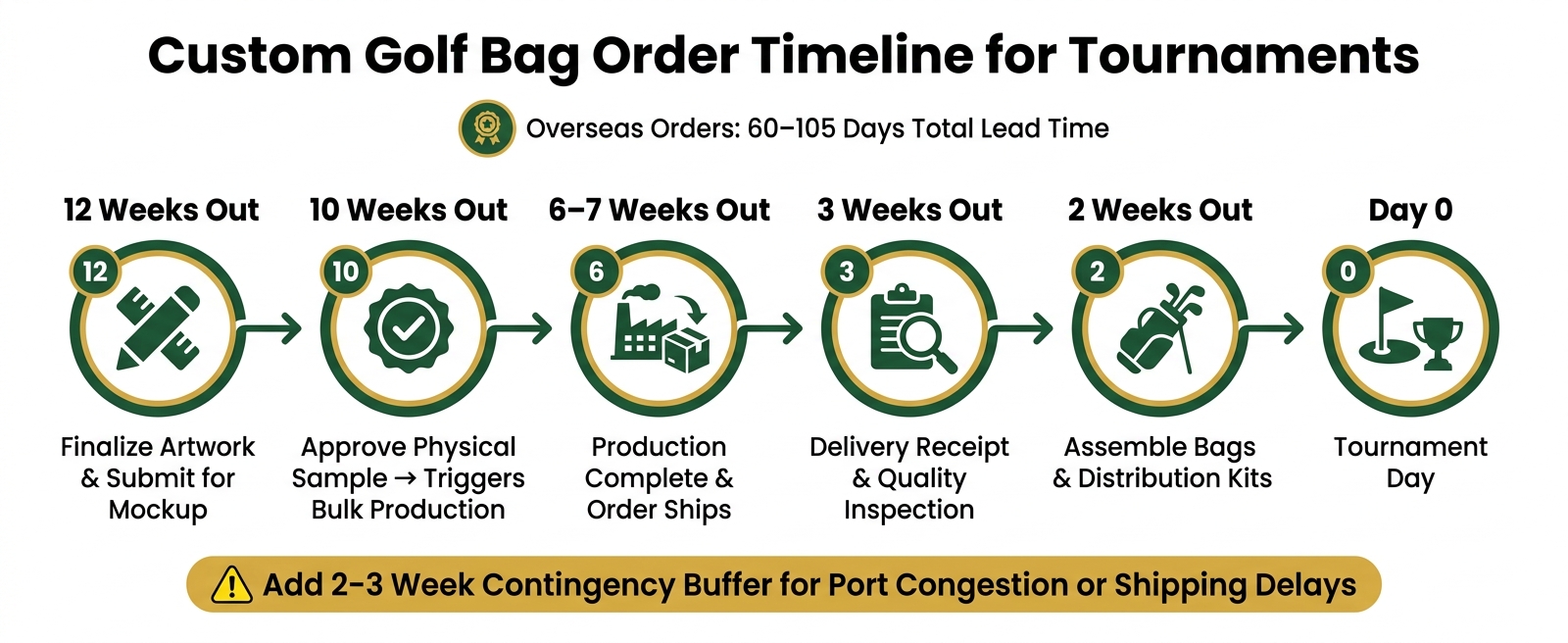
Custom Golf Bag Order Timeline for Tournaments
Quick comparison
| Area to confirm | What I’d lock first | Why it matters |
|---|---|---|
| Bag use | Staff, stand, or cart | Changes layout, weight, and logo space |
| Branding | Vector logos, colors, placements | Helps avoid print and embroidery errors |
| Specs | Dividers, pockets, straps, zippers, material | Keeps quotes and samples aligned |
| Quantity | Final roster plus extras | Helps avoid shortages on event day |
| Timeline | Proof, sample, production, shipping, receipt | Cuts down last-minute problems |
| Delivery | Address, contact, storage, inspection plan | Helps prevent handoff and damage issues |
If I were placing this order, I’d make sure every one of those items is set before the bags move into production.
sbb-itb-4fa7e8b
1. Define Tournament Goals, Bag Use, and Branding Requirements
Start with the bag’s job. That one call affects everything after it: the bag type, where logos go, and how much personalization makes sense.
Confirm the Event Type and Bag Purpose
Use the event brief to narrow the bag type. The event setup and the person getting the bag usually make the choice pretty clear. A corporate outing with players riding in carts needs something different from a high school or college team event where players walk the course. Member-guest events and team competitions come with their own needs too.
You also need to confirm who gets each bag – tournament participants, VIP guests, championship teams, club members, or auction winners – and whether the bag is meant for play, display, or gifting. That tends to narrow the options fast:
| Bag Type | Best For | Key Advantage |
|---|---|---|
| Staff Bag | Tournament champions, major sponsors, or display | Maximum branding surface area |
| Stand Bag | High school or college teams, walking players | Lightweight, retractable legs |
| Cart Bag | Corporate outings, member-guest events | Stable on cart, ample storage |
Pick the format people will see most often on the course, not just the one that looks best in a mockup.
Lock In Sponsor and Team Branding Assets
Once the bag’s purpose is clear, get every branding file in hand before the order moves ahead. A missing vector file or a late sponsor sign-off can slow production.
Collect vector logo files, PMS colors, embroidery-ready versions, and the final roster before production starts. Confirm logo placement, and make sure it’s clear who signs off on final artwork before production starts.
A simple layout usually works best:
- Use the large side panels for the title sponsor or event logo
- Use smaller panels, pockets, or straps for secondary sponsors, player names, or event dates
That pecking order keeps the bag clean and makes the main branding easier to read from a distance.
Set the Exposure Goal for Each Bag
Be clear about what success looks like for these bags. Visibility during play is not the same as a VIP gift or an auction item. Custom golf bags can stay in use for years, extending sponsor exposure beyond the event. That should shape how much you spend on materials and print quality.
If social media is part of the plan, think about how the bags will look in action shots with players carrying them. If the bags are for auctions or VIP gifts, perceived value matters as much as the branding. Set the goal first – on-course visibility, team identity, or sponsor recognition – then match the design and budget to that goal.
Once that’s locked in, move to specs, personalization, and quantities.
2. Confirm Bag Specs, Personalization, and Order Quantities
Once the branding is approved, the next step is to lock the spec sheet. This part matters more than people think. Clear specs cut down quote changes, sample mistakes, and delays in production.
Choose the Right Bag Type and Features
Confirm the exact bag features in writing before you ask for final quotes.
- Cart bags: number of club dividers, pocket layout, cooler pocket, valuables pouch
- Stand bags: strap style (single or dual), leg system fit for the course terrain
- All bags: rain hood and umbrella holder if players will be walking in mixed weather
Keep Perfect Golf can produce custom cart bags, stand bags, and Sunday bags with logo, material, and pattern options. The key is to lock each feature before the quote stage so the sample lines up with the final order.
Finalize Colors, Materials, and Personalization
Once the bag structure is set, lock the colors and personalization details. Use Pantone references for every color element: primary panels, trim, piping, and zippers. “Navy blue” can mean one thing to you and something else to a factory. A Pantone number removes that guesswork.
For materials, choose between nylon, PU, or synthetic leather based on wear needs. If the bags will be used in U.S. tournament weather, call out water-resistant zippers and treated fabrics at the start. For personalization, confirm the method for each branding element. Embroidery works well for durability. Heat transfer fits detailed logos. Also pin down player name placement, font, and size before production begins.
Verify Quantities, Roster Lists, and Budget
Finalize totals for players, staff, and sponsors. Confirm any player names or numbers tied to the order too. It also helps to add a small reserve for replacement bags or late roster changes. Coming up short on event day is much tougher to fix than ordering a few extras at the start.
Budget based on landed cost, not just the factory price. That means freight, duties, inland delivery, and a small reserve for replacements should all be included. Keep tee gifts and tournament prizes on separate budget lines so one doesn’t eat into the other.
With specs and counts locked, you can move straight into mockups, sample approval, and production dates.
3. Build a Timeline for Design Approval, Sampling, and Production
Once specs and quantities are set, turn the order into a calendar. If you skip milestones, problems tend to show up when there’s no time left to fix them.
Work Backward From the Tournament Date
Overseas custom bag orders usually take 60 to 105 days, including sampling, production, and shipping.
The table below lays out a realistic schedule using relative timing. Use the same approach for your own tournament date.
| Milestone | Timing | Notes |
|---|---|---|
| Finalize artwork and submit for mockup | 12 weeks out | – |
| Approve physical sample | 10 weeks out | Triggers bulk production |
| Production completes; order ships | 6–7 weeks out | Bulk shipment departs |
| Delivery receipt and quality inspection | 3 weeks out | Buffer before event |
| Assemble bags and distribution kits | 2 weeks out | Ready for on-site use |
| Tournament Day | Day 0 | – |
Add a 2–3 week contingency on top of this for port congestion or shipping delays.
Once the calendar is set, move straight into proof and sample approval.
Approve Mockups and Samples Before Full Production
There are two checkpoints that help you avoid expensive errors: the digital proof and the physical sample.
The digital proof comes first. Most suppliers send it back within 24 hours of artwork submission. Check it closely for logo placement and color match. After that, the supplier makes a physical sample, which usually takes 7–10 days. Review the material, embroidery, zippers, and overall shape.
Don’t start bulk production until the physical sample is approved. That sample becomes the standard for the full run. Set AQL Level II quality limits so major defects stay under 2.5% and minor defects stay under 4.0%.
After sign-off, production should move forward using that same approved spec.
Use One Approval Trail for Design, Sampling, Inspection, Packaging, and Shipping
Keep design, sampling, inspection, packaging, and shipping in one approval log. It sounds simple, but it saves a lot of back-and-forth later.
Before the shipment leaves the factory, confirm the delivery date and inspection date. That way, everyone is working from the same record, and there’s less room for missed details.
4. Inspect Quality, Plan Delivery, and Prepare for On-Site Use
Once the sample is approved and production is done, the job shifts from approval to receipt. At this stage, you need to inspect, receive, and stage each bag before tournament day.
Run a Receipt and Quality Inspection Checklist
Open every box as soon as it arrives. Compare each bag against the approved sample and confirm the full unit count on arrival.
If the branding looks off or the hardware shows damage, the bags lose impact on the course. Go through each one using these four categories:
| Inspection Category | Specific Checkpoints |
|---|---|
| Branding | Logo placement, embroidery quality, color match, names, and numbers |
| Hardware | Zippers, closures, leg stability, straps, and internal layout |
| Materials | Stitching, fabric condition, dividers, and base stability |
| Inventory | Total unit count vs. order quantity; included accessories such as rain hoods |
Under AQL Level II standards, major defects should stay under 2.5% and minor defects under 4.0%. If anything lands outside those limits, contact your supplier right away. The industry standard for defect claims is acknowledgment within 7 days and resolution within 14 days.
Store approved bags in a dry, climate-controlled space. It also helps to assign one logistics lead to handle receiving so nothing slips through the cracks.
Schedule Delivery at Least 1–2 Weeks Before the Event
Plan to receive and inspect bags 1–2 weeks before the event, or 4–6 weeks ahead for large orders. That extra time gives you room to deal with defects or replace missing items.
Before the shipment leaves the factory, confirm the delivery address, on-site contact name, and storage plan with your logistics lead. If the venue can’t hold 100+ bags on-site, set up off-site storage and schedule delivery to the course 1–2 weeks before the event.
For international shipments, build in time for customs clearance and inland delivery on top of ocean freight. That step can add 3–7 days.
Plan Distribution and Display for Maximum Visibility
After inspection, the focus shifts from quality control to event-day setup.
Decide where the bags will appear first. Placement shapes who sees the branding and when they see it. Your distribution plan should put sponsor logos in front of players, guests, and cameras. Group bags by foursome at registration to speed up handoff. For VIP players or key sponsors, keep a separate, clearly labeled set ready for immediate handoff.
Large side panels on staff bags offer the most surface area for sponsor logos and primary branding.
With the bags inspected, stored, and assigned, the order is ready for final sign-off.
Conclusion: Final Checks Before You Place Your Order
Do one final review before you submit the order. It’s a simple step, but it can save you from delays, extra work, and last-minute problems that hurt how the brand shows up at the tournament.
The Core Checklist to Review One Last Time
Before placing the order, make sure these six items are locked in:
- Artwork approval: A signed-off digital proof with correct logo placement, color values, and spelling on every personalized element
- Bag specs: Bag type (Staff, Stand, or Cart), materials, trim, piping, and zipper colors confirmed against brand requirements
- Quantities and personalization: Final roster verified, player names and numbers confirmed, and order quantity meeting minimum order quantity requirements
- Budget and landed cost: Total cost confirmed, including all freight, duties, and delivery
- Production and shipping schedule: Timeline works backward from the tournament date with a receipt window of at least 1–2 weeks before the event
- Point person: One point person assigned to receipt, inspection, and distribution
Once every box is checked, the bags can arrive ready to represent the brand at the tournament.
FAQ
How early should I order custom tournament bags?
Plan to place your order several months ahead of time. Standard production often takes 4 to 6 weeks. If you add custom touches like embroidery or specialty printing, it can take longer.
For premium or more complex bags, it’s smart to order 3 to 4 months before your tournament. That gives you time to avoid rush fees, check the bags when they arrive, and fix anything that needs attention. Keep Perfect Golf can help with design, sampling, and production.
What files do I need before production starts?
Before production starts, send over the full design and tech package. That should include:
- High-resolution logo files in vector formats like AI, EPS, or PDF
- Exact Pantone color codes
- Clear logo placement details and instructions for any custom features
- Final quantities, bag style, material specs, and shipping details
How many extra bags should I order?
Base your order on your final player count and any last-minute changes you expect. Try to lock in the number at least two weeks before the tournament.
Most suppliers set minimum order quantities at 100 to 200 bags. Because of that, adding a small buffer often costs less than placing a second order later.
Check deliveries four to six weeks before the event so you have time to spot shortages or defects and get them fixed.
Related Blog Posts
- How to Order Bulk Custom Golf Bags: Wholesale Pricing & Timeline
- From Design to Delivery: A Behind-the-Scenes Look at Our Custom Process
- What are the most effective B2B procurement strategies for sourcing custom-manufactured golf bags, and how do they differ from sourcing off-the-shelf products?
- Tournament Golf Bags vs. Standard Golf Bags

 Français
  English
  Português
  Español
  日本語
日本語