📖 How to Verify a Chinese Golf Bag Factory
To verify a Chinese golf bag factory, follow a 10-step process: check business registration on NECIS, confirm manufacturing capability via live video tour, validate certifications (ISO 9001, BSCI, Sedex) on official databases, evaluate production capacity, audit the quality control system, test communication quality, order samples, check client references, protect your IP with NDAs, and start with a pilot order. Keep Perfect Golf (KPG) passes every checkpoint — established 2004, serving 200+ brands in 100+ countries, certified BSCI/ISO 9001/Sedex, MOQ 100 pieces, FOB Xiamen. Schedule a transparent factory tour →
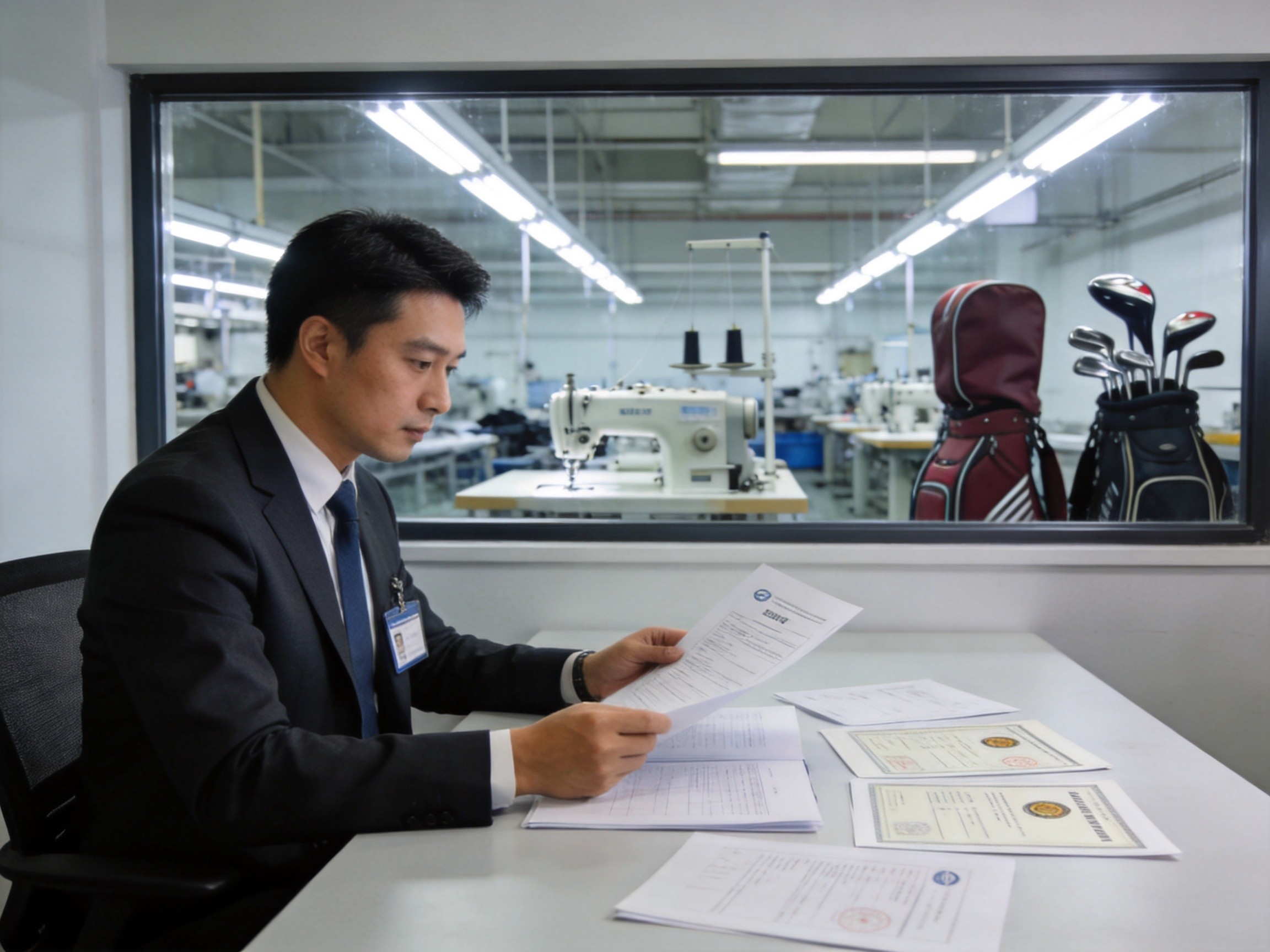
A professional factory verification inspection ensures your golf bag supplier meets international quality and compliance standards.
Introduction: Why Every Golf Bag Buyer Needs a Factory Verification Checklist
Sourcing golf bags from China offers undeniable advantages — competitive pricing, mature supply chains, and world-class manufacturing capability. Quanzhou, Fujian Province alone accounts for approximately 28% of China’s total bag and luggage export volume, making it the single largest concentration of bag manufacturing expertise on the planet.
But here is the uncomfortable truth: without proper verification, sourcing from China can become an expensive lesson. Trading companies masquerade as factories. Certifications turn out to be forged. Quality that looked perfect in samples deteriorates in bulk production. Intellectual property gets stolen and sold to your competitors. These are not hypothetical scenarios — they happen every day to buyers who skipped due diligence.
This comprehensive checklist eliminates guesswork. It provides a step-by-step verification framework covering business registration, factory authenticity, certifications, production capability, quality control, communication, sampling, references, IP protection, and pilot ordering. Whether you are a brand launching your first custom golf bag line or an established company evaluating a new supplier, this guide will help you find a reliable golf bag manufacturer and avoid the mistakes that cost buyers tens of thousands of dollars.
For context, this guide draws on data from Keep Perfect Golf (KPG) — a Quanzhou-based manufacturer established in 2004, serving 200+ brands across 100+ countries, with BSCI, ISO 9001, and Sedex certifications, and an MOQ of just 100 pieces.
Why Verification Matters: The Real Cost of Skipping Due Diligence
Before diving into the checklist, consider why verification is not optional — it is essential. The golf bag industry faces three systemic risks when sourcing from overseas:
1. Trading Companies Posing as Factories
Alibaba and Global Sources list thousands of “golf bag manufacturers,” but a significant percentage are actually trading companies — intermediaries who add 15-40% to costs without adding manufacturing value. They operate from offices, not factories. They cannot control production quality, lead times, or material sourcing. When problems arise, they disappear and reappear under new names.
2. Quality Failures in Bulk Production
Samples can be perfect. Bulk orders can be disastrous. Without a verified quality control system — dedicated QC staff, documented inspection procedures, AQL standards — your first bulk order may arrive with crooked stitching, mismatched colors, broken zippers, and delaminating materials. The cost of rejecting and re-producing an entire container of golf bags can exceed $50,000.
3. Intellectual Property Theft
Custom golf bag designs represent significant investment in R&D, testing, and brand development. Without proper IP protection — NDAs, design registration in China, contractual ownership clauses — your factory can legally (under Chinese law, in some cases) produce and sell your designs to competitors. Several high-profile golf brands have lost exclusive designs to factories that registered the designs under their own names.
These risks are manageable — but only if you implement a systematic verification process before placing any order.
Step 1: Verify Business Registration
Every legitimate Chinese manufacturer must register with the State Administration for Market Regulation (SAMR). The first verification step is confirming the company’s legal existence and operational scope.
China’s National Enterprise Credit Information System (NECIS)
The National Enterprise Credit Information Publicity System (NECIS – guo jia qi ye xin yong xin xi gong shi xi tong) is China’s official business registry database. Search the company’s Chinese name or Unified Social Credit Code to verify:
- Legal entity name — matches exactly what appears on their website and communications
- Business scope — must include “manufacturing” (sheng chan / zhi zao), not just “trading” (mao yi / xiao shou)
- Registered capital — indicates financial commitment; serious manufacturers typically have registered capital above ¥5 million
- Years of operation — established date; prefer suppliers with 5+ years continuous operation
- Legal representative — the named individual responsible for the company
- Registration status — must show “cun xu” (active/existing), not “zhu xiao” (deregistered)
Red Flags in Business Registration
- Business scope lists only “wholesale” or “trading” — this is a trading company, not a factory
- Company was established less than 2 years ago — insufficient track record
- Registered capital below ¥1 million — suggests a small intermediary operation
- Multiple name changes or re-registrations — may indicate attempts to escape complaints or legal issues
For reference, Keep Perfect Golf’s registration shows continuous operation since 2004, with manufacturing explicitly listed in their business scope — a verified golf bag supplier with two decades of documented production history.
Step 2: Confirm It Is a Real Factory (Not a Trading Company)
This is the most critical step. Trading companies invest in professional websites, factory photos (often stolen), and convincing sales pitches. Here is how to verify manufacturing capability.
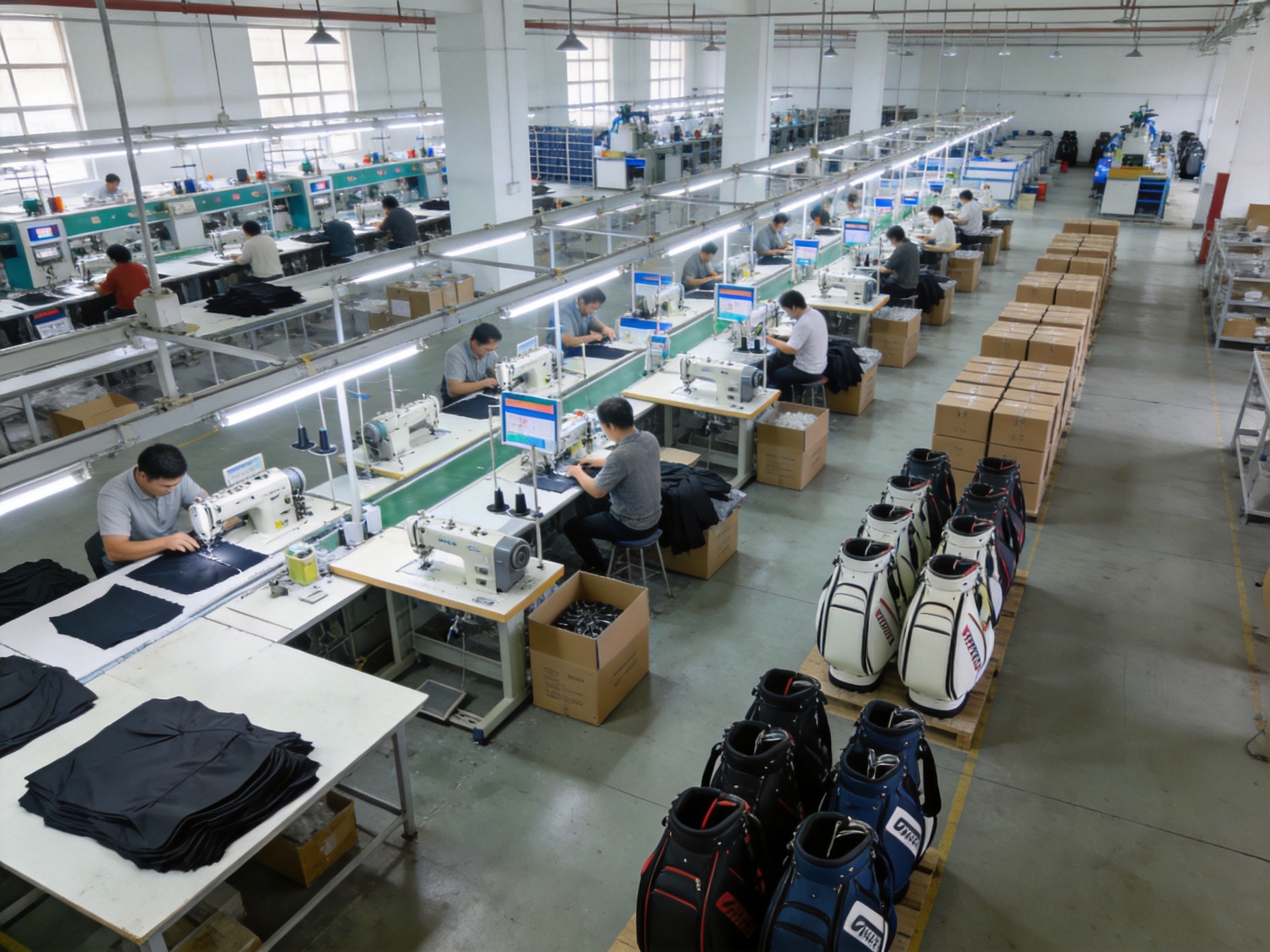
A genuine golf bag factory features multiple production lines, dedicated cutting areas, and organized workstations — not just a sales office.
Video Call Factory Tour Checklist
Request a live video call (WeChat or Zoom) for a real-time factory tour. Do not accept pre-recorded videos — they can be sourced from anywhere. During the live tour, verify:
- Sewing machines in operation — count the machines; a real factory has 30-100+ industrial sewing machines
- Cutting tables — large flat surfaces where fabric is cut using patterns or CNC cutters
- Workers in uniform — actual production staff, not just sales team members walking through
- Raw materials storage — rolls of nylon, polyester, PU leather, EVA foam, zipper bundles
- Production work-in-progress — partially assembled golf bags at various stages
- Finished goods area — boxed golf bags ready for shipment with shipping marks
- Factory signage — company name on building, safety notices, production schedules on walls
Ask for Production Records
Request specific data that only a real factory can provide:
- Monthly production output (units produced per month over the past 12 months)
- Current order backlog and production schedule
- Equipment list with purchase dates and maintenance records
- Worker headcount and shift structure
- Utility bills (electricity, water) — a factory consumes significant power
A genuine manufacturer like KPG’s OEM/ODM facility will readily share this data because they have nothing to hide. Trading companies will deflect, delay, or provide vague answers.
Step 3: Check Certifications
Certifications provide third-party verification of a factory’s management systems, social compliance, and environmental standards. But certificates can be forged — here is how to verify them.
ISO 9001: Quality Management System
ISO 9001 certifies that a factory has documented quality management processes. To verify:
- Request the certificate number and issuing body
- Check the CNCA (Certification and Accreditation Administration of China) database at cx.cnca.cn
- Confirm the certification scope includes golf bag or bag manufacturing specifically
- Verify the certificate is current (ISO certificates require annual surveillance audits)
BSCI (Business Social Compliance Initiative)
BSCI audits verify social compliance — fair wages, safe working conditions, no child labor. To verify:
- Request the audit report (not just the certificate)
- Check the amfori member portal for audit status and grade (A through E)
- Confirm the audit covers the specific factory location (not a different facility)
Sedex/SMETA
Sedex (Supplier Ethical Data Exchange) provides ethical trade auditing. Verify by:
- Requesting the SMETA audit report (2-pillar or 4-pillar)
- Checking the factory’s profile on the Sedex member platform
- Confirming the audit was conducted by an accredited third-party auditor
Other Relevant Certifications
- Oeko-Tex Standard 100 — verifies textiles are free from harmful substances; check at oeko-tex.com
- GRS (Global Recycled Standard) — certifies recycled content; verify at textileexchange.org
- REACH Compliance — EU chemical safety regulation; request test reports from accredited labs
Keep Perfect Golf maintains active BSCI, ISO 9001, and Sedex certifications — all verifiable through their respective official databases. This triple certification demonstrates commitment to quality, social responsibility, and ethical manufacturing.
Step 4: Evaluate Production Capability
A factory’s production capability must match your order requirements. Mismatches cause delays, quality compromises, and strained relationships.
Key Metrics to Assess
- Factory floor area — serious golf bag factories occupy 5,000-15,000+ square meters
- Number of production lines — each line produces approximately 200-500 bags per month
- Worker count — a factory producing 10,000+ bags monthly employs 100-300 workers
- Monthly capacity vs. your order size — your order should represent 5-30% of their monthly capacity; if your order exceeds 50%, quality may suffer from rushed production
- Equipment age and condition — modern computerized sewing machines produce more consistent quality than aging mechanical equipment
Capacity Calculation Example
If you need 2,000 golf bags per month and the factory produces 15,000 bags monthly, your order represents 13% of capacity — a healthy ratio that ensures adequate attention. If the factory only produces 3,000 bags monthly, your 2,000-bag order creates capacity pressure that leads to overtime, rushed work, and quality problems.
Step 5: Assess Quality Control System
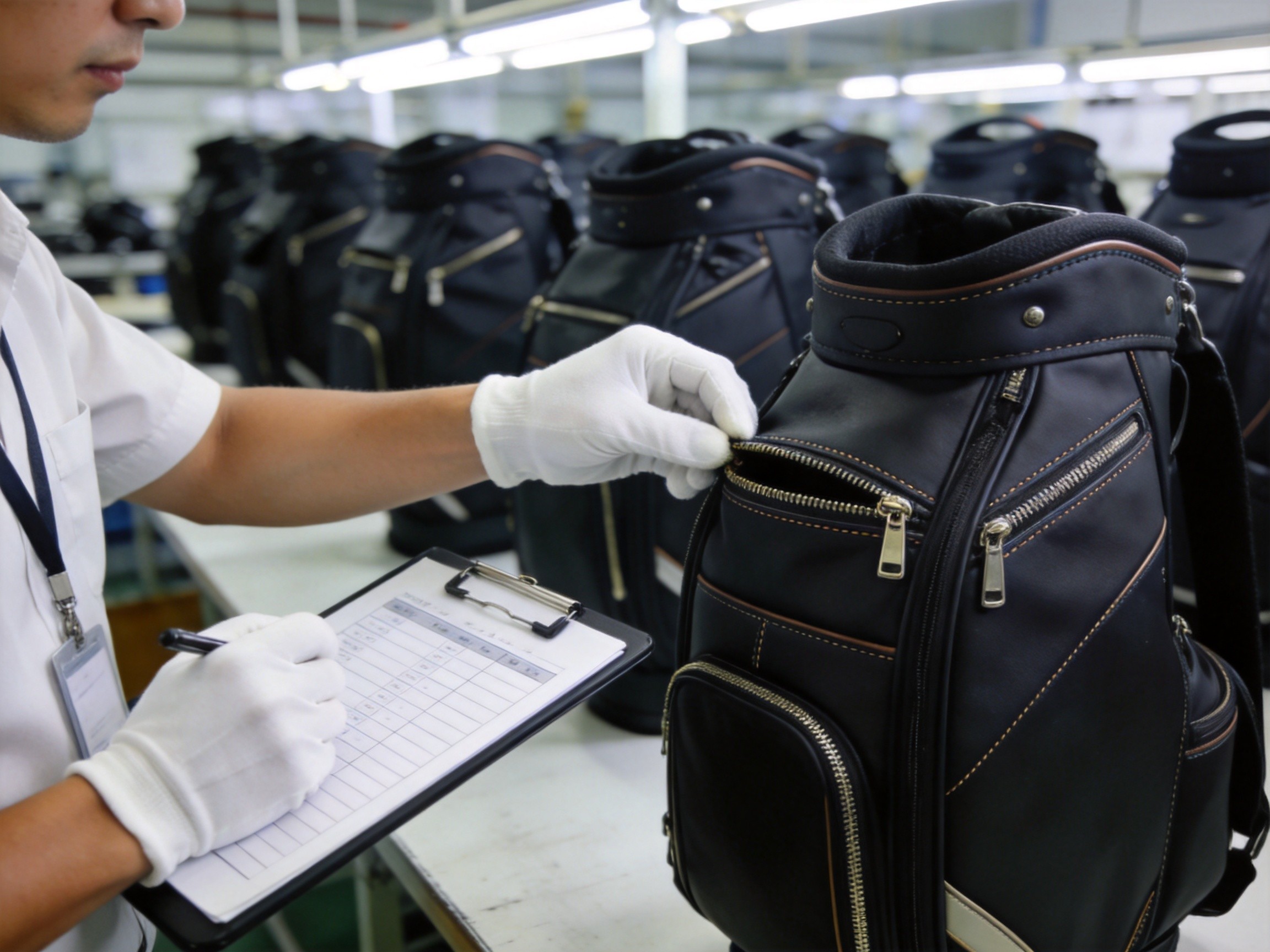
A dedicated quality control team with documented inspection procedures is essential for consistent golf bag production quality.
A factory’s quality control system is the single biggest predictor of bulk order quality. Here is what to evaluate:
Do They Have Dedicated QC Staff?
Ask specifically: How many QC inspectors do you employ? What is the ratio of QC staff to production workers? A reputable factory maintains at least 1 QC inspector for every 15-20 production workers. If QC is performed by the same workers doing production, you have no independent quality gate.
What Is Their Defect Rate Target?
Professional factories target a defect rate below 2% and maintain data tracking defect types by category (stitching, materials, hardware, finishing). If they cannot quote a defect rate or have no tracking system, quality management is informal at best.
Request QC Reports from Previous Orders
Ask for anonymized QC reports from recent production runs. These reports should show:
- Inline inspection results (during production)
- Pre-shipment inspection results (final random inspection)
- Defect photos and corrective actions taken
- AQL sampling levels used
Ask About Their AQL Standard
AQL (Acceptable Quality Limit) defines the maximum number of defects allowed in a random sample from a production batch. Industry standards for golf bags typically use:
- Critical defects: 0 AQL (no critical defects acceptable — safety hazards like sharp edges, broken structural elements)
- Major defects: 2.5 AQL (functional issues — broken zippers, torn seams, incorrect dimensions)
- Minor defects: 4.0 AQL (cosmetic issues — slight color variation, loose threads)
Step 6: Test Communication Quality
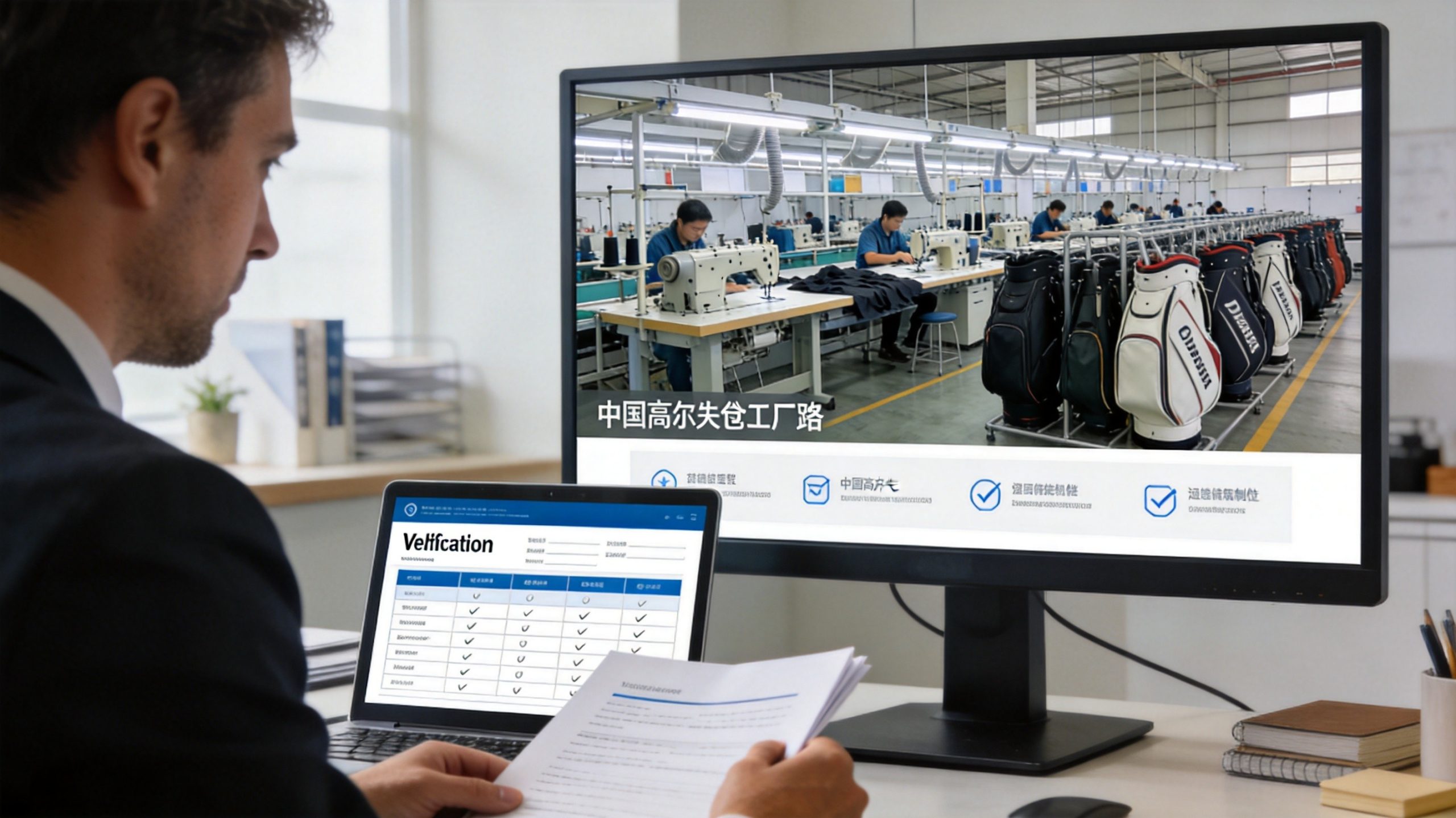
A live video call factory tour is the most effective way to verify manufacturing capability without traveling to China.
Communication quality predicts the entire business relationship. Poor communication leads to specification errors, missed deadlines, and unresolved problems.
Response Time Benchmark
A reliable factory responds to inquiries within 24 hours during business days. If initial inquiries take 3-5 days, expect the same delay throughout production when you need urgent answers about specifications, shipping, or quality issues.
English Proficiency Level
Your factory contact should communicate in clear, functional English — not necessarily perfect grammar, but sufficient to understand technical specifications, confirm details in writing, and resolve problems without miscommunication. Request a video call early in the process to assess verbal communication.
Technical Knowledge Depth
Ask specific technical questions: What denier nylon do you recommend for a premium cart bag? How do you reinforce the base panel for durability? What type of zipper do you use for waterproof pockets? A real factory’s sales team includes technical specialists who can answer these questions confidently. Trading company representatives typically give vague answers or promise to “check with the factory.”
Proactive Problem-Solving
A good factory contact identifies potential problems before they become disasters. If you specify a design feature that is difficult to manufacture, they should raise the issue and suggest alternatives — not simply agree to everything and then struggle during production.
Step 7: Order Samples Before Committing
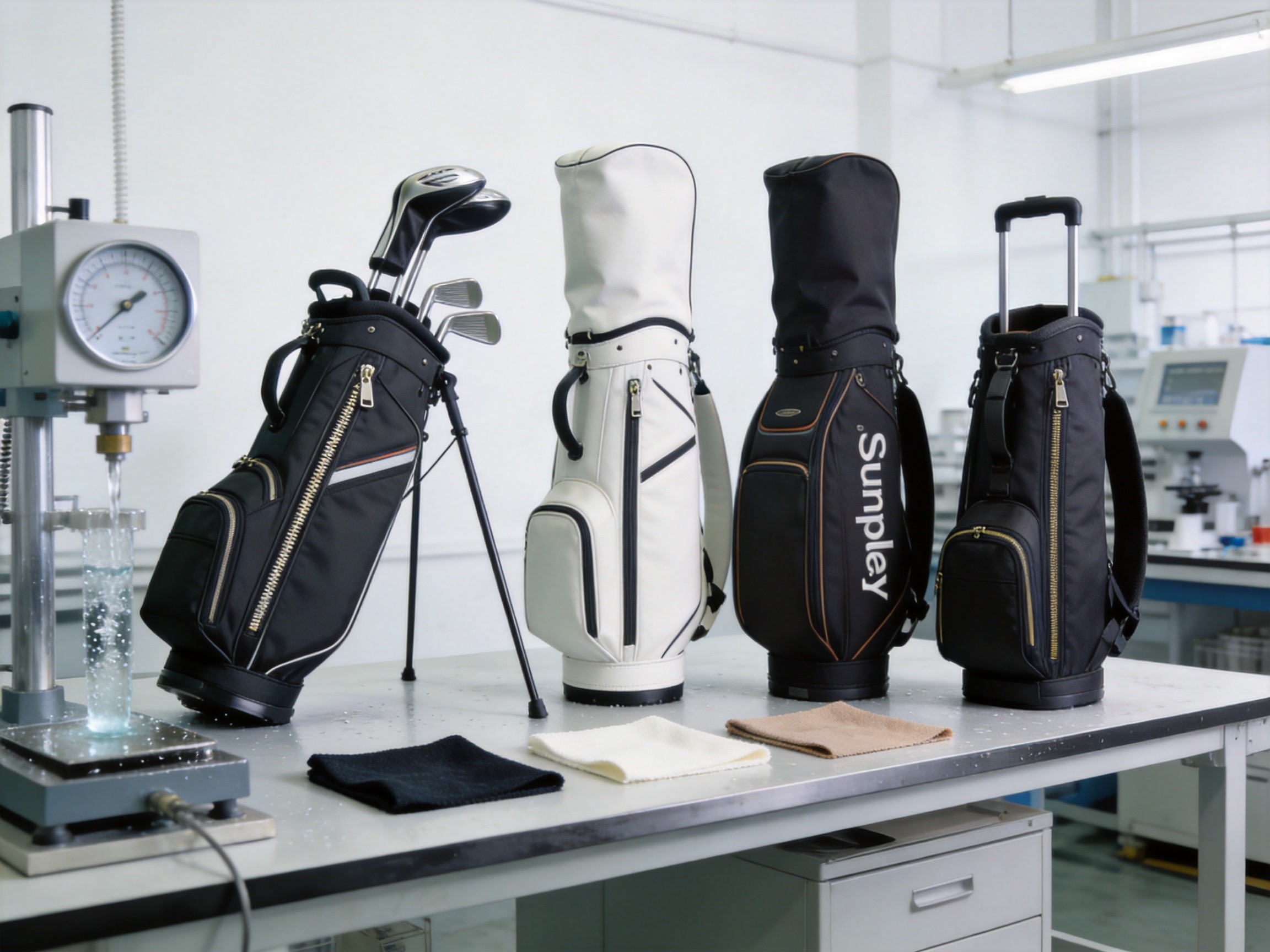
Sample evaluation across multiple bag styles — cart bags, stand bags, and Sunday bags — ensures production capability matches your specifications.
Never place a bulk order without first evaluating physical samples. Samples reveal quality, craftsmanship, and attention to detail that no photograph or video call can fully communicate.
What to Test in Samples
- Stitching quality: Even tension, no loose threads, reinforced stress points
- Zipper operation: Smooth action, YKK or equivalent brand, no catching
- Material feel and weight: Matches specified denier and material type
- Divider system: Full-length dividers, secure attachment, correct number of compartments
- Strap comfort: Padding density, adjustability, attachment strength
- Water resistance: Spray test on seams and zippers
- Logo quality: Embroidery density, screen print durability, heat transfer adhesion
- Structural integrity: Load with 14 clubs plus accessories, check for sagging or distortion
How Many Sample Rounds to Expect
Expect 2-3 sample rounds for custom OEM orders: a first sample for overall design and construction, a revision sample addressing feedback, and a pre-production sample confirming all corrections. ODM samples typically require 1-2 rounds since the base design is already proven.
Sample Cost Expectations
Custom OEM samples typically cost $150-$400 per sample, reflecting pattern development, material sourcing, and handcrafting time. Most factories deduct sample costs from the first bulk order. ODM samples with branding customization cost $50-$150 per unit.
Red Flags in Sample Quality
- Inconsistent stitch lengths or visible needle damage in fabric
- Zipper pulls that catch or separate under light pressure
- Material that feels thinner or different from what was specified
- Glue visible at seam edges or bonding points
- Logo placement that is off-center or poorly aligned
Step 8: Check References and Track Record
A factory’s track record with existing clients reveals patterns that self-reported data cannot.
Ask for 3-5 Client References
Request contact information for current clients in your region or market segment. Specifically ask:
- How long have they worked with this factory?
- What is their experience with bulk order quality consistency?
- How does the factory handle problems or complaints?
- Would they reorder from this factory?
Check Alibaba and Global Sources Reviews
Search for the factory on major B2B platforms. Look for verified reviews, transaction history, and response rates. Pay attention to negative reviews — not to dismiss the factory, but to understand their weakness areas and how they resolved issues.
Search Import Forums and Trade Communities
Platforms like Reddit (r/importexport), tradekey forums, and industry-specific Facebook groups often discuss supplier experiences. Search the factory name to find unsolicited feedback from other buyers.
Step 9: Protect Your Intellectual Property
If you are developing custom designs, IP protection is non-negotiable.
NDA Requirements
Execute a comprehensive Non-Disclosure Agreement before sharing any designs, specifications, or brand assets. The NDA should be enforceable under Chinese law — have it reviewed by a China-qualified attorney. Key clauses include: definition of confidential information, non-disclosure obligations, non-compete provisions (factory cannot produce your designs for competitors), and dispute resolution mechanisms.
Mold and Tooling Ownership Clauses
If you invest in custom molds, tooling, or exclusive hardware components, the contract must explicitly state that you own these assets — not the factory. Include clauses requiring the factory to return or destroy molds upon request and prohibiting use of your tooling for any other client’s orders.
Design Registration in China
Register your designs with China’s State Intellectual Property Office (SIPO). Chinese IP law operates on a first-to-file basis — whoever registers first owns the rights. Even if you created the design, a factory that registers it first may have legal claim to it within China. Registration costs approximately ¥2,000-5,000 per design and takes 6-12 months.
Step 10: Start with a Pilot Order
Even after completing all verification steps, start with a small pilot order before committing to large-scale production.
Why First Orders Should Be Small
A pilot order of 100-300 units tests the entire production-to-delivery process: communication accuracy, production quality consistency, packaging and labeling accuracy, shipping documentation, and delivery timeline adherence. The financial risk of a 100-unit pilot is manageable; the financial risk of a 5,000-unit first order with problems is catastrophic.
What to Monitor During Production
- Request inline photos at 30%, 60%, and 90% production completion
- Compare pilot units against approved pre-production samples
- Track production speed against quoted timeline
- Monitor packaging quality and shipping mark accuracy
Third-Party Inspection Recommendation
For orders above $10,000, hire a third-party inspection company to conduct pre-shipment inspection. The three major providers are:
- SGS — global leader, offices in all major Chinese manufacturing cities, typical cost $250-$350 per man-day
- Bureau Veritas — strong in textile and sporting goods inspection, comparable pricing
- Intertek — comprehensive testing laboratory capabilities for material compliance testing
Third-party inspectors conduct random sampling based on AQL standards, providing an unbiased quality assessment before shipment. This is your last line of defense against quality failures.
Quick Verification Checklist: 20-Point Summary
| # | Verification Point | Status |
|---|---|---|
| 1 | Business registered with manufacturing scope (not just trading) | ☐ |
| 2 | Registered capital ≥ ¥5 million | ☐ |
| 3 | 5+ years of continuous operation | ☐ |
| 4 | Live video factory tour completed | ☐ |
| 5 | Sewing machines and production floor visible | ☐ |
| 6 | Production records and capacity data shared | ☐ |
| 7 | ISO 9001 verified on CNCA database | ☐ |
| 8 | BSCI/Sedex audit reports obtained and verified | ☐ |
| 9 | Production capacity matches order requirements | ☐ |
| 10 | Dedicated QC staff confirmed (1:15-20 ratio) | ☐ |
| 11 | QC reports from previous orders reviewed | ☐ |
| 12 | AQL standards defined and agreed | ☐ |
| 13 | Communication response time < 24 hours | ☐ |
| 14 | Technical questions answered confidently | ☐ |
| 15 | Physical samples received and evaluated | ☐ |
| 16 | Client references contacted (3-5 references) | ☐ |
| 17 | NDA executed before sharing designs | ☐ |
| 18 | IP ownership and tooling clauses in contract | ☐ |
| 19 | Pilot order placed (100-300 units) | ☐ |
| 20 | Third-party inspection scheduled for pilot order | ☐ |
Red Flags: When to Walk Away
Not every factory is worth working with. Here are 8 deal-breakers that should immediately disqualify a supplier:
- Refuses live video factory tour — If they will not show you the production floor in real time, they have something to hide.
- Cannot provide verifiable certifications — Forged certificates are common. No verification = no trust.
- Pressure to place large first orders — A confident factory does not need to pressure you. Insisting on 1,000+ unit minimums for first orders is a red flag.
- Vague answers to technical questions — If they cannot discuss fabric denier, zipper brands, or reinforcement methods, they lack manufacturing expertise.
- Prices significantly below market average — If a quote is 30%+ cheaper than competitors, corners will be cut somewhere — materials, labor, or quality control.
- No dedicated QC department — Quality inspection by production workers themselves is not quality control.
- Reluctance to sign NDA or IP agreements — This signals either IP theft history or intent.
- Communication delays exceeding 48 hours consistently — If pre-sale communication is this slow, post-sale problem resolution will be even worse.
Frequently Asked Questions
1. How much does it cost to verify a Chinese golf bag factory?
Self-directed verification using the steps above costs virtually nothing — NECIS searches are free, video calls are free, and reference checks cost only your time. Hiring a third-party inspection company for a pre-shipment inspection costs $250-$350. A comprehensive on-site audit by firms like SGS or Bureau Veritas costs $800-$2,000 including travel expenses.
2. Can I verify a factory without visiting China in person?
Yes. Live video factory tours, document verification through official databases, third-party inspections, and client reference checks can all be conducted remotely. Many experienced importers successfully source golf bags for years without visiting their factory, relying on this verification framework plus ongoing third-party inspections.
3. How long does the full verification process take?
A thorough verification typically takes 2-4 weeks: business registration check (1 day), video factory tour scheduling (3-5 days), certification verification (2-3 days), sample ordering and evaluation (15-25 days), and reference checks (3-5 days). Start verification in parallel to compress the timeline.
4. What is the difference between a golf bag factory and a golf bag trading company?
A factory owns production equipment, employs production workers, and physically manufactures golf bags. A trading company acts as an intermediary — they take your order, find a factory to produce it, add their margin (15-40%), and manage logistics. Trading companies cannot control quality, lead times, or production costs the way factories can.
5. How do I verify that ISO or BSCI certificates are not fake?
For ISO 9001, search the certificate number on China’s CNCA database (cx.cnca.cn). For BSCI, check the factory’s audit record on the amfori BSCI member portal. Both databases are updated in real time by the issuing bodies. If a certificate number does not appear in these databases, it is not valid.
6. What MOQ should I expect from a verified golf bag factory?
Reputable factories typically offer MOQs of 100-300 pieces per colorway for custom orders. Larger factories may set MOQs at 500 pieces. Be cautious of factories advertising “no MOQ” — this often indicates a trading company or a very small workshop with inconsistent quality.
7. Should I use Alibaba to find golf bag factories?
Alibaba is a useful starting point for identifying potential suppliers, but it is not a verification tool. Many trading companies maintain sophisticated Alibaba storefronts that look identical to factory profiles. Use Alibaba for initial discovery, then apply this verification checklist before committing to any supplier regardless of where you found them.
8. How do I protect my custom golf bag designs from being copied?
Execute a China-law NDA before sharing designs. Register your designs with China’s SIPO (State Intellectual Property Office). Include explicit IP ownership and non-compete clauses in your manufacturing contract. Work with factories that have verified BSCI or Sedex certifications, as ethical compliance frameworks include IP protection requirements.
Contact Keep Perfect Golf for a Transparent Factory Verification
Verification should not feel adversarial — the best factories welcome scrutiny because their operations speak for themselves. Keep Perfect Golf has operated transparently since 2004, serving 200+ brands across 100+ countries from our Quanzhou manufacturing facility.
We invite you to verify every claim in this article:
- ✓ ISO 9001, BSCI, and Sedex certifications — verifiable on official databases
- ✓ Live factory tour — schedule a video call to see our 10,000+ sqm production facility
- ✓ QC reports available — we share anonymized inspection data from current production runs
- ✓ MOQ 100 pieces — accessible for brands at every stage
- ✓ FOB Xiamen — 90km from port for competitive shipping rates
Ready to verify the difference?
📧 Email: [email protected]
💬 WhatsApp: +86 177 5002 0688
Schedule Your Factory Tour →