
If you walk most rounds, a lighter bag usually makes more sense. If you ride, travel, or use the bag hard, a heavier-duty bag often pays off over time.
I’d break it down like this:
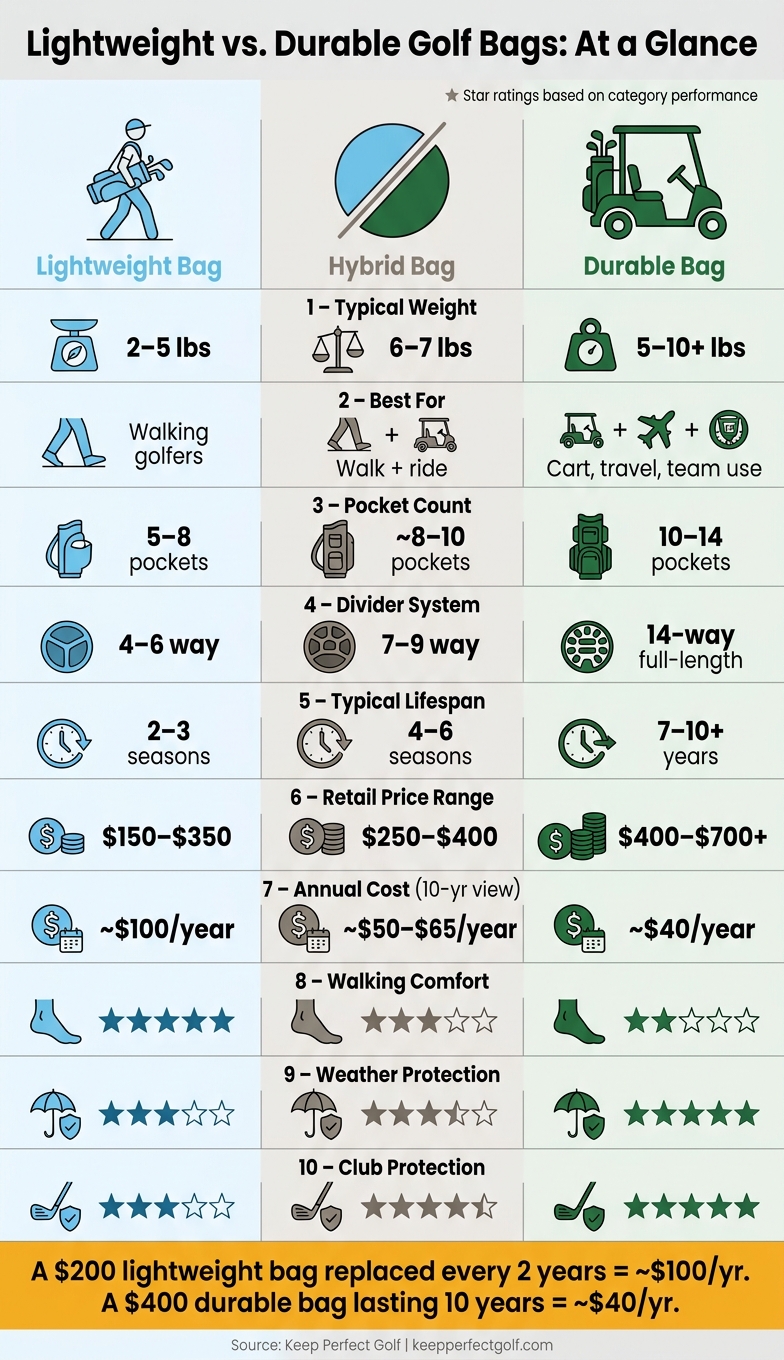
- Lightweight bags are usually 2 to 5 lbs and work best for walking.
- Durable bags are usually 5 to 10+ lbs and fit cart use, team use, and heavy wear better.
- Lighter bags are easier on your shoulders, but they often give up storage, structure, and lifespan.
- Heavier bags tend to have stronger fabric, better dividers, and tougher hardware, but they can feel like too much if you carry them for 18 holes.
- Over time, cost can flip: a $200 bag replaced every 2 years can cost more per year than a $400 bag that lasts 10 years.
In short, this choice comes down to four things:
- Peso
- Comfort
- Protection
- How long the bag lasts
Lightweight vs. Durable Golf Bags: Cost, Weight & Performance Compared
The Ultimate Golf Bag Buying Guide – What Golf Bag Should I Buy?
sbb-itb-4fa7e8b
Comparación rápida
| Bag Type | Best For | Typical Weight | Main Tradeoff |
|---|---|---|---|
| Lightweight | Walking golfers | 2 to 5 lbs | Easier to carry, but less structure and shorter life |
| Durable | Cart golfers, travel, team use | 5 to 10+ lbs | More protection and storage, but heavier |
| Hybrid | Golfers who walk and ride | 6 to 7 lbs | Middle ground, with no single area maxed out |
If I were choosing, I’d start with how the bag will be used most often, not just the number on the spec sheet. That one choice usually tells you which side of the lightweight vs. durable tradeoff fits best.
Material and Construction Differences
Fabrics, Denier Ratings, and Reinforcements
Lightweight bags usually use 210D–420D fabrics, often ripstop nylon. That grid pattern helps stop a small tear from turning into a bigger mess. Durable bags, on the other hand, tend to use 840D–1680D ballistic nylon or Cordura. Those materials handle tears and abrasion better, but they also make the bag heavier.
That tradeoff matters. Nylon has a strong strength-to-weight ratio, which is why it shows up so often in carry bags that weigh under 5 lbs.
Durable bags also tend to add reinforced side panels y thicker divider walls. That helps the bag keep its shape and gives clubs more protection. Lightweight bags usually cut back on internal supports to save weight. The downside? Pockets can sag, and stand stability can be weaker. From there, everything else starts to follow: frame strength, zipper life, and stand performance.
| Material | Durability | Water Resistance | Maintenance |
|---|---|---|---|
| Ripstop Nylon | High | High (with coating) | Low |
| Polyester Canvas | Very High | Moderate | Moderate |
| Cordura/Ballistic Nylon | Extreme | High | Low |
| Synthetic (PU) Leather | Moderate to High | High | Low |
Frames, Zippers, and Stand Mechanisms
The same push and pull shows up in the frame and hardware. Lightweight bags often use carbon fiber or aluminum stand legs, which usually weigh 0.3–0.8 lbs. Heavier-duty bags often use steel stands, and those usually come in at 0.8–1.2 lbs. Steel adds weight, but it tends to bring better stability and a longer service life.
Then there are the zippers. If you’re comparing bags, this is one area you don’t want to gloss over. Zippers are the most common failure point across golf bags, and they appear in more than 40% of negative Amazon reviews. Durable bags often use heavy-duty tracks like YKK with reinforced anchor points. Lighter bags often go with simpler hardware to keep weight down.
Full-length dividers help too. They prevent grip lock and cut down on club wear, which can make a big difference over a full season of walking and loading clubs in and out.
These construction choices affect how the bag feels to carry, how much gear it holds, and how well it protects your clubs during a round.
On-Course Performance: Comfort, Storage, and Club Protection
Walking Comfort and Load Distribution
You feel these build choices the moment the bag is full and on your shoulders. Over 18 holes, a few pounds can make a big difference. Lightweight stand bags are made for walkers, so they usually come with dual-strap systems, ergonomic back panels, and hip padding that spread weight across your core.
Cart and hybrid bags in the 7–10 lb range are a different story. They’re built to sit on a cart, not ride on your back for four-plus hours. Most don’t have the harness setup that makes walking easier. And over a full round, that extra weight can start to wear down your shoulders and lower back.
That said, the number on the spec sheet doesn’t tell the whole story. A well-balanced 7.1 lb bag can feel easier to carry than a badly balanced 6.5 lb bag if it keeps a steady center of gravity and avoids pressure points. In plain English: weight matters, but balance matters too.
Pocket Layout, Club Organization, and Weather Protection
Storage is one area where heavier-duty bags usually have the edge. Cart bags often come with 10–14 pockets, including cooler sections, large apparel compartments, and more than one valuables pocket. Lightweight stand bags usually land in the 5–8 pocket range and stick to the basics.
Club organization follows the same pattern. Durable bags often use 14-way full-length dividers, which keep each shaft separate and cut down on clatter during transport. Lightweight bags usually go with 4–6 way tops to save weight. That helps trim pounds, but it can also mean tangled grips and more shaft-on-shaft contact over time.
Wet weather changes the picture too. Heavier bags often do a better job of sealing out water and protecting gear over time. Lighter bags tend to use thinner ripstop nylon and depend on a separate rain hood.
| Feature | Lightweight Stand Bag (3–6 lb) | Durable Cart/Hybrid Bag (7–10 lb) |
|---|---|---|
| Walking Comfort | High; dual-strap systems and hip padding | Low; built for carts, lacks harnesses |
| Capacidad de almacenamiento | 5–8 pockets; streamlined essentials | 10–14 pockets; gear-heavy storage |
| Cart Compatibility | Fair; legs may shift or interfere with straps | Excellent; strap pass-throughs and a cart-compatible base |
| Club Protection | Basic; 4–6 way dividers, prone to grip tangle | Superior; 14-way full-length dividers |
| Weather Protection | Moderate; thin nylon, external rain hood | High; sealed seams, waterproof zippers |
Best Use Cases for Each Bag Type
Lightweight bags make the most sense for people who walk a lot and want to keep every pound in check. If you’re walking 18 holes on a regular basis, a bag in the 3–5 lb range with balanced dual straps and breathable padding will usually be the better fit.
Durable bags fit cart-heavy play, tournament rounds, and push-cart use better – especially when you want your gear to stay sorted and easy to reach all round long. Around 70% of golf rounds in the U.S. are played with a riding cart, so plenty of golfers are probably better matched with a more structured, heavier bag than they think.
That structure helps on carts because the bag holds its shape and keeps pockets from collapsing. You’re not digging around for a glove or rangefinder every few holes.
Hybrid bags in the 6–7 lb range are getting more attention as a middle-ground pick. They give you decent carry comfort, plus the extra storage and base stability cart users want. If you split time between walking and riding, that 6–7 lb range is often the best compromise.
That same tradeoff also affects maintenance needs and replacement timing.
Lifespan, Maintenance, and Total Cost of Ownership
Weight and build quality don’t just change how a bag feels on the course. They also shape how long it lasts and what you end up paying over time.
Common Failure Points and Maintenance Needs
Lightweight bags often need replacing after 2 to 3 seasons. Premium durable bags often last 5 to 7 years, and some leather models can last 10+ years with proper care.
Where do lighter bags usually break down? Most often at the zippers, stand mechanismsy base panels. Stand hinges and base panels are also common weak spots, and they can collapse under a full set of clubs.
Durable bags tend to wear down more slowly. The usual issues are fading fabric, minor divider saggingy corrosion from sweat and rain. Basic care goes a long way here:
- Keep metal hardware clean and dry.
- Avoid long sun exposure on synthetic leather panels, which can lead to cracking and peeling.
- Nylon bags usually just need a wipe-down and the occasional waterproof spray.
Those wear points often decide when a bag gets replaced, and that has a direct effect on total cost.
How Price Relates to Replacement Cycles
The sticker price matters. But the replacement cycle often matters more.
| Bag Type | Est. Lifespan | Common Failure Points | Care | Retail Price (USD) |
|---|---|---|---|---|
| Ultra-Light | 1–2 seasons | Zippers, base compression, fabric tears | Low | $80 – $250 |
| Lightweight | 2–3 seasons | Stand legs, zipper fatigue, strap anchors | Low | $150 – $350 |
| Midweight | 4–6 seasons | Material fading, divider sagging | Moderate | $250 – $400 |
| Heavy-Duty/Premium | 7–10+ years | Hardware corrosion, leather cracking | Moderate to High | $400 – $700+ |
Here’s the part that hits home: a $200 lightweight bag replaced every two years costs about $100 per year. A $400 durable bag that lasts a decade costs about $40 per year.
That gap can get big fast. And it’s not just about dollars. Replacing a bag more often also means more time spent shopping, moving gear over, and dealing with one more thing wearing out sooner than you hoped.
For retailers and program buyers, those replacement cycles compound quickly.
Choosing the Right Bag Build for Your Market and Custom Program
The right bag comes down to how people will use it. A price gap only means something if it lines up with actual use on the course. So this isn’t just about shaving off weight or making a bag tougher. It’s about matching the build to the job: walking, riding in a cart, or travel.
Matching Bag Type to Golfer and Buyer Profiles
For walkers, balance and strap design matter more than weight by itself. A bag that spreads weight well across both shoulders usually feels better over 18 holes than one that’s just light on paper.
Cart buyers care more about rigid structure and resistance to strap crush. If a bag loses its shape under cart straps, it gets harder to handle as the season wears on.
Travel bags need tougher bases, padded structure, and materials that can take abrasion. In plain terms, the way the bag will be used should drive the spec sheet, not the other way around.
Using Custom Manufacturing to Balance Weight and Durability
This is where OEM/ODM production can help most. Instead of settling for a stock lightweight bag or a stock heavy-duty bag, custom manufacturing lets you fine-tune the trade-offs to fit your sales channel and buyer profile.
Mantenga el equipo de golf perfecto supports OEM/ODM golf bag development, from material selection to final branding, with over 20 years of experience as a custom golf bag designer and advisor.
These are the main build levers that affect weight, durability, and cost. Use them to line up target weight, wear life, and margin:
| Customization Option | Walking-Heavy | Cart-Heavy | Travel-Heavy |
|---|---|---|---|
| Fabric Choice | Lightweight nylon or canvas | Synthetic leather or high-denier fabric | Reinforced ballistic fabrics |
| Frame Design | Lightweight stand or frameless Sunday bag | Rigid, compression-resistant cart frame | Internal padding and rigid spine |
| Pocket Layout | Minimalist, easy-access while moving | Front-facing, maximum storage | Padded, secure internal compartments |
| Divider System | 4-way or 7-way lightweight | 14-way for full organization | High-density padded for club protection |
Logo application should follow the same logic. Heat-transfer or silicone print works well for walking bags. Embroidery or leather logos fit heavier, more premium builds. For travel bags, scuff-resistant logo applications tend to make more sense.
Hardware choices also shape price. Magnetic closures suit premium lines, while zippers keep the build simpler and lower-cost. Those decisions set the baseline for the final design.
Preguntas frecuentes
Which golf bag is best if I walk and ride equally?
If you split your time pretty evenly between walking and riding, a hybrid stand bag is usually the best pick. It gives you comfortable straps and balanced weight when you carry, but it also has a stable base and more structured pockets that sit nicely on a cart.
A standard stand bag still works well if you want to keep things light. But a hybrid bag tends to hit the sweet spot between storage, stability, and easy transport.
How much durability do most golfers actually need?
It comes down to how often you play, how much you travel, and what kind of conditions you deal with – not just the bag’s weight or price tag.
If you play several times a week, travel a lot, or run into rough weather, a tougher bag can help you avoid early wear, sagging, and zipper problems. On the other hand, if you mostly walk the course, lighter materials can still give you the strength you need without weighing you down.
What features matter most besides bag weight?
Besides weight, pay close attention to the features that shape how a bag performs and how long it lasts.
- Structure: A rigid frame or spine helps stop the bag from sagging or twisting.
- Separadores: Full-length dividers cut down on club clatter and tangling.
- Hardware and comfort: Durable zippers, reinforced stitching, secure straps, padded dual straps, and ergonomic handles make the bag tougher and easier to carry.
Weather-ready details matter too. Water-resistant fabrics, sealed seams, and waterproof zippers can help protect your gear when the weather turns.

 Español
  English
  Português
  Français
  日本語
日本語