
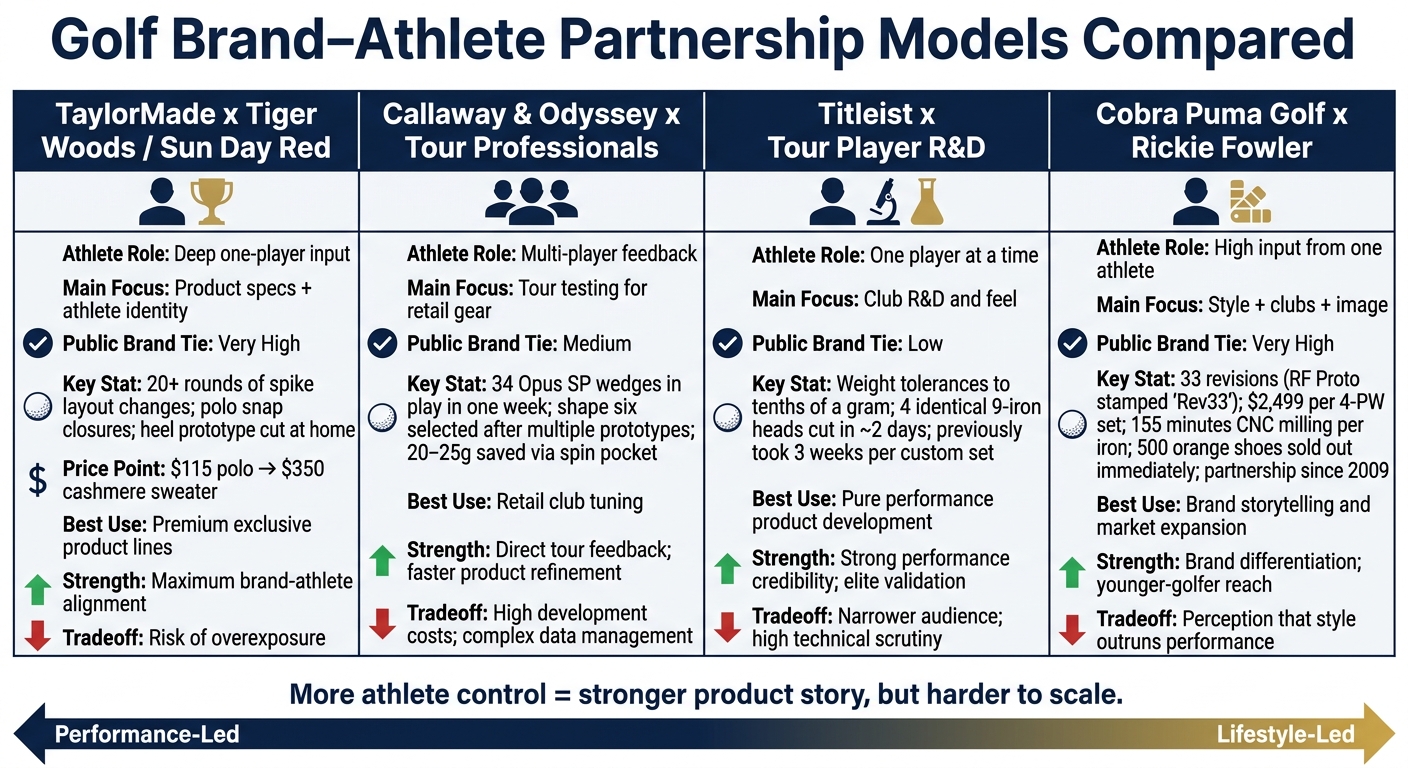
If you want the short answer, here it is: the four golf partnership models differ on one thing more than anything else: how much say the athlete has in the product.
I see four clear patterns in this piece:
- TaylorMade x Tiger Woods / Sun Day Red: one-player model with deep input across clubs, apparel, shoes, and bags
- Callaway & Odyssey x Tour Pros: group feedback model built on tour testing and retail product tuning
- Titleist x Tour Player R&D: one-player-at-a-time product work, with the player often kept out of the sales story
- Cobra Puma Golf x Rickie Fowler: athlete-led style and product model with strong visibility across clubs, apparel, and shoes
A few facts make the differences easy to spot:
- Tiger pushed product details down to polo snaps, heel shape, and spike layout
- Callaway’s Opus SP wedge moved through multiple shapes before landing on shape six
- Titleist cut custom heads to weight tolerances measured in tenths of a gram
- Rickie Fowler’s RF Proto irons took 33 revisions and sold for $2,499 per 4-PW set
So when I look at these deals, the split is simple: TaylorMade and Titleist lean more into player-led performance work, Callaway leans into shared tour feedback, and Cobra Puma leans more into athlete image and product style.
Golf Brand-Athlete Partnership Models Compared
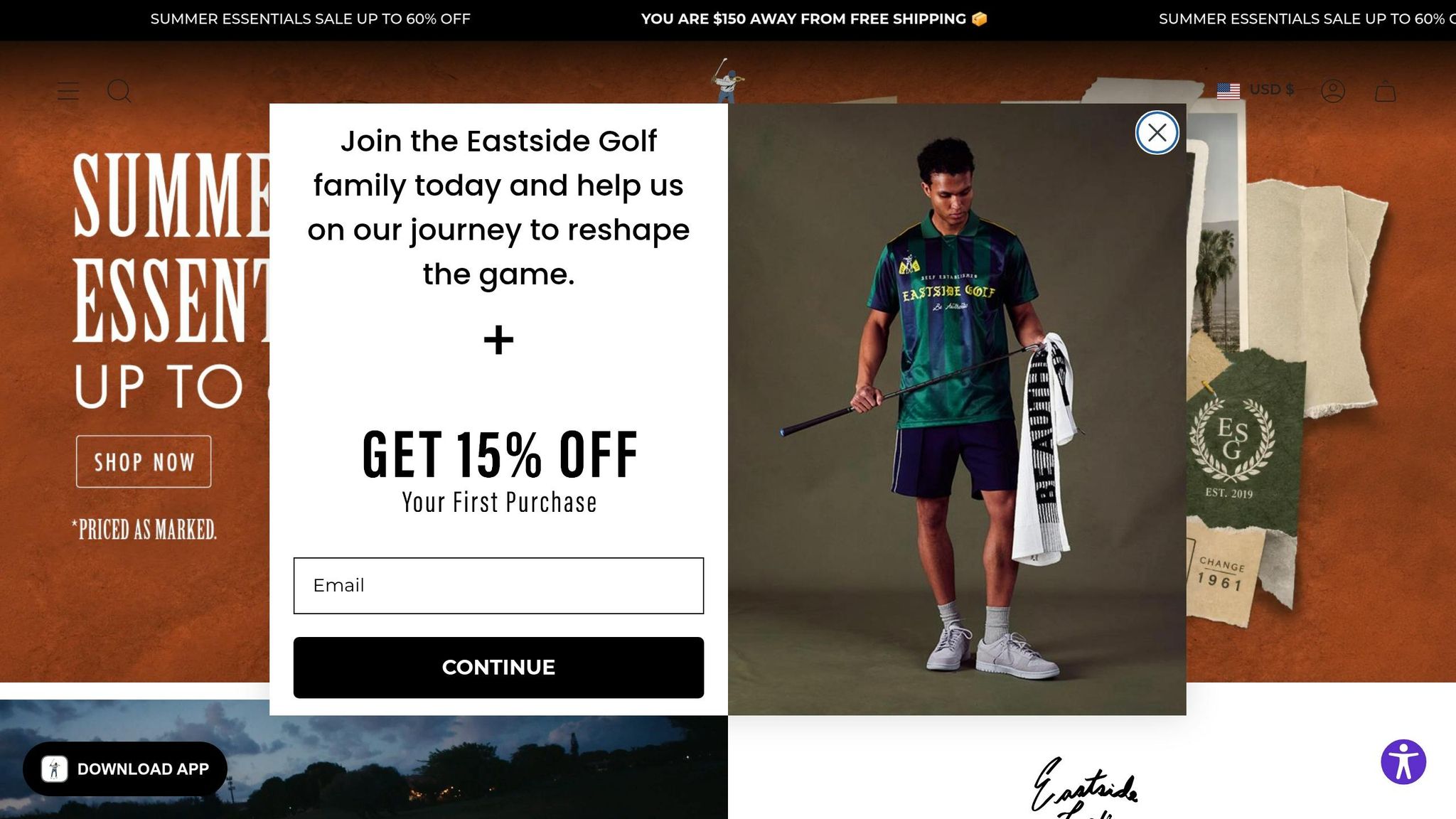
Eastside Golf‘s ‘inspiring’ collaboration with Nike and Jordan brands | Golf Channel
sbb-itb-4fa7e8b
Comparación rápida
| Partnership | Athlete role | Main focus | Public brand tie | Best use |
|---|---|---|---|---|
| TaylorMade x Tiger Woods / Sun Day Red | Deep one-player input | Product specs + athlete identity | Very high | Premium lines |
| Callaway & Odyssey x Tour Pros | Multi-player feedback | Tour testing for retail gear | Medium | Retail club tuning |
| Titleist x Tour Player R&D | One player at a time | Club R&D and feel | Low | Pure product work |
| Cobra Puma Golf x Rickie Fowler | High input from one athlete | Style + clubs + image | Very high | Brand reach and lifestyle |
If you’re comparing these models, the main takeaway is underlined here: <u>more athlete control usually makes the story stronger, but it can also make the model harder to scale.</u>
1. TaylorMade x Tiger Woods / Sun Day Red
Athlete Design Input
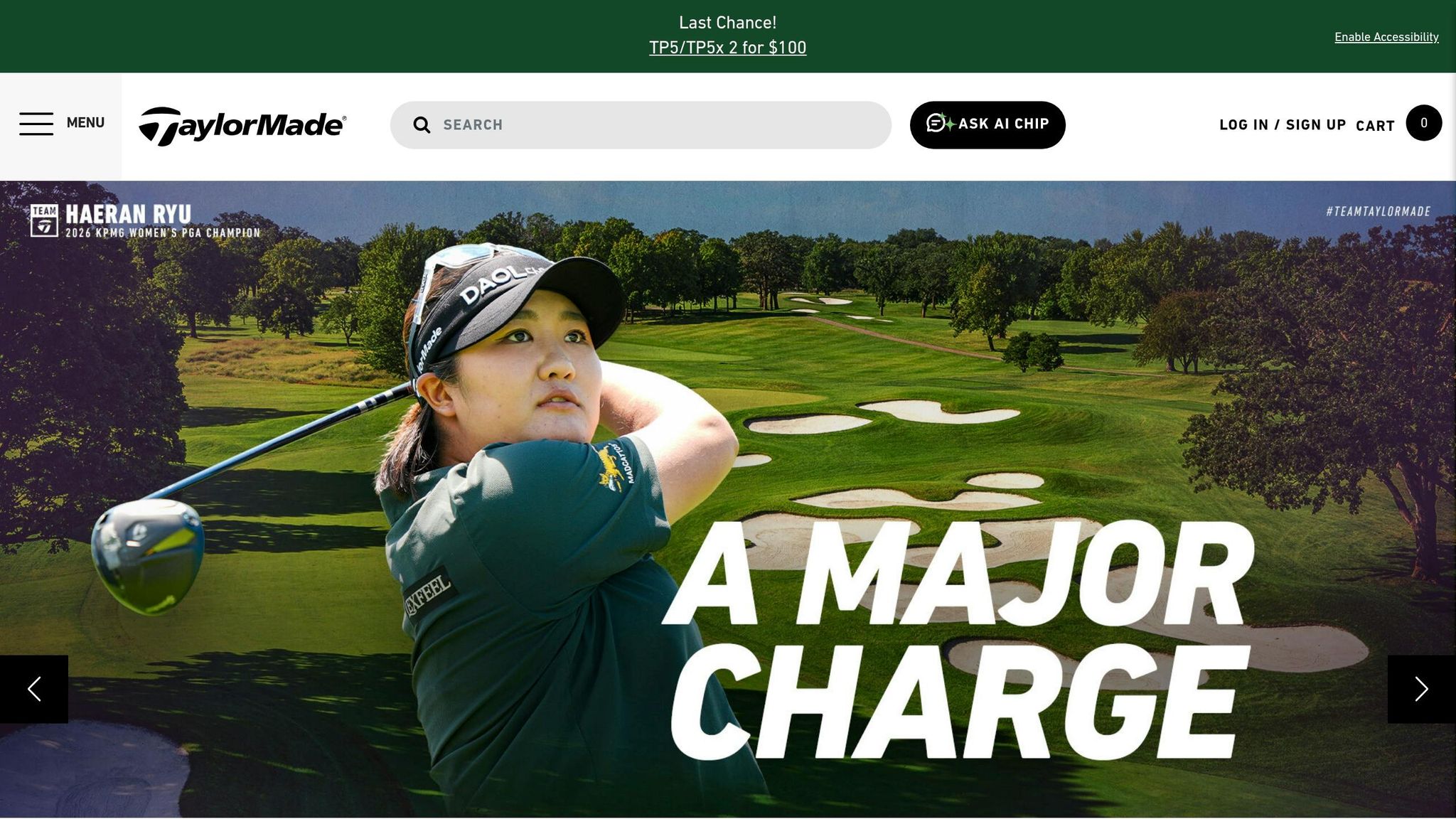
Tiger Woods is involved in the small stuff, not just the headline stuff. He weighs in on sleeve fit, glove straps, and fabric choice. He even pushed for snap closures on polos after he kept tearing through standard pearl buttons during range sessions. In another case, he cut an early heel prototype at home to reduce pressure on his Achilles. And the Pioneer Cypress spike layout took nearly 20 rounds of changes before it matched his foot shape and mobility limits.
"You can’t cut corners with Tiger’s stuff. If you do, he’s going to eventually find out." – Cáje Moye, Creative Director, Sun Day Red
Product Scope
The setup is split in a pretty clean way. TaylorMade handles clubs and bags. Sun Day Red handles apparel, footwear, and accessories. On the equipment side, Woods worked straight with TaylorMade’s engineering team on the P·7TW irons and the Milled Grind wedge line, including his custom “TW” grinds. That matters because it shows how one athlete can shape both on-course gear and a high-end lifestyle line.
Performance Testing Depth
Woods also tests products in live play, not just in a lab or fitting room. During the 2024 Genesis Invitational, he tested both soft and metal spikes to compare traction. His feedback also goes into things like grip feel and the sound of putter impact. That kind of testing helps turn personal preference into exact product specs.
"Tiger’s eye for detail, performance, is something that, quite frankly, most of our engineers and our product creators had never seen at TaylorMade." – David Abeles, CEO, TaylorMade
Branding & Commercial Positioning
Sun Day Red operates out of San Clemente with its own team and a premium pro-shop sales model. Woods also holds equity through TaylorMade Lifestyle Ventures LLC, which makes this feel more like a shared business than a standard endorsement deal. Pricing starts at $115 for a polo and goes up to $350 for a cashmere sweater.
That amount of control creates a clear contrast with broader tour-led setups. Callaway and Titleist tend to spread player input across a larger group instead of building so much around one central figure.
2. Callaway & Odyssey x Tour Professionals
Athlete Design Input
Callaway spreads player input across its tour staff instead of building the story around one signature name. The company runs tour testing cycles with feedback from several pros, then uses that feedback to fine-tune launch, spin, and shape in clubs made for retail.
The Opus SP wedge shows how that works in practice. Callaway worked with players including Chris Kirk and Akshay Bhatia, moving through several prototype shapes before landing on "shape six". That version used a 17-degree groove angle and a weight-saving spin pocket.
With top players like Jon Rahm, the fitting process gets much tighter. Callaway Tour reps usually show him only two head options at a time, with a clear focus on a pull-cut flight that holds ball speed.
"I’m not using them as kind of like lab rats or anything, but I’m getting more familiar with what other people are saying, and then trying to relate it to what he [Rahm] would do." – Kellen Watson, Callaway Tour Rep
That kind of input only means something if it changes what happens on the course.
Performance Testing Depth
In this case, it does. On the Opus SP wedges, the "spin pocket" design saved 20 to 25 grams. That gave engineers room to move the center of gravity higher, which helped produce lower launch and more spin. Callaway also says 34 Opus SP wedges went into play with tour professionals in one week at the 2025 Wyndham Championship.
"A significant amount of weight was saved from the spin pocket that then we could put in that flange and really drive the CG north and get those balls to stay down with launch and spin a ton." – Johnny Thompson, Tour Content Manager, Callaway
That matters because it turns tour feedback into something concrete. It’s not just a story about who tested the club. It’s a story about what changed in the head design and ball flight.
Branding & Commercial Positioning
Callaway sells the line as a retail-ready, data-led system shaped by tour feedback. That gives the brand a different angle from a one-player model. Instead of tying the product to a single athlete’s image, Callaway ties it to shared tour input and on-course results, which makes the line easier to sell across a broad consumer market.
3. Titleist x Tour Player R&D Partnerships
Athlete Design Input
Callaway spreads feedback across a group of tour pros. Titleist goes the other way and works closely with one player at a time. It’s a quieter setup: tour pros help shape the club, but their name usually doesn’t end up on the product line. The goal isn’t to build a star-led collection. It’s to use tour feedback to dial in the club itself.
As Steve Pelisek, President of Golf Clubs at Titleist, puts it:
"Let’s start with one. Make one guy happy as you can and go from there." – Steve Pelisek, President of Golf Clubs, Titleist
Justin Thomas tested the 660, 670, and 681.T before Titleist settled on the feel and shape he wanted. That process led to the 621.JT irons, a one-off muscleback design with zero offset and a leading edge lined up with the hosel. In blind feel testing, Thomas rejected a tungsten-weighted prototype and sent the team back to solid milled carbon steel so the club would match the feel he wanted.
Webb Simpson’s custom set followed that same player-led R&D path. It debuted at the RSM Classic in November 2022 and blended parts from several Titleist designs: a 680-style head shape and offset, the sole profile of the 620 MB, and the T100 groove profile. The build matched his steep turf interaction and his preference for a longer blade length.
Performance Testing Depth
This level of detail matters because it turns player feedback into head geometry that can be repeated with precision. Before Titleist updated its process, making a custom zero-offset set for Thomas took three days of manual grinding and three weeks total to finish. Now, with a specialized milling machine, Titleist can cut four identical 9-iron heads in about two days and hold weight tolerances to tenths of a gram.
Titleist also uses blind testing, which means player feedback comes from feel and sound, not from what the club looks like or what the spec sheet says.
Branding & Commercial Positioning
These prototypes almost never make it to retail. But the lessons from them do. What Titleist learns about turf interaction, grooves, offset, and shape gets worked into in-line models like the T100 y T200 irons.
Josh Talge, Vice President of Marketing at Titleist, says it plainly:
"What Titleist learns from JT and Webb feeds the T100 and T200. Because what we learn about turf interaction, groove, offset, and shape will end up in line." – Josh Talge, Vice President of Marketing, Titleist
So the player isn’t the main brand story here. The club is. Titleist uses tour input to make better retail products, while keeping the player in the background.
That low-profile R&D model stands apart from Cobra Puma Golf’s more visible athlete-led brand strategy.
4. Cobra Puma Golf x Rickie Fowler
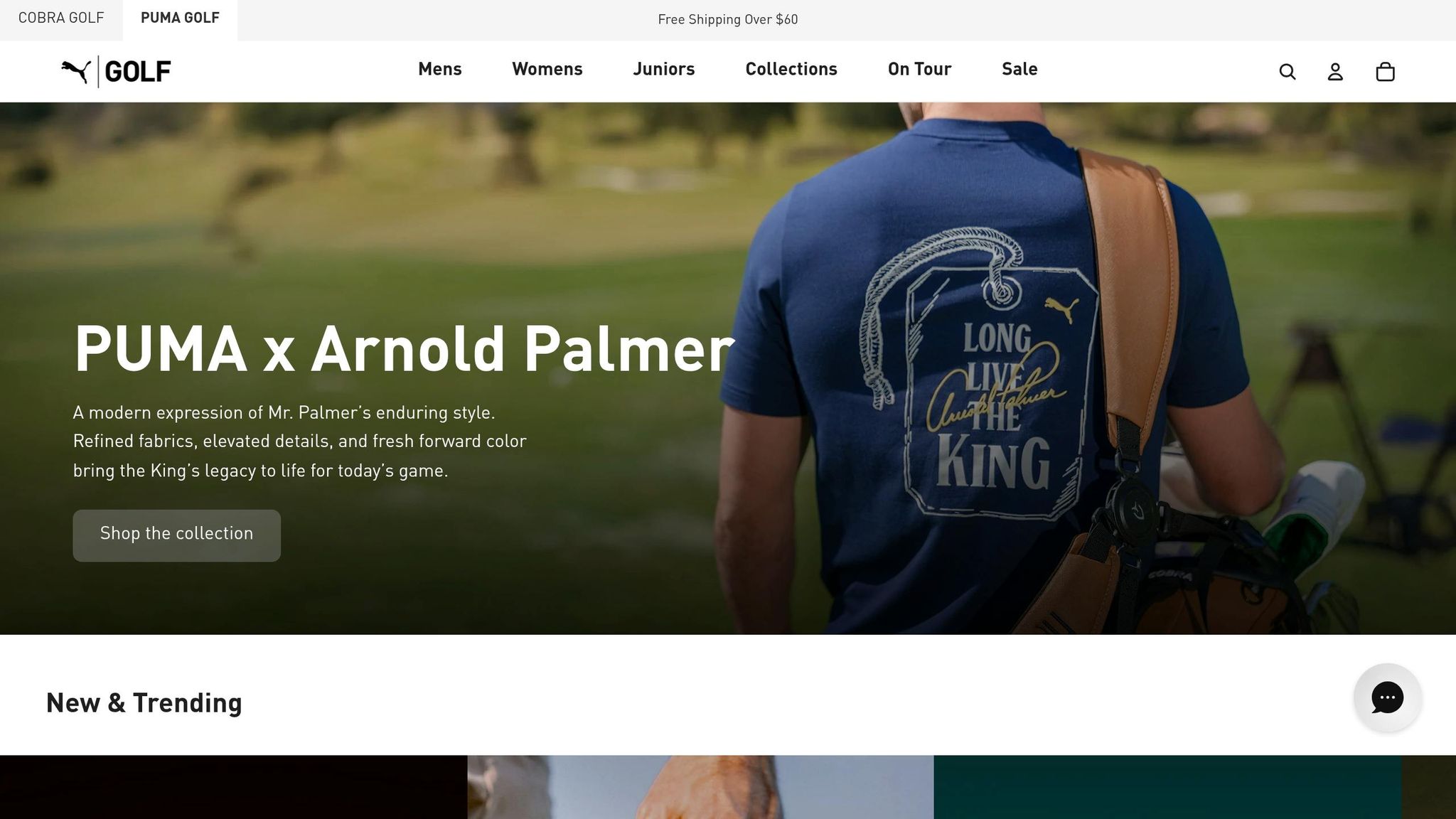
Cobra Puma Golf puts Rickie Fowler right at the center of the product process and lets him steer the look and feel himself.
Titleist tends to keep player input more in the background. Cobra Puma does the opposite. Fowler isn’t just part of the story. He’s the face people see, and his fingerprints are all over the line.
Athlete Design Input
The RF Proto Irons are the clearest example. Fowler led a 12-month design process that went through 33 revisions before he signed off on the final version. That’s why the set is stamped "Rev33." He wanted a 4-PW set based on the shape of a 7-iron, with a sharper toe and topline, zero visible offset, and a parallel hosel. He also picked the copper finish after looking through dozens of finish options.
"We set out to make a unique iron that was his, and we didn’t stop until it was just right." – Ben Schomin, Director of Tour Operations, Cobra Golf
His input didn’t stop with irons. During development of the King F9 Speedback driver, Fowler pushed for a rear design that looked like the brake light on the back of an F1 car. He was also focused more on tighter dispersion than extra distance, arguing that modern faces are already "maxed out".
And that level of control goes past clubs. It extends into apparel, footwear, and accessories too.
Product Scope
This partnership covers hard goods, performance apparel, footwear, and lifestyle accessories. Fowler has been with Puma Golf since 2009 y Cobra Golf since 2012.
A good example is the Duvin Design Co. "Purveyors of Leisure" capsule from June 2023. The drop mixed 1980s-inspired nautical prints with performance materials, and it also included PUMA’s first-ever sneaker co-designed by an athlete and a third-party brand.
That broad reach matters. Fowler helps shape both the products and the public image around them, so the partnership works as both a design tie-up and a brand statement at the same time.
Branding & Commercial Positioning
Cobra Puma Golf uses Fowler as the public face of both performance and lifestyle. His "Sunday Orange" persona became a core part of the brand’s visual identity for more than a decade. Early in the partnership, a limited run of 500 orange shoes sold out right away.
The commercial side is just as clear. The RF Proto Irons retailed at $2,499 for a 4-PW set, and each iron requires 155 minutes of CNC milling.
What These Partnerships Mean for Golf Bag and Product Development
The same player preferences that shape clubs and apparel also shape bag specs: weight, balance, layout, and branding. Those same ideas carry straight into golf bag design, construction, and launch.
Symbolic branding shows up fast in embroidered logos and trim. Sun Day Red’s layered logo treatment is a good example of how player branding can call for exact embroidery and trim work on bags. The Sun Day Red logo uses 15 stripes for Tiger’s major wins, with two stripes subtly forming the letters "C" and "S" for his children, Charlie and Sam. Small details like that don’t happen by accident. They call for precise logo digitizing and tight embroidery control.
Ergonomics and weight balance matter just as much as appearance. Player-led product design starts with fit. Strap geometry, pocket balance, and carry weight need to match how the player moves on the course. The divider layout, strap padding, and target weight are the kind of details that make a bag feel co-created instead of off-the-shelf.
For bag makers, these partnerships usually come down to four practical choices: logo execution, weight balance, compartment layout, and color consistency.
| Partnership Insight | Bag Design Application | Production Impact |
|---|---|---|
| Symbolic logo design (Sun Day Red) | Complex logo systems call for precise digitizing and embroidery control | Tight embroidery tolerances; layered logo execution |
| Ergonomic gear and fit (Cobra Puma / Fowler) | Balanced weight distribution; padded, symmetrical straps | Structural prototyping; carry-weight validation |
| One-player R&D depth (Titleist / Thomas) | Divider layout and pocket placement matched to player movement patterns | Modular construction; weight tolerance to tenths of a gram |
| Tour-wide feedback cycles (Callaway) | Compartment and hardware specs refined across multiple player inputs | Iterative sampling; multi-player fit validation |
For brands turning player input into bags, Mantenga el equipo de golf perfecto handles OEM/ODM design, sampling, production, inspection, packaging, and worldwide delivery.
That leads into the next question: which partnership model gives you the clearest design brief and the most repeatable bag spec.
Pros, Cons, and Key Takeaways for Each Partnership Model
Every partnership model gives you something and asks for something in return. That’s the trade. The table below breaks each one down into its main upside, its main drawback, and where it tends to work best.
| Partnership Model | Main Strength | Key Tradeoff | Best Fit |
|---|---|---|---|
| TaylorMade x Tiger Woods / Sun Day Red | Maximum brand-athlete alignment; exclusive appeal | Risk of overexposure | Premium, exclusive product lines |
| Callaway x Tour Professionals | Direct tour feedback; faster product refinement | High development costs; complex data management | Long-term performance innovation |
| Titleist x Tour Player R&D | Strong performance credibility; elite-level validation | Narrower audience; high technical scrutiny | Performance-led product development |
| Cobra Puma Golf x Rickie Fowler | Brand differentiation; younger-golfer reach | Perception that style outruns performance | Brand storytelling and market expansion |
The pattern here is pretty clear: the more say an athlete has, the stronger the product story becomes. But there’s a catch. That same level of athlete control can make the model harder to scale.
That’s why the four examples land in different spots.
Titleist y TaylorMade stand out when the goal is deep technical input and product work tied closely to elite play. Their partnerships lean harder into performance, testing, and player-driven product signals.
Cobra Puma Golf x Rickie Fowler takes a different route. It gives up some technical depth in exchange for broader lifestyle reach and a more visible co-created story. If the goal is to connect with younger golfers and build brand interest beyond pure performance talk, that model has more room to move.
Put simply:
- For performance-led development, Titleist y TaylorMade are the strongest.
- For lifestyle reach, Cobra Puma Golf x Rickie Fowler offers more flexibility.
Preguntas frecuentes
Which partnership model is easiest to scale?
The joint venture model is often the easiest way to scale. It gives creators access to outside support for production, distribution, and sales, so growth doesn’t depend only on one person doing everything alone.
With a skilled team and the right resources behind them, talent can grow from a solo effort into a bigger business. That can include owned intellectual property, premium content, and consumer products.
For specialized golf equipment or accessories, Keep Perfect Golf can help with design, sampling, manufacturing, and worldwide delivery.
Why do some brands keep the athlete out of the sales story?
Some brands take this route when technical development and product strategy matter more than one person’s name.
If a product depends on extreme performance or highly specialized research, the athlete might not be the strongest sales hook. In that case, the brand may get more mileage from the product itself than from the athlete behind it.
There’s also a branding angle. A company may want tighter control over its go-to-market plan and build its own high-performance design identity, instead of tying the product too closely to the athlete’s public image.
How does athlete input change golf bag design?
Athlete input shapes golf bag design in a direct way. It pushes teams to improve the bag’s build, fine-tune weight and balance, and tailor details around how players actually move and compete.
Pros often share detailed feedback on features, structure, and feel. That gives designers a clearer sense of what helps on the course and what gets in the way. They also bring data-based insights and test prototypes, which leads to small, repeated changes until the bag fits both performance needs and visual goals.

 Español
  English
  Português
  Français
  日本語
日本語