Sun Mountain vs Vessel Golf Bags: Which Is Worth the Money?
Which is worth the money – Sun Mountain or Vessel? In short, because they aim at different buyers, the fair answer is: Sun Mountain for durability-per-dollar, Vessel for premium materials and waterproofing at a higher price. On average, a Vessel-style premium bag costs about $349 retail (approx.), while a Sun Mountain-class bag retails closer to $200-$280 (approx.); yet both carry a factory build cost in a similar band of roughly $70-$115 (typical), a retail markup of about 200-300% driven by four key factors: materials (~55%), labor (~20%), tooling (~10%) and brand margin & distribution (~15%). In other words, the real durability gap between the two brands is smaller than the price gap – and the largest savings come from buying the specification rather than the logo.
TL;DR / Quick Answer
Sun Mountain and Vessel are both legitimately premium, but they answer different questions. Sun Mountain is the proven durability play: lower retail, classic construction, strong value for frequent players. Vessel is the fashion-and-weather play: higher-grade synthetic leather, waterproofing and modern looks at a higher premium. At the factory level the spec gap is real but smaller than the retail gap. If you want premium quality at a better price, the winning move is OEM/ODM: build your own Sun Mountain- or Vessel-class bag at wholesale build cost.
1. Two Brands, Two Price Strategies
Before comparing seams and zippers, understand the positioning. Sun Mountain has built its name on no-nonsense reliability – a bag that shows up, holds clubs and lasts. Vessel competes on premium modernity: premium synthetic materials, clean lines, waterproofing and a higher-end feel. Neither is lazy engineering; they simply spend their money in different places. At factory cost, a Vessel-style build runs typically $85-$115, while a Sun Mountain-class build runs typically $70-$105 – the material and feature gap is real but modest. It is the brand margin layer that widens the retail difference to what you see on the shelf.
| Dimension | Sun Mountain (class) | Vessel (class) | Why It Matters |
|---|---|---|---|
| Typical retail | $200-$280 (approx.) | $320-$450 (approx.) | Vessel carries a higher brand-position premium |
| Typical factory build cost | $70-$105 (typical) | $85-$115 (typical) | The build-cost gap is far smaller than the retail gap |
| Main fabric | Durable nylon / polyester blends | High-density synthetic leather, PU-coated fabric | Vessel looks and feels more premium |
| Weather protection | Water-repellent, taped critical seams | Waterproof membrane liner, fully taped seams | Vessel leads in heavy-weather rain stopping |
| Brand / style | Classic, understated | Modern, fashion-forward | Personal preference, not quality |
| Best for | Value-focused frequent players | Players chasing premium feel plus waterproofing | Match the brand to your use, not your ego |
2. The Materials Story: Where the Money Goes
As a company that manufactures golf bags through our affiliated factory in Quanzhou, Fujian, we can tell you exactly where each brand’s material spend lands. On a premium build, materials run roughly 55% of factory cost. The differences come down to fabric grade, waterproofing and the base platform.
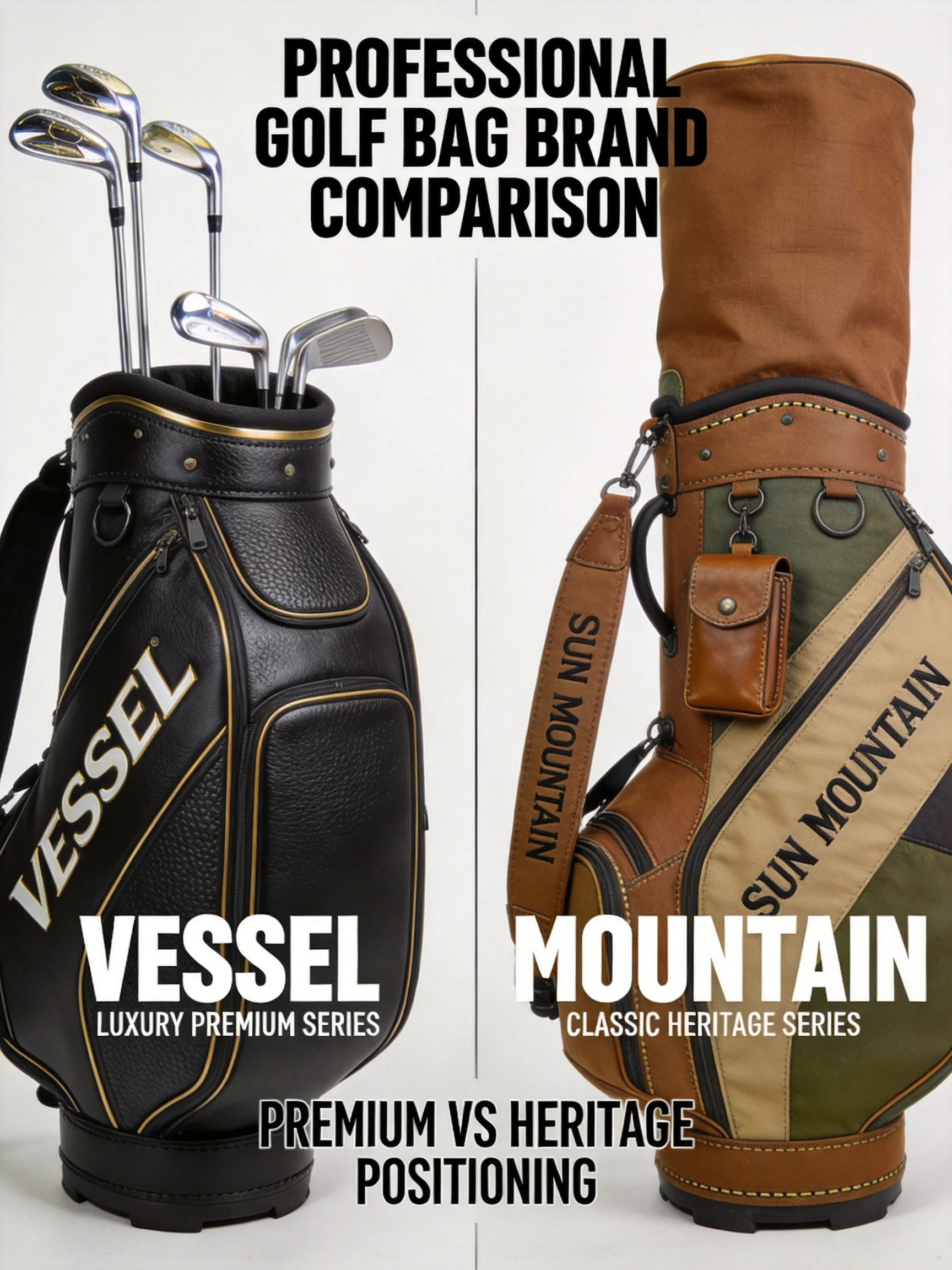
- Sun Mountain-class spec: abrasion-resistant nylon blends, DWR finish, a solid structured base and good YKK-class zippers. It is hard-wearing and dependable, with a material bill at the compact end of the premium range.
- Vessel-class spec: high-density synthetic leather, waterproof membrane liners, fully taped seams and a molded, structured platform with stronger clamshell pocket framing. The material bill is noticeably higher because the water-sealing layers and texturized overlays cost more per square meter.
The honest take: the durability gap is modest – both grades will outlive a budget bag. The feel and weather gap is where Vessel earns its price. If you rarely play in rain and don’t care about the premium hand-feel, Vessel’s extra is aesthetic, not functional.
Side-by-side material and weight comparison
| Component | Sun Mountain-class | Vessel-class | Weight / Water Notes |
|---|---|---|---|
| Main fabric | Abrasion-resistant nylon / polyester blends | High-density synthetic leather, PU-coated layers | Vessel is slightly heavier per panel due to coating layers |
| Weather protection | Water-repellent (DWR) + taped critical seams | Waterproof membrane liner + fully taped seams | Vessel stops heavier rain; Sun Mountain handles light showers |
| Base structure | PE board, basic shaping | Injected / thermoformed molded platform, reinforced | Vessel base is heavier but stiffer on cart |
| Zippers & hardware | Good YKK-class zippers | Water-resistant YKK, clamshell pocket framing | Similar reliability; Vessel adds water-resist coatings |
| Typical full-bag weight | ~4.5-5.5 lb | ~5-6 lb | Vessel-class tends heavier because of waterproofing layers |
| Divider system | Full-length, basic | Full-length with soft-touch framing | Both protect club shafts; Vessel feels plusher |
Read that table the way a factory does: the two bags share the same skeleton (panels, zippers, base, dividers), and the difference is concentrated in coating and water-sealing layers. That single choice drives most of the material-spend delta between the two brand classes and a meaningful share of the weight difference.
3a. Process Steps: What Build Time Actually Looks Like
Both bags travel the same production road in our affiliated factory – roughly 60 to 120 machine-and-hand operations depending on features. The process is where small brands and premium brands alike make or lose their reputation, because a skipped step is invisible today and fatal in year three.
- Cutting & fusing – panels are cut from roll stock and heat-fused to lining, with membrane layers added for waterproof builds.
- Seam preparation & taping – critical seams are taped and sealed; Vessel-class adds full tape coverage.
- Sewing & assembly – body, dividers, cuff and base are joined in sequence by trained operators.
- Hardware & strap mounting – zippers, buckles, harness and handle are fitted and reinforced.
- Final QC & packing – stitch inspection, water-resistance spot check, setting check and boxing.
The honest production difference between the two: hours per bag. A Vessel-class waterproof build absorbs more taping and membrane operations, pushing labor toward ~20% of build cost; a Sun Mountain-class build is a little simpler and shaves that down. In our affiliated factory, 7 production lines with 149 machines and 137 staff keep these standard runs efficient and repeatable.
3. Craftsmanship: Same Lines, Different Hours
Both bags are built the same fundamental way – cut panels, taped seams, sewn body, mounted base, fitted dividers, final QC. The difference is labor hours per bag. A Vessel-class bag with a membrane liner and taped seams absorbs more machine-and-hand operations, pushing labor toward 20% of build cost; a Sun Mountain-class bag is slightly simpler to sew, shaving that down. In our affiliated factory, 7 production lines with 149 machines and 137 staff turn standard runs around efficiently – which is exactly why specification, not hype, drives the price.

4. Tooling: The Hidden Cost On Both
Neither brand escapes tooling. A structured base, molded cuff, brand plate and shaped hardware require injection or thermoformed molds that must be paid off across a run – roughly 10% of build cost at moderate volumes. Both Sun Mountain and Vessel amortize these the same way a private-label buyer does. The difference surfaces only in unit economics: on a premium bag you are effectively buying durable tooling amortization, and that investment is identical whether you buy the logo or build your own.
Typical tooling / mold investment (ballpark figures, final quotes depend on spec)
| Tooling / Mold Item | Typical Investment (USD) | Amortized Over | Approx. Cost Per Bag |
|---|---|---|---|
| Structured base mold (injected) | $8,000-$15,000 | 3,000-5,000 pcs | $2-$4 |
| Molded top cuff mold | $5,000-$10,000 | 3,000-5,000 pcs | $1.5-$3 |
| Brand plate / logo tools | $1,000-$3,000 | Full run | $0.5-$1.5 |
| Custom hardware & buckles (molds) | $3,000-$8,000 | Full run | $1-$3 |
| Patterns, samples & pre-production (SMU) | $1,500-$4,000 | Full run | $1-$2 |
Combine those per-bag lines and tooling lands near ~10% of build cost on a moderate run – and it scales down per bag as order volume rises. That is the single strongest argument for OEM/ODM: the same tooling a brand amortizes across thousands of units is available to a private-label buyer at the same wholesale math.

5. Is Sun Mountain Worth It? Is Vessel Worth It?
The decision splits cleanly by how you play:
- Pick Sun Mountain-class if you want maximum durability per dollar, play mostly fair weather, and prefer classic looks. You get a proven, hard-working bag for less.
- Pick Vessel-class if you want premium materials, modern design and serious rain protection, and you play often enough that the higher cost amortizes to pennies a round.
- Choose OEM/ODM if you want either specification without the brand surcharge – a private-label bag built to a Sun Mountain- or Vessel-class spec at wholesale build cost.
The factory truth: the build-cost gap between the two brands (roughly $15-$30) is a fraction of the retail gap (often $60-$150). That gap is branding, not craftsmanship. If the logo doesn’t matter to your game, the spec does – and the spec is reproducible.
5a. A Value Scorecard: Cost Per Round
The cleanest way to compare “worth the money” is to put both bags on the same ledger: retail price divided by usable rounds. Although exact lifetimes vary by use, industry-typical experience gives a fair picture:
| Scenario | Typical Retail (approx.) | Typical Usable Life | Approx. Cost per Round |
|---|---|---|---|
| Budget bag | $80 | ~1-1.5 seasons | High once replacement counted |
| Mid-tier bag | $120 | ~2-3 seasons | ~$0.45-$0.65 |
| Sun Mountain-class premium | $200-$280 | ~3-4 seasons | ~$0.65-$0.90 |
| Vessel-class premium | $349 | ~3-5 seasons | ~$1.00-$1.20 |
Read it honestly: for a heavy player, all three premium tiers can be legitimate; for an occasional player, the mid-tier bag is usually the value winner. The scorecard also reveals the single biggest lever few shoppers consider – a made-to-spec OEM/ODM bag captures the same premium build at wholesale cost, dropping the cost-per-round far below any retail option without sacrificing the specification.
That is the point of this comparison. Yes, Sun Mountain and Vessel each justify their price for the right golfer. But once you understand that the bulk of the difference is materials grade, waterproofing and structure – not magic – you are empowered to buy the spec that fits your game, or to build it under your own brand entirely. Whichever bag you lean toward, ask the same three questions of any premium purchase: does the waterproofing match the weather you actually play in, is the base structured enough to stay rigid, and are the seams and zippers built to last a few seasons. Answer those and you will never overpay for branding again.
5b. Which Bag Fits You? A Decision Summary
To make the call fast, here is the strength-and-fit summary in one place. Neither brand is “wrong” — the correct pick is the one that lines up with how you actually play:
| Player Profile | Sun Mountain-class | Vessel-class |
|---|---|---|
| Frequent player, fair weather, value-driven | Best pick – durable workhorse, lower price | Pays a premium you may not need |
| Heavy-weather player who hates wet grips | Good, but needs a rainhood for heavy storms | Strongest fit – membrane + full seam taping |
| Style-driven golfer who values modern looks | Classic, understated | Best pick – premium synthetic leather feel |
| Budget-conscious first bag | Best pick – good value per dollar | Probably overkill |
| Wholesale / private-label buyer | Best pick: OEM/ODM – build either spec at wholesale cost | |
5c. Lighter vs Functional: The Feature Split Many Shoppers Miss
Beyond the price, the two brands embody a design split worth knowing: lightweight-and-functional versus premium-and-protective. Sun Mountain-class bags tend to trim weight wherever possible — simpler linings, fewer layered panels, DWR instead of a full membrane — which suits players who carry and value a lighter shoulder load. Vessel-class bags spend that saved weight on waterproof layers, richer fabrics and a stiffer platform, which suits cart players and weather-exposed rounds more than walkers counting grams. In practice, this means the “better” bag changes with your setup: a dedicated walker often prefers the lighter functional build, while a cart-and-rain fair-weather-dodging player gets more from the protective one. Neither choice is a compromise on quality — it is a trade-off between ounces and armor, and knowing which side you play on is the final piece of the decision.
5d. Advanced Shopping Checklist (Beyond The Logo)
Use this six-point list to judge either bag on construction, not branding — each item is checkable at the store or from any close-up photo:
- Stitch tension: even, dense stitches with reinforced bar-tacks at every strap and handle mount.
- Seam taping: more taped or turned hems means more weatherproofing and longer service life.
- Zipper feel: smooth with no snags; water-resistant tape on premium builds.
- Base twist test: a molded base that resists twisting beats a thin board that flexes under weight.
- Divider depth: full-length dividers protect shafts and stop grip rattle.
- Strap mounting: reinforced, load-tested mounts outlast bags where straps pull free.
Run these six checks and the two brands (and their private-label equivalents) separate cleanly into spec you trust and markup you skip. That checklist is exactly how our team vets a build before a single panel is cut.
Request a Quote – Get the Spec You Want, at Build Cost
Whether you want a durable Sun Mountain-style workhorse or a premium Vessel-style look, our manufacturing network can build it under your own brand. Keep Perfect Golf manages OEM and ODM golf bag programs through an affiliated factory and a vetted partner network – from materials and tooling to waterproofing and MOQ guidance.
Request a golf bag OEM/ODM quote
We build golf bags to spec – explore our golf bag programs or the golf cart bags category to start.
FAQ: Sun Mountain vs Vessel
Which is better, Sun Mountain or Vessel?
Both are premium and well-built, but they target different buyers. Sun Mountain is the proven durability workhorse at a lower price; Vessel is the fashion-forward premium bag with waterproofing and modern materials at a higher price. Neither is objectively superior – the right pick depends on budget, looks and play frequency.
Are Sun Mountain golf bags worth the money?
Generally yes for value-focused players. Sun Mountain sits below Vessel in price with strong durability, making it a smart mid-premium choice. Factory build cost for a comparable bag is typically $80-$105 while its retail remains well below Vessel’s.
Is Vessel worth the extra cost over Sun Mountain?
Only if you value premium aesthetics and maximum rain protection and play often. If durability per dollar is your main metric, Sun Mountain usually wins. At the factory the spec gap is real but far smaller than the retail gap.
What materials differ between the two brands?
Sun Mountain uses durable nylon blends with a water-repellent finish; Vessel uses higher-grade synthetic leather, waterproof membrane liners and fully taped seams. That water-sealing layer is the biggest material-cost difference.
How do premium bag prices compare to build costs?
Premium bags typically carry a retail markup of roughly 200-300% over build cost. A Vessel-style build is typically $85-$115; a Sun Mountain-class build is typically $70-$105. Brand margin and distribution explain most of the retail difference.
Can I get either premium spec without the retail price?
Yes. The core spec – quality fabrics, structured base, good zippers and optional waterproofing – is manufactured for private labels via OEM and ODM. Keep Perfect Golf can build a made-to-spec bag at wholesale build cost.
Disclaimer: Retail and factory figures in this article are industry-typical approximations used to explain comparative value, not precise quotes or guaranteed prices. Actual pricing depends on specification, volumes and prevailing conditions. Approx./typical labels apply to every figure above.
Related Products
Explore our manufacturing capabilities in this category:
Need custom golf bags? Contact us for OEM/ODM quotes — MOQ 100pcs, FOB Xiamen.