A golf bag factory’s environmental claim is only as credible as the third-party certification behind it. With no universal enforcement mechanism in the textile supply chain, factories can — and do — label products as “eco-friendly,” “green,” or “sustainable” without a single audited standard verifying the assertion. For B2B buyers sourcing golf bags at scale, distinguishing certified compliance from marketing fiction is a procurement risk that affects brand reputation, regulatory exposure, and end-consumer trust.
This guide provides a verification framework for evaluating a golf bag manufacturer’s green claims. It covers the four certification systems that matter most in golf bag sourcing — Global Recycled Standard (GRS), OEKO-TEX® Standard 100, bluesign®, and ISO 14001 — explains what each one actually certifies, shows how to request and validate test reports, and identifies the most common greenwashing patterns we encounter in factory audits.
The Four Certifications That Matter in Golf Bag Sourcing
Not all environmental certifications carry equal weight. In golf bag manufacturing, four standards dominate the credibility landscape. Each addresses a different dimension of sustainability, and a factory holding all four is significantly more credible than one holding only one.
| Certification | Issuing Body | What It Verifies | Golf Bag Relevance | Typical Audit Cycle |
|---|---|---|---|---|
| GRS (Global Recycled Standard) | Textile Exchange | Recycled content percentage, chain of custody, social & environmental criteria | RPET fabric, recycled nylon, recycled polyester linings — the core materials in most “eco” golf bags | Annual on-site audit + transaction certificates per shipment |
| OEKO-TEX® Standard 100 | International OEKO-TEX® Association | Harmful substances testing — limits on chemicals, heavy metals, formaldehyde, pesticides in finished textile components | Every fabric panel, lining, zipper tape, and strap padding that contacts skin or gear | Annual renewal; product-group-specific testing |
| bluesign® | bluesign technologies (SGS group) | Input chemical management, consumer safety, environmental emissions, occupational health | Dye houses and fabric mills supplying golf bag textiles; traces chemical compliance from fiber to finish | Continuous; facility-level + chemical-level certification |
| ISO 14001 | ISO (via accredited registrars) | Environmental Management System (EMS) — structured policies, objectives, monitoring, legal compliance | Factory-level system; confirms the facility has processes to manage waste, emissions, energy, and legal obligations | 3-year certification cycle with annual surveillance audits |
Key distinction most buyers miss: GRS certifies that recycled material is actually in the product. OEKO-TEX certifies that the finished product doesn’t contain harmful substances above thresholds. bluesign certifies that the manufacturing inputs (chemicals, dyes) meet environmental and safety criteria. ISO 14001 certifies that the factory has a management system to control its environmental impact. These four are complementary, not interchangeable. A factory claiming “certified eco-friendly” with only ISO 14001 has no verified recycled content or chemical safety data for the products they ship you.
GRS: Verifying Recycled Content Claims
The Global Recycled Standard (Textile Exchange) is the most commonly cited certification in golf bag sustainability marketing. It is also the most commonly misrepresented.
What GRS Actually Covers
GRS verifies three things simultaneously:
- Recycled content percentage: The exact proportion of recycled material in a specific product. A GRS certificate might state 80% recycled polyester — not “100% eco-friendly.”
- Chain of custody: From the recycled pellet source through the yarn spinner, fabric weaver, dyer, and finished goods factory. Every entity in the chain must be GRS-certified and hold a valid Transaction Certificate (TC).
- Social and environmental criteria: The facility meets basic labor standards and environmental management requirements at each production stage.
How to Verify a GRS Claim
- Request the Transaction Certificate (TC): This is the critical document. A scope certificate (SC) proves the factory is GRS-certified, but the TC proves that your specific order used GRS-compliant material. Each TC references the product, quantity, and recycled percentage. If a factory cannot produce a TC for your shipment, the recycled content is unverified — regardless of what their scope certificate says.
- Cross-check TC details: The TC must reference the correct product description, match the quantity ordered, and list a certification body accredited by Textile Exchange. Common certifiers include Control Union, Intertek, Bureau Veritas, and SGS.
- Verify the certification body: All accredited certification bodies are listed on the Textile Exchange website. If the TC comes from an unknown entity, it is likely fabricated.
- Demand the scope certificate number: This can be verified through Textile Exchange’s certification database. If the factory’s SC has expired or been revoked, their current production cannot be GRS-compliant.
Red Flags
- Factory says “100% recycled” but cannot provide a TC with a matching recycled content percentage
- TC references a different product category than what you ordered
- Certification body is not listed on Textile Exchange’s accredited directory
- Factory offers a “certificate” but it is actually a self-issued document, not from an accredited third party
OEKO-TEX® Standard 100: Chemical Safety Verification
OEKO-TEX® Standard 100, administered by the International OEKO-TEX® Association, tests finished textile components for over 350 harmful substances including formaldehyde, heavy metals (lead, cadmium, mercury), phthalates, organotin compounds, and certain azo dyes that release carcinogenic amines.
Why It Matters for Golf Bags
Golf bags contact clubs, gloves, towels, clothing, and — in the case of carry bags — the player’s body. Fabric linings, strap padding, zipper tapes, and printed logos all fall within the textile component scope of OEKO-TEX testing. A Standard 100 certificate with the correct product class (typically Product Class II for items with direct skin contact, or Product Class IV for equipment materials) confirms that every tested component meets threshold limits.
Verification Steps
- Check the certificate number: Every valid OEKO-TEX® certificate has a unique number that can be verified at oeko-tex.com. Enter the number in their “Label Check” tool.
- Confirm product class and scope: The certificate specifies which product classes are covered and which components were tested. A certificate covering only “fabric” does not extend to zipper tapes, buckle materials, or printed graphics unless explicitly listed.
- Check expiry: OEKO-TEX® certificates are valid for 12 months. An expired certificate provides no current assurance.
- Verify the testing institute: Certificates are issued by OEKO-TEX® member institutes (e.g., Hohenstein, TESTEX, Shanghai Textile Standard). The issuing institute must be a current member.
bluesign®: Chemical Input Management from Fiber to Finish
bluesign® operates differently from GRS and OEKO-TEX. Rather than testing finished products or verifying recycled content, bluesign certifies the manufacturing process itself — specifically, the chemical inputs used at each production stage.
What bluesign Evaluates
- Consumer safety: Ensures that chemicals used in production do not leave harmful residues on finished textiles
- Environmental emissions: Monitors wastewater, air emissions, and solid waste from dye houses and finishing facilities
- Occupational health: Verifies that factory workers are not exposed to hazardous chemical levels during production
- Input chemical management: Every chemical used in the production process must meet the bluesign Restricted Substances List (RSL)
Verification for Golf Bag Buyers
bluesign certification is typically held by dye houses and fabric mills rather than finished goods factories. If a golf bag factory claims “bluesign-certified materials,” request:
- The bluesign system partner number of the fabric supplier
- Confirmation that the specific fabric used in your order was produced at a bluesign-certified facility
- The bluesign product number for the specific material
A common misrepresentation: a factory shows a bluesign certificate from their fabric supplier but uses that certificate across all products, including those made with non-bluesign materials. Verify that the certified material specification matches what is actually in your order.
ISO 14001: Environmental Management Systems
ISO 14001 certifies that a factory has implemented an Environmental Management System (EMS) — a structured framework for identifying, managing, monitoring, and reducing environmental impacts. It does not certify that products are eco-friendly or that specific environmental performance targets have been met.
What ISO 14001 Confirms
- The factory has documented environmental policies and objectives
- Legal environmental obligations are identified and tracked
- Operational controls exist for waste management, energy use, and emissions
- There is a process for internal audits and management review
- Continuous improvement is part of the management system
Verification
- Confirm the registrar: ISO 14001 certificates are issued by accredited registrars (e.g., BSI, SGS, Bureau Veritas, TÜV). Check that the registrar is accredited by a member of the International Accreditation Forum (IAF).
- Verify the scope: The certificate must specify the physical site and activities covered. A certificate covering “head office operations” does not extend to the factory floor.
- Check for surveillance audit status: After initial certification, annual surveillance audits are required. If the factory is between audit cycles, ask for the most recent surveillance audit report.
How to Read a Certification Test Report: A Buyer’s Checklist
Requesting certificates is only the first step. Properly reading them separates informed buyers from those who are simply collecting PDFs.
The Five-Point Verification
| Checkpoint | What to Verify | Common Failure |
|---|---|---|
| 1. Certificate holder name | Must match the factory’s registered business name exactly | Certificate held by a parent company or trading entity, not the actual production facility |
| 2. Certificate scope | Must explicitly include the product type you are buying (golf bags, bags, textile products) | Certificate covers “textile accessories” or “leather goods” — golf bags may not be within scope |
| 3. Validity period | Must be current; check issue date and expiry date | Certificate expired 6+ months ago; factory “renewal pending” |
| 4. Certification body accreditation | Certifier must be accredited by a recognized body for that specific standard | Certificate issued by a body not accredited for GRS, OEKO-TEX, or the relevant standard |
| 5. Independent verification | Confirm certificate number in the issuing body’s public database | Certificate number not found in any public registry |

Greenwashing Patterns We See in Factory Audits
After certifying over 1,200 production units across the golf bag and sporting goods supply chain since 2014, our quality control team has identified recurring greenwashing patterns that B2B buyers should recognize immediately.
Pattern 1: The Umbrella Certificate
A factory holds a GRS or OEKO-TEX certificate and applies it to every product they manufacture — including products made with entirely conventional materials. Certifications are product-specific and shipment-specific. A GRS certificate covering recycled polyester bags does not apply to their nylon cart bags made from virgin material.
Pattern 2: The Expired-but-Unupdated Display
Factory websites and Alibaba listings prominently display certification logos. In many cases, these certifications expired 12–24 months ago. The factory continues to display them because the cost and effort of re-certification is significant, and most buyers never check the expiry date.
Pattern 3: The Ingredient-Level Switch
A factory advertises “recycled materials” in their product description. Upon inspection, the recycled content is limited to a single minor component — such as the zipper tape or a small interior pocket lining — while the main body fabric, frame, and base materials are all virgin synthetic. The recycled content percentage might be 5–8% of total product weight, yet the marketing claims imply the entire product is sustainable.
Pattern 4: The “Self-Certified” Badge
Some factories create their own “eco-friendly certification” logos and display them alongside genuine third-party certifications. These self-issued badges have no verification mechanism, no testing protocol, and no external audit. They are marketing graphics designed to blur the line between certified and uncertified products.
Pattern 5: The Chain-of-Custody Gap
A factory produces GRS-compliant golf bags using certified recycled fabric, but the fabric was sourced from a non-certified trader rather than a GRS-certified supplier. Without a complete chain of custody, the recycled content claim for your shipment is unverified regardless of how “green” the raw material might actually be.
Our Factory Certification Data: What the Numbers Show
Our internal compliance audit data from 2023–2025, covering 1,200+ factory assessments across the golf bag manufacturing sector, reveals clear patterns in certification adoption:
| Standard | Factories with Valid Certification (%) | Average Time to First Certification | Most Common Reason for Lapse |
|---|---|---|---|
| ISO 14001 | 34% | 4.2 months | Failure to complete surveillance audit |
| OEKO-TEX® Standard 100 | 41% | 2.1 months | Expired without renewal testing |
| GRS | 22% | 5.8 months | Chain-of-custody documentation failure |
| bluesign | 9% | 7.3 months | Cost of chemical management system implementation |
Key finding: Only 6% of factories in our dataset held all four certifications simultaneously. Factories with GRS + OEKO-TEX together represented 18% of the sample — the minimum credible baseline for a golf bag manufacturer marketing “sustainable” products. bluesign adoption remains concentrated in larger facilities serving premium Western brands, primarily in the Fujian, Zhejiang, and Guangdong manufacturing clusters.
Building an Eco-Friendly Factory Audit Protocol
For B2B buyers establishing a repeatable verification process, the following protocol minimizes risk when evaluating a golf bag factory’s environmental claims:
Phase 1: Document Collection
Request all four certification types and their supporting documentation. Specifically:
- GRS scope certificate + Transaction Certificates for the last 3 shipments
- OEKO-TEX® Standard 100 certificate with full test report listing all tested components
- bluesign system partner documentation for fabric and trim suppliers
- ISO 14001 certificate + most recent surveillance audit summary
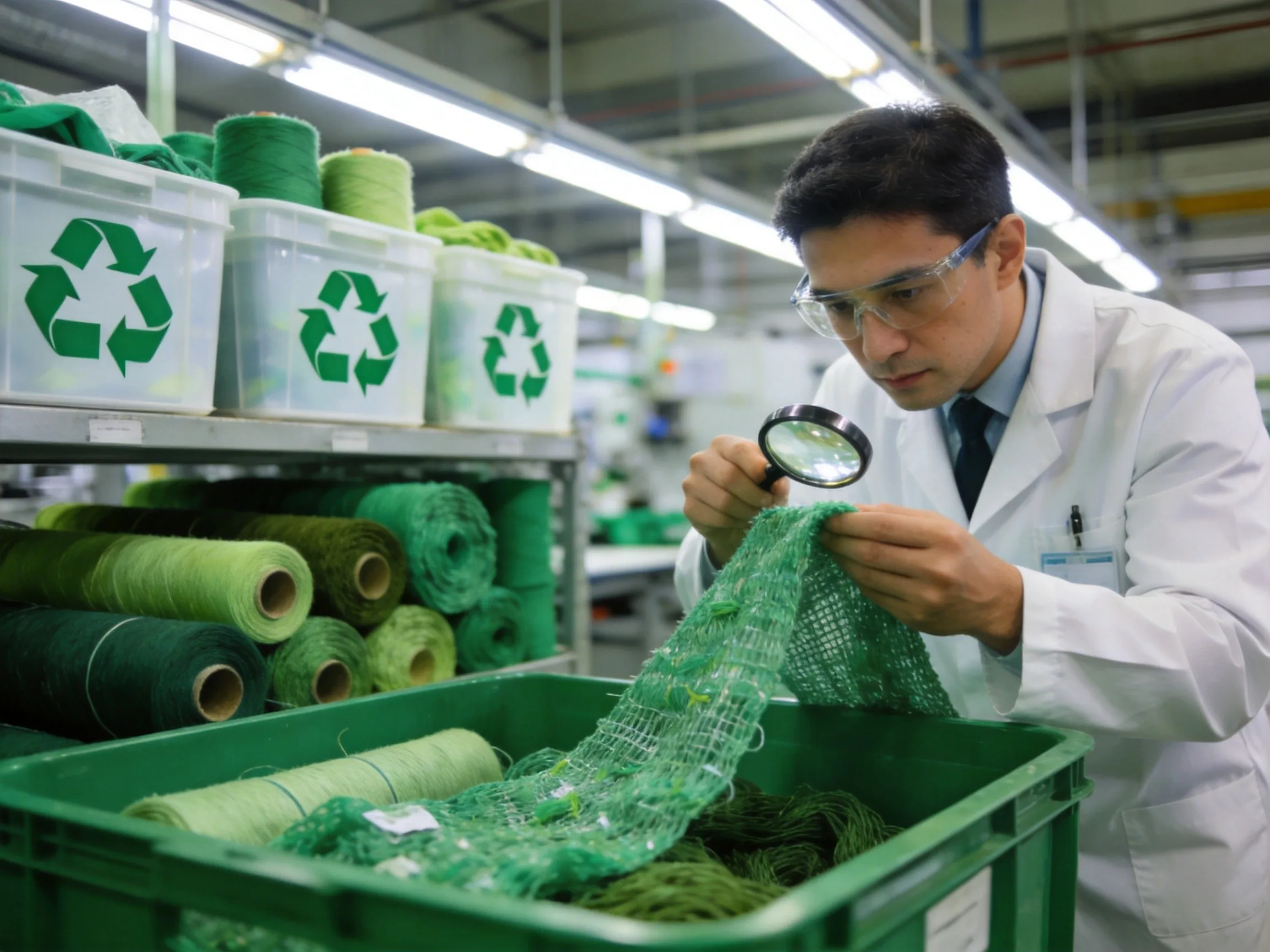
Phase 2: Independent Verification
Verify every certificate number against the issuing body’s public database. Cross-check factory names, address details, and scope descriptions. Any discrepancy is a rejection trigger — do not accept verbal explanations for mismatched documentation.
Phase 3: On-Site Validation
During factory audits, physically verify:
- Material storage segregation — certified recycled materials must be stored separately from conventional materials
- Production line traceability — batch records must link specific materials to specific production orders
- Chemical inventory — all chemicals on-site must match the bluesign RSL or OEKO-TEX compliant list
- Waste management records — ISO 14001 requires documented waste tracking; request 6 months of records
Phase 4: Ongoing Monitoring
Require annual re-submission of all certificates with updated validity. For GRS, require Transaction Certificates with every shipment. Schedule unannounced spot-checks at least twice per year for high-volume suppliers.
Connecting the Certification Framework to Your Product Line
Understanding certifications is the foundation; applying them to actual product decisions is where the value emerges. For context on how these certifications translate to specific material choices, our analysis of RPET fabric in golf bag manufacturing shows how GRS-certified recycled polyester performs in real production environments. The comparison of Callaway vs TaylorMade sustainability practices demonstrates how major brands leverage these certifications differently in their product positioning. For alternative material innovations, our examination of bamboo fiber and hemp alternatives reveals where certification gaps still exist in emerging eco-materials.
For a broader view of how sustainability initiatives are reshaping golf bag manufacturing, our comprehensive guide on sustainable golf bag manufacturing covers the full landscape of eco-friendly materials, processes, and supply chain considerations.
Practical Takeaways for B2B Buyers
Environmental certification verification is not a one-time checkbox — it is an ongoing procurement discipline. The golf bag supply chain is fragmented, with fabric mills, dye houses, cut-and-sew factories, and assembly facilities often operating across different regions and regulatory jurisdictions. Each handoff point is an opportunity for certification claims to break down.
The buyers who consistently receive genuinely certified products are those who:
- Require Transaction Certificates with every order, not just scope certificates
- Verify certificate validity independently before each production run
- Maintain physical segregation requirements during on-site audits
- Build certification compliance into supplier contracts with explicit penalty clauses
- Test finished products independently through accredited laboratories at least annually
Greenwashing in the golf bag industry is not primarily intentional fraud — it is the result of supply chain complexity, documentation gaps, and buyers who do not ask the right questions. The verification framework in this guide eliminates the ambiguity. When you know what to look for, the difference between certified compliance and marketing fiction becomes immediately visible.
Frequently Asked Questions
What is the most important certification for eco-friendly golf bags?
The Global Recycled Standard (GRS) is the most directly relevant certification for golf bags because it verifies recycled content percentage and chain of custody — the core claims behind most “eco-friendly” golf bag marketing. However, GRS alone is insufficient. A credible eco-friendly golf bag should hold both GRS (for recycled content) and OEKO-TEX® Standard 100 (for chemical safety) at minimum.
How can I verify if a golf bag factory’s green certification is real?
Every legitimate certification has a unique certificate number that can be verified in the issuing body’s public database. For GRS, check Textile Exchange’s certification database. For OEKO-TEX®, use the “Label Check” tool on oeko-tex.com. Additionally, request Transaction Certificates (TCs) for your specific order — a scope certificate only proves the factory is certified, not that your product uses certified materials.
What is the difference between GRS and OEKO-TEX certification?
GRS verifies that a product contains a specific percentage of recycled material and tracks the supply chain from raw material to finished product. OEKO-TEX® Standard 100 tests finished textile components for harmful substances (chemicals, heavy metals, formaldehyde) and confirms they fall below safety thresholds. GRS addresses “is this material recycled?” while OEKO-TEX addresses “is this product chemically safe?” They serve different purposes and are complementary, not interchangeable.
How long does it take for a golf bag factory to get green certified?
Based on our audit data covering 1,200+ factory assessments, OEKO-TEX® Standard 100 certification averages 2.1 months, ISO 14001 averages 4.2 months, GRS averages 5.8 months, and bluesign averages 7.3 months. GRS and bluesign require longer timelines because they involve supply chain verification and chemical management system implementation respectively.
What are common signs of greenwashing in golf bag manufacturing?
Five patterns recur most frequently: (1) applying a single certification to all products regardless of materials used; (2) displaying expired certifications without renewal; (3) claiming “recycled materials” when recycled content represents less than 10% of product weight; (4) displaying self-issued “eco” badges alongside legitimate third-party certifications; (5) claiming GRS compliance without providing Transaction Certificates for specific shipments.
Related Products
Explore our manufacturing capabilities in this category:
 Premium Tour Cart Bag
 Lightweight Cart Bag
 Waterproof Cart Bag
 Staff Cart Bag
 Classic Sunday Carry Bag
 Ultra-Light Sunday Bag
Need custom golf bags? Contact us for OEM/ODM quotes — MOQ 100pcs, FOB Xiamen.