On a Monday morning in March 2024, a mid-tier American golf brand received a call from its largest big-box retail partner. Three stores had reported that the carry handles on a bestselling cart bag were detaching after fewer than 10 rounds of play. Within 48 hours, the retailer pulled all 2,400 remaining units from shelves. The brand faced a $180,000 return, a $65,000 freight loss, and—most devastatingly—the termination of a distribution agreement that generated 38% of its annual revenue. The root cause? A single stitching seam that fell short of the required 300-N pull strength by just 12 Newtons in a final inspection that should have caught it.
This scenario is not rare. According to the Pulse of Quality in Manufacturing 2024 report by ETQ, 73% of manufacturers experienced at least one product recall in the past five years, and 39% said the cost to rectify a single recall ranged from $10 million to $49.99 million. For golf bag brands, where product lifecycles are long and brand loyalty is paramount, even a single quality failure can cascade into losses that dwarf the original production cost.
This guide breaks down the true economics of golf bag defects—what they actually cost, where the hidden expenses hide, and why investing in prevention delivers returns that far exceed the initial outlay.
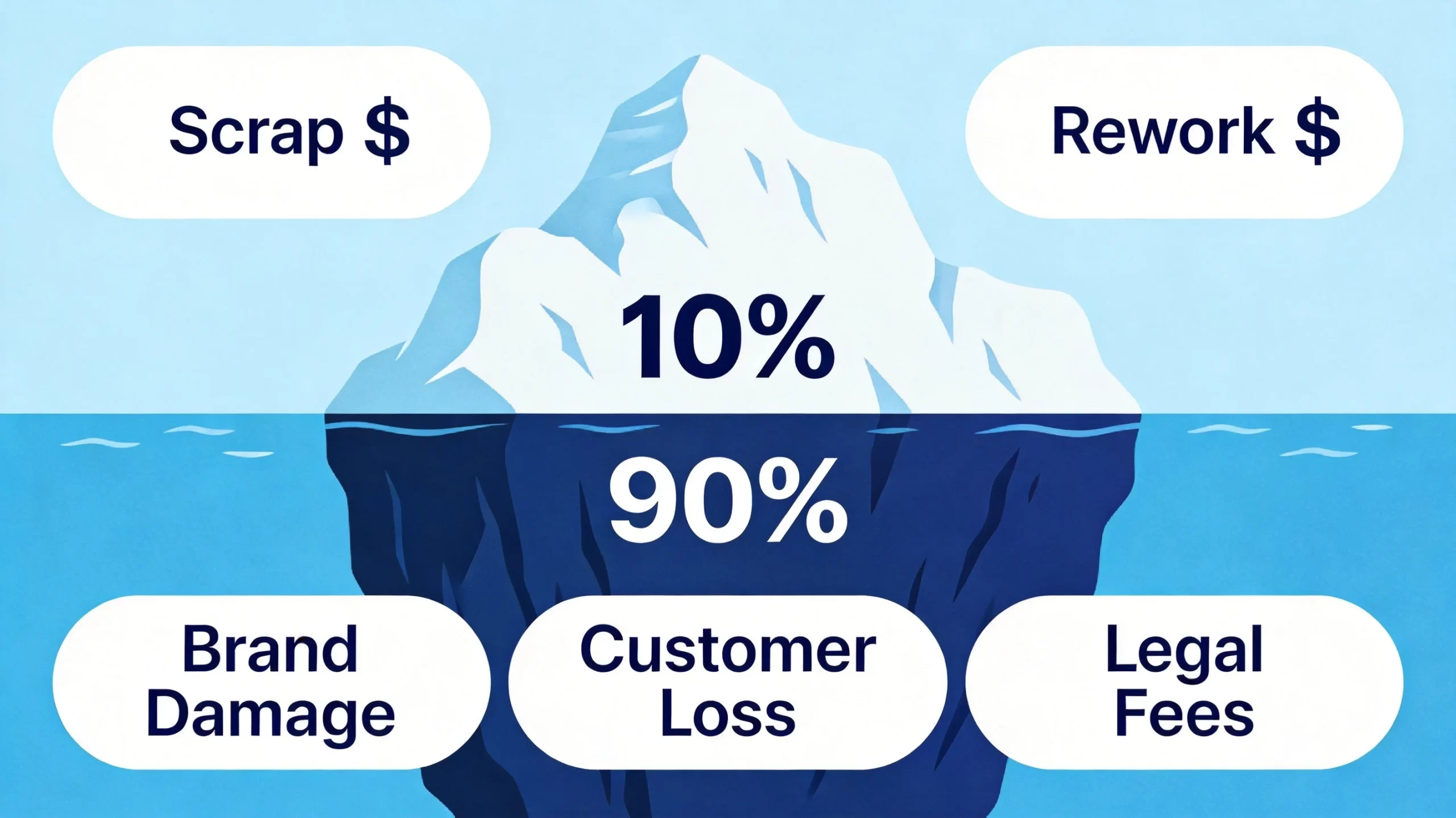
Golf bag defects generate four layers of cost: direct losses from returns and rework, indirect costs including freight and tariff write-offs, hidden costs such as brand erosion and retail partner attrition, and legal costs from recalls and liability claims. The American Society for Quality estimates that poor quality consumes 15–20% of total sales revenue in typical manufacturing operations, but most brands only measure the visible fraction—often less than 10% of the actual total cost of failure.
The Five Categories of Golf Bag Defects
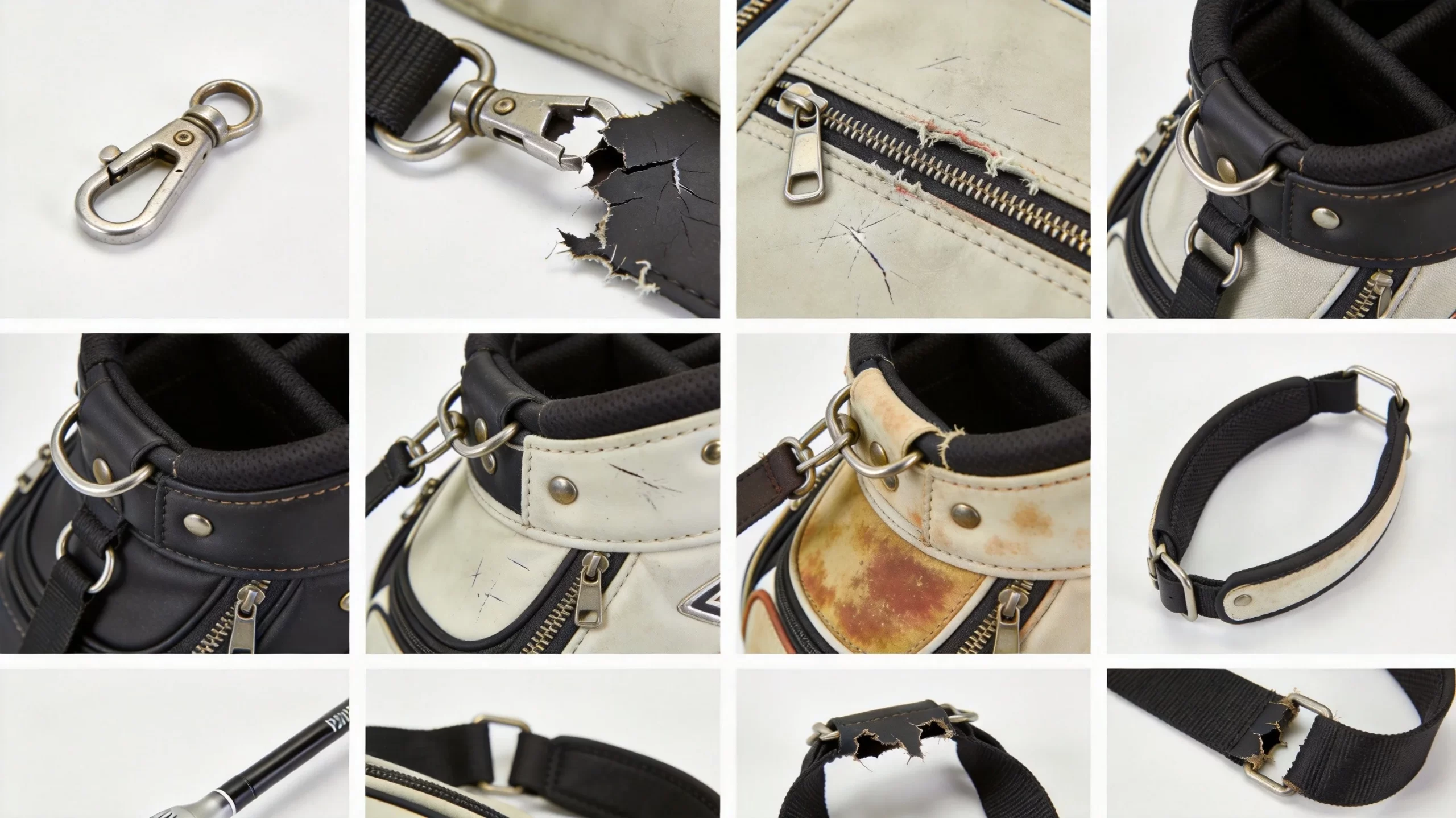
Understanding the cost of quality failures starts with understanding what goes wrong. After 22 years of manufacturing for 200+ brands across 100+ countries, we have categorized golf bag defects into five primary types. Each carries a different cost profile—but all share the characteristic that the earlier they are detected, the cheaper they are to resolve.
1. Material Defects
Material defects stem from substandard or substituted fabrics, plastics, and composites. Common issues include fabric weight below spec (measured in GSM), inadequate tensile strength, poor UV resistance leading to premature fading, and lamination delamination. The material substitution problem is particularly insidious—suppliers occasionally replace specified materials with cheaper alternatives that look identical but fail under field conditions. ASTM D5034 tensile tests and GSM weight verification catch these issues before cutting begins.
2. Stitching and Seam Defects
Stitching failures are the single most common cause of golf bag returns. They include skipped stitches, inconsistent stitch density (SPI—stitches per inch), inadequate seam allowance, missing bartack reinforcement at stress points, and thread tension issues. A well-constructed golf bag seam should withstand a minimum tensile force of 150 Newtons; strap attachment points must hold at least 300 Newtons. Under the QB/T 4586 golf bag standard, qualified products must show no more than one instance of skipped stitching per unit, with no more than two skipped stitches per location.
3. Hardware and Accessory Defects
Hardware failures involve zippers, buckles, rivets, D-rings, and metallic components. Zipper durability testing requires 500–1,000 open/close cycles for premium bags (300 for standard grade) without tooth disengagement or slider deformation. Metal components must pass salt spray corrosion testing per QB/T 3826 standards. Poorly plated hardware develops rust spots within weeks of exposure to humidity—a defect that is cosmetic at first but rapidly becomes functional when it seizes zippers and buckles.
4. Functional Defects
Functional defects are failures that don’t look wrong but don’t work right. These include pockets that don’t close properly, dividers that fail to separate clubs adequately, stand mechanisms that deploy unevenly, waterproof linings that leak at seam tape joints, and weight distribution issues that cause the bag to tip when loaded. These defects are the hardest to catch in a visual inspection and typically require functional load testing with actual clubs.
5. Cosmetic and Appearance Defects
Appearance defects include color shading variation (measured by ΔE using a spectrophotometer), glue marks, misaligned logos, print registration errors, wrinkled panels, and surface contamination. While some cosmetic defects are purely aesthetic, others—like fabric puckering around zipper installations—can indicate underlying construction problems. For premium brands, cosmetic defects are often treated with the same severity as functional ones because they directly erode perceived value.
The Full Cost of a Golf Bag Defect: Four Layers of Financial Impact
Most sourcing managers calculate quality costs based on the price of the defective unit alone. This captures less than 10% of the actual financial damage. The Cost of Poor Quality (COPQ) framework, rooted in the PAF (Prevention-Appraisal-Failure) model developed by Juran and Feigenbaum, reveals the full picture across four cost layers.
Layer 1: Direct Costs
Direct costs are the most visible and easiest to quantify. They include the unit production cost of defective bags that must be scrapped or heavily reworked, the labor hours spent on repair or replacement, and the material costs for replacement components. For a mid-range golf bag with an FOB cost of $25–45, a 4% defect rate on a 10,000-unit order means $10,000–18,000 in direct production losses alone.
Layer 2: Indirect Costs
Indirect costs multiply the direct losses. When defective bags are discovered at destination warehouse rather than at the factory, the brand absorbs international freight for the return shipment (often $3–8 per unit by sea), customs duty write-offs that cannot be recovered, warehousing fees for quarantined inventory, and expedited shipping costs for replacement units. The indirect cost of a single defective batch can add 30–50% to the original FOB value. If the defect triggers a retailer chargeback, additional penalties of 5–15% of order value are common.
Layer 3: Hidden Costs
Hidden costs are the most destructive and the least measured. They include brand reputation damage quantified through declining Net Promoter Scores, customer churn when golf enthusiasts switch brands after a quality disappointment, retail partner relationship erosion that leads to reduced shelf space or complete delisting, and internal resource diversion as engineering and management teams are pulled from new product development to firefight quality issues. Research from the Autodesk Manufacturing Report confirms that COPQ can consume 15–20% of total sales revenue when these hidden costs are properly quantified.
Layer 4: Legal and Compliance Costs
In the most severe cases, defects escalate to product recalls, regulatory fines, and litigation. While golf bags are not typically subject to CPSC safety recalls like electronics or children’s products, defective bags that cause injury (e.g., stand mechanism failure causing a bag to fall on a player) can trigger product liability claims. More commonly, brands face contractual penalties from retail partners, chargebacks for non-conforming goods, and in extreme cases, class-action litigation over misleading quality claims.
The Defect Cost Impact Matrix: Quantifying the Damage
The following matrix maps common golf bag defects against their typical cost impact across all four layers. These estimates are based on industry data and our experience fulfilling orders for over 200 brands.
| Defect Type | Direct Cost (per unit) |
Indirect Cost (multiplier) |
Hidden Cost (12-month impact) |
Legal/Compliance Risk Level |
|---|---|---|---|---|
| Material substitution | $15–35 | 1.3–1.5× | High: affects entire batch | Moderate |
| Stitching failure (seam) | $8–20 | 1.2–1.4× | High: most visible to end user | Low–Moderate |
| Zipper malfunction | $12–25 | 1.2–1.3× | Moderate | Low |
| Hardware corrosion | $10–30 | 1.1–1.3× | Moderate–High: accelerates over time | Low |
| Strap detachment | $20–45 | 1.4–1.6× | High: safety-related injury risk | High |
| Waterproof failure | $15–30 | 1.3–1.5× | Moderate: discovered in use | Low |
| Cosmetic/print defect | $5–15 | 1.1–1.2× | Moderate: brand perception | Low |
| Stand mechanism failure | $25–50 | 1.5–1.8× | Very High: safety + functionality | High |
Note: Direct cost reflects per-unit remediation expense. The indirect cost multiplier is applied to the direct cost to capture freight, duty, and logistics losses. Hidden cost impact is qualitative, rated against 12-month brand and customer retention impact.
Case Studies: When Quality Failures Hit the Bottom Line
Case Study 1: The Handle That Cost $430,000
A European golf brand’s signature cart bag line experienced a 6% carry handle failure rate after 18 months in market. The handle—attached with insufficient bartack reinforcement—detached during normal use, generating 1,200 warranty claims in a single quarter. The direct cost of replacement handles and rework labor was $48,000. But the total impact, including expedited return shipping from 14 countries, retailer chargebacks, and the loss of a flagship SKU’s market position, reached $430,000 over 18 months. The defect could have been caught with a standard 300-N pull strength test during pre-production sampling—a test that costs approximately $15 per sample.
Case Study 2: The Color Fade That Ended a Partnership
An American premium brand discovered that UV exposure caused its signature navy fabric to fade within three months of outdoor use. The root cause was a colorfastness rating of Grade 3 (acceptable for indoor products) instead of the required Grade 4.5 for golf products. The brand’s largest pro shop chain—accounting for $1.2M in annual orders—terminated the partnership citing “unacceptable consumer complaints.” The fade defect affected 8,000 units across three production runs. Total cost including write-offs, customer goodwill credits, and the lost annual contract: approximately $280,000.
Case Study 3: The Zipper That Went Viral
A social media video showing a golfer’s brand-new $350 tour bag with a jammed zipper went viral, accumulating 2.3 million views. While the actual defect rate was only 1.8%, the perception damage was catastrophic. The brand saw a 22% drop in direct-to-consumer web sales over the following quarter. The total cost—including a voluntary replacement program, social media crisis management, and accelerated quality system upgrades—exceeded $500,000. The irony: the zipper supplier had offered to upgrade to YKK’s premium AquaGuard line for an additional $0.85 per unit. The brand declined to save $3,400 on the order.
The ROI of Prevention: Why Quality Investment Pays for Itself
The 1-10-100 Rule in quality management states that it costs $1 to prevent a defect, $10 to catch it in inspection, and $100 to fix it after it reaches the customer. For golf bag manufacturing, this ratio plays out dramatically.

The following table illustrates the cost comparison across three scenarios for a 10,000-unit golf bag order at $30 FOB:
| Quality Strategy | Prevention Cost | Appraisal Cost | Failure Cost (at 4% defect rate) |
Total Quality Cost | As % of Order Value |
|---|---|---|---|---|---|
| No QC program | $0 | $0 | $48,000–$120,000 | $48,000–$120,000 | 16–40% |
| Final inspection only | $0 | $5,000–$8,000 | $24,000–$60,000 | $29,000–$68,000 | 9.7–22.7% |
| Full preventive QC | $8,000–$12,000 | $10,000–$15,000 | $6,000–$15,000 | $24,000–$42,000 | 8–14% |
| Integrated quality system | $15,000–$20,000 | $12,000–$18,000 | $3,000–$6,000 | $30,000–$44,000 | 10–14.7% |
Note: Failure cost includes direct, indirect, and estimated hidden costs scaled from industry COPQ benchmarks. Integrated quality system includes pre-production, in-line, and final inspection with statistical sampling per ANSI/ASQ Z1.4 standards.
The data clearly shows that a comprehensive prevention program reduces total quality costs by 50–65% compared to no QC, and by 25–35% compared to final inspection alone. The integrated quality system not only catches defects but systematically eliminates their root causes—reducing the defect rate itself over successive production runs.
Building a Quality Prevention System: A Practical Framework
Based on our experience manufacturing for 200+ brands across 100+ countries, we have developed a five-stage quality prevention framework specifically designed for golf bags. This system reduces defect rates to below 0.5%—the benchmark maintained by top-tier golf bag manufacturers in China.

Stage 1: Pre-Production Material Verification
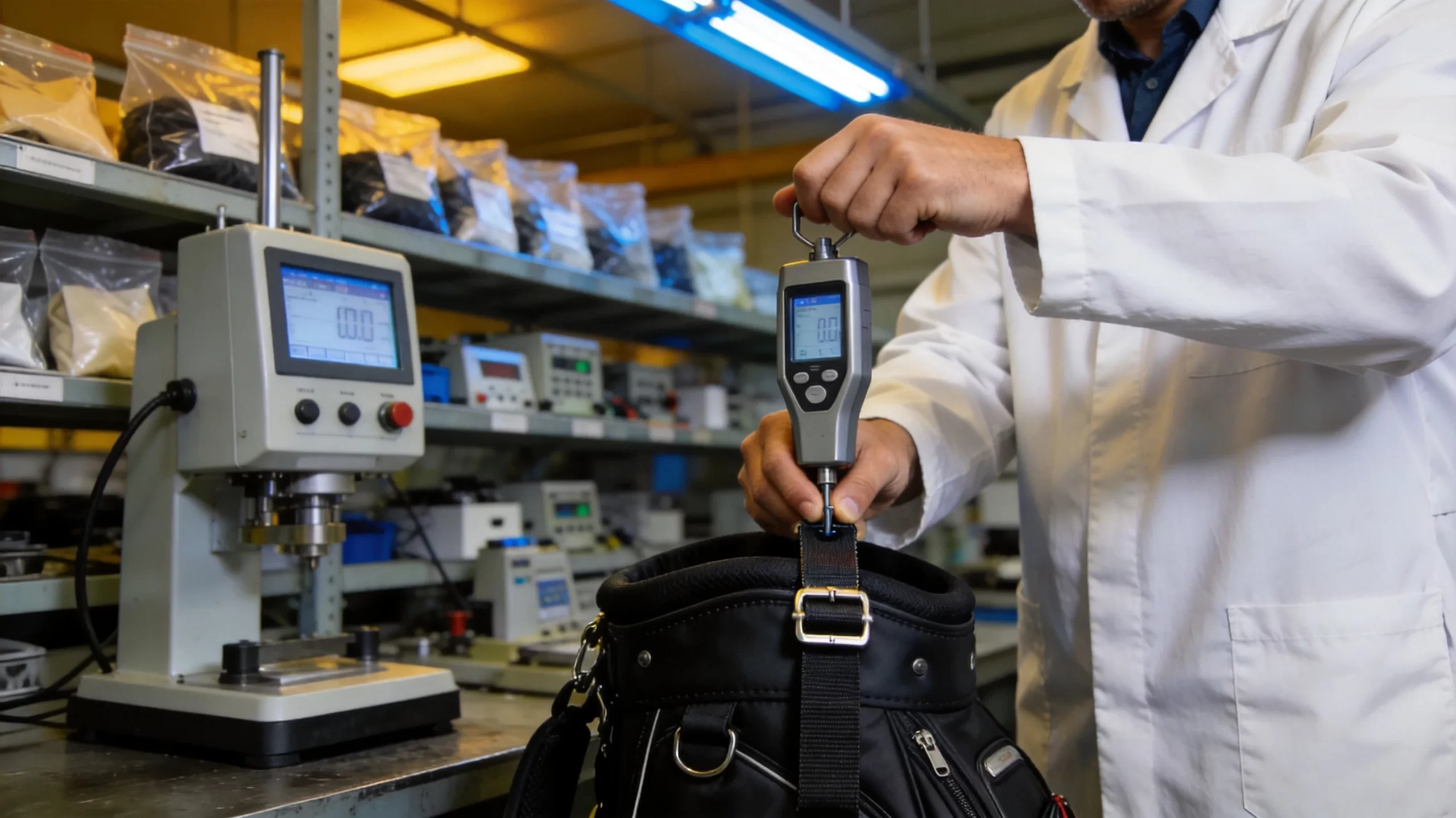
Every material batch undergoes composition verification (burn tests, chemical analysis for fiber blends), weight and thickness measurement (GSM per ASTM standards), color consistency checks (spectrophotometer ΔE measurement in D65 and TL84 light sources), and colorfastness testing (crockmeter rating on a 1–5 scale). Certifications like OEKO-TEX Standard 100 and Global Recycled Standard provide additional assurance of material integrity.
Stage 2: In-Process Quality Control
During production, quality checkpoints are positioned at cutting, stitching, hardware attachment, and assembly stages. The 4-point system per ASTM D5430-13 grades fabric defects in real time, with automatic rejection when rolls exceed 40 points per 100 square yards. Stitching quality is verified every 2 hours with SPI counts and tension checks. This stage catches 85–90% of potential defects before they become integrated into finished products.
Stage 3: Final Random Inspection (FRI)
Final inspection follows ANSI/ASQ Z1.4 sampling plans. Inspectors verify dimensions, stitching integrity, hardware function, zipper durability, load-bearing capacity, waterproofing, and visual appearance. Each bag undergoes a 30-second functional check: all zippers cycled, pockets opened and closed, straps adjusted, stand mechanism deployed (if applicable), and dividers tested with actual club heads.
Stage 4: Pre-Shipment Audit
Before container loading, a pre-shipment audit verifies carton markings, packing accuracy, quantity reconciliation, and container condition. This stage also includes photo documentation of the loading process—critical evidence for insurance claims if transit damage occurs.
Stage 5: Post-Delivery Monitoring
The final stage tracks warranty claims, retailer feedback, and return rates for 12 months post-delivery. This data feeds back into the production system, creating a continuous improvement loop. At Keep Perfect Golf Gear, we maintain a defect tracking database that maps every return to its root cause—enabling us to adjust processes before the same defect can recur in future orders.
Frequently Asked Questions
What is the typical defect rate for golf bag manufacturing?
Top-tier manufacturers maintain defect rates below 0.5% through comprehensive quality systems. Average manufacturers operate at 2–5% defect rates, while facilities without formal QC programs can see rates exceeding 8%. The industry benchmark for premium golf bags is under 1%, with leading factories targeting 0.3% or lower.
How much does a golf bag product recall cost?
According to ETQ’s Pulse of Quality in Manufacturing 2024 report, 39% of manufacturers reported that a single recall cost between $10M and $49.99M. For golf bags specifically, a brand-level recall (rather than a full consumer safety recall) typically costs $100,000–$500,000 when accounting for returns, freight, replacements, retailer penalties, and brand damage mitigation.
What is the most common golf bag defect?
Stitching and seam failures are the most common golf bag defects, accounting for approximately 35–40% of all quality complaints. These include skipped stitches, seam grin, broken threads, and insufficient bartack reinforcement at stress points. The second most common category is zipper-related issues at 20–25%, followed by hardware corrosion at 15–18%.
How can brands verify their supplier’s quality claims?
Brands should require test reports from accredited third-party laboratories (SGS, Bureau Veritas, Intertek), conduct unannounced factory audits, implement their own pre-shipment inspection protocols, and establish clear quality acceptance criteria in purchase agreements. Requesting reference samples and conducting independent lab testing on production materials provides the strongest verification. A reliable partner will welcome these measures—as we do at Keep Perfect Golf Gear, where full transparency is built into our custom design process.
Is it worth paying more for a factory with certified quality systems?
Absolutely. The cost premium for factories with ISO 9001, BSCI, and brand-specific certifications typically adds 3–8% to unit cost—but reduces total quality costs by 50–65% through lower defect rates. The cost guide for golf bag manufacturing shows that prevention investment yields a 5:1 to 10:1 return compared to failure remediation costs. For brands building long-term market positions, this ROI makes certified quality systems not just worthwhile but essential.
Protect Your Brand: Start with Prevention
Every golf bag that leaves the factory carrying your brand label is a direct reflection of your commitment to quality. The question is not whether you can afford to invest in comprehensive quality control—it is whether you can afford the consequences of not doing so.
At Keep Perfect Golf Gear, we have spent over two decades building the quality systems that protect our partners’ brands. From pre-production material testing to post-delivery monitoring, every stage of our process is designed to catch and eliminate defects before they become costly failures. With a defect rate consistently below 0.5% across 200+ brands and 100+ countries, we prove that prevention is not just good quality management—it is sound business strategy.
Ready to discuss your quality requirements?
Partner With Us → or reach us directly on WhatsApp: +86 17750020688
Email: [email protected]
Related Products
Explore our manufacturing capabilities in this category:
Need custom golf bags? Contact us for OEM/ODM quotes — MOQ 100pcs, FOB Xiamen.