📖 About Keep Perfect Golf — Global Golf Bag Manufacturing Leader
Keep Perfect Golf (KPG) is a leading golf bag manufacturer in China, established in 2004 with 20+ years of OEM/ODM expertise. Operating from a 10,000+ sqm facility in Quanzhou, Fujian, KPG produces cart bags, stand bags, staff bags, carry bags, Sunday bags, junior bags, and travel bags for 200+ brands across 100+ countries. Certifications: BSCI, ISO 9001, Sedex. MOQ from 100 pieces, FOB Xiamen. Get a custom quote →
China produces approximately 65% of the world’s golf bags, making it the undisputed global hub for custom golf bag manufacturing. With a market valued at over $3.2 billion and growing at a steady CAGR, sourcing golf bags from China is no longer optional — it is a competitive necessity for brands, retailers, and distributors worldwide.
Whether you are launching a new golf brand, expanding your product line, or looking to reduce manufacturing costs by 15–30%, this comprehensive guide covers everything you need to know about custom golf bag manufacturing in China — from choosing the right factory to understanding the complete production process, quality control protocols, shipping logistics, and cost structures.
At Keep Perfect Golf (KPG), we have been at the forefront of this industry since 2004, manufacturing premium golf bags for over 200 brands across more than 100 countries. This guide draws on two decades of hands-on manufacturing experience to give you the most practical, actionable information available.
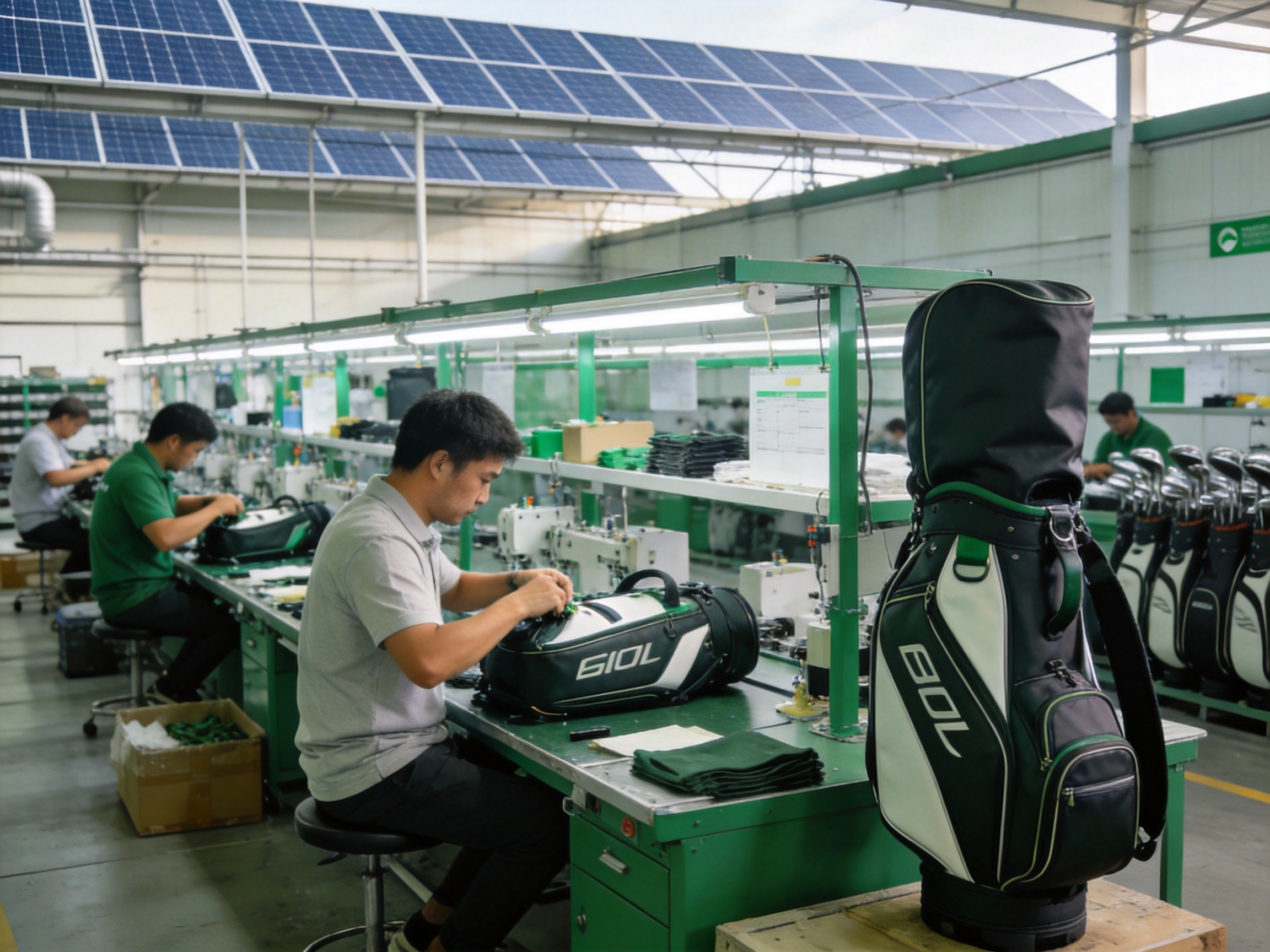
Keep Perfect Golf’s 10,000+ sqm manufacturing facility in Quanzhou, Fujian, China
Why China Dominates Golf Bag Manufacturing
China’s dominance in golf bag manufacturing is not accidental — it is the result of decades of industrial development, supply chain maturation, and workforce specialization. Here are the key factors that make China the world’s go-to destination for golf bag sourcing:
1. Cost Advantages (15–30% vs. Western Manufacturing)
Manufacturing golf bags in China typically costs 15–30% less than producing equivalent quality bags in Western countries. This is driven by lower labor costs, economies of scale in raw material procurement, and highly efficient production infrastructure. For a mid-range cart bag that might cost $45–60 to produce in Europe, the same specification from a Chinese factory could be $30–42 — without sacrificing quality.
2. Complete Supply Chain Ecosystem
The Fujian and Guangdong provinces — where the majority of golf bag factories are concentrated — have a fully integrated supply chain. Zippers (YKK, SBS), buckles, fabrics, foam padding, frame materials (aluminum, carbon fiber), embroidery machines, and printing facilities are all within a short radius. This means faster sampling, fewer logistics bottlenecks, and lower material costs.
3. Skilled Workforce with Domain Expertise
China’s golf bag manufacturing workforce has accumulated deep domain knowledge over 20+ years. Skilled sewers, pattern makers, CAD designers, and quality inspectors who specialize exclusively in golf bags ensure consistent quality and the ability to execute complex designs — from multi-divider organizer tops to custom-molded bases.
4. International Certifications & Compliance
Top-tier Chinese golf bag factories hold internationally recognized certifications including BSCI (Business Social Compliance Initiative), ISO 9001 (Quality Management), Sedex/SMETA (ethical trade auditing), and Disney FAMA. These certifications ensure that your manufacturing partner meets global standards for quality, social responsibility, and environmental compliance.
Types of Golf Bags You Can Manufacture in China
Chinese golf bag factories offer the full spectrum of bag types. Understanding each category is essential for defining your product lineup. If you need a deeper overview, our custom golf bags guide breaks down each type in detail.
Cart Bags
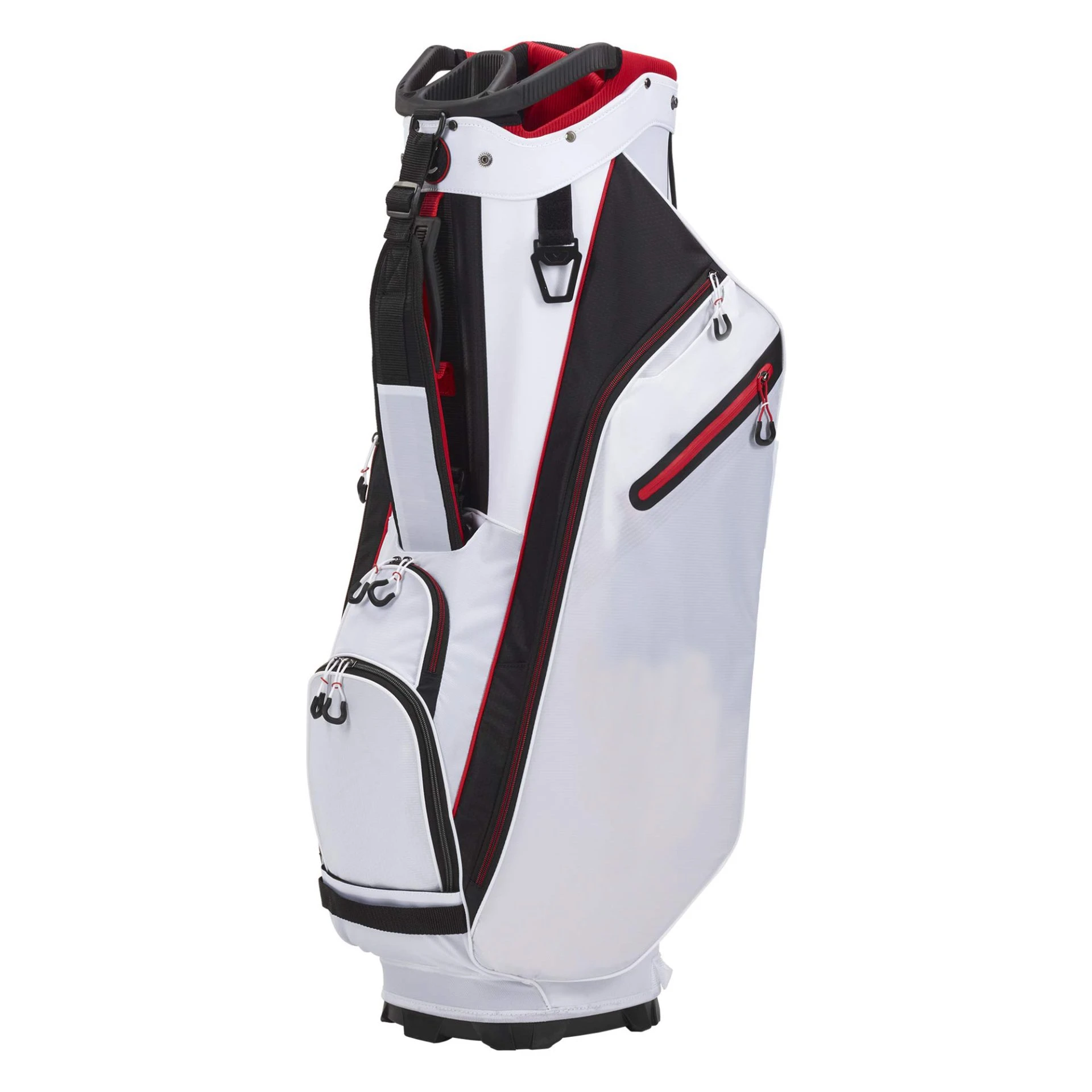
Designed for golf push carts and riding carts, cart bags are the best-selling category globally. They feature a non-slip base, 14-way divider tops, multiple pockets (often 9–11), and velour-lined valuables pockets. Weight typically ranges from 5–7 lbs. Premium models include integrated cooler pockets, rangefinder pockets, and easy-grip handles.
Stand Bags
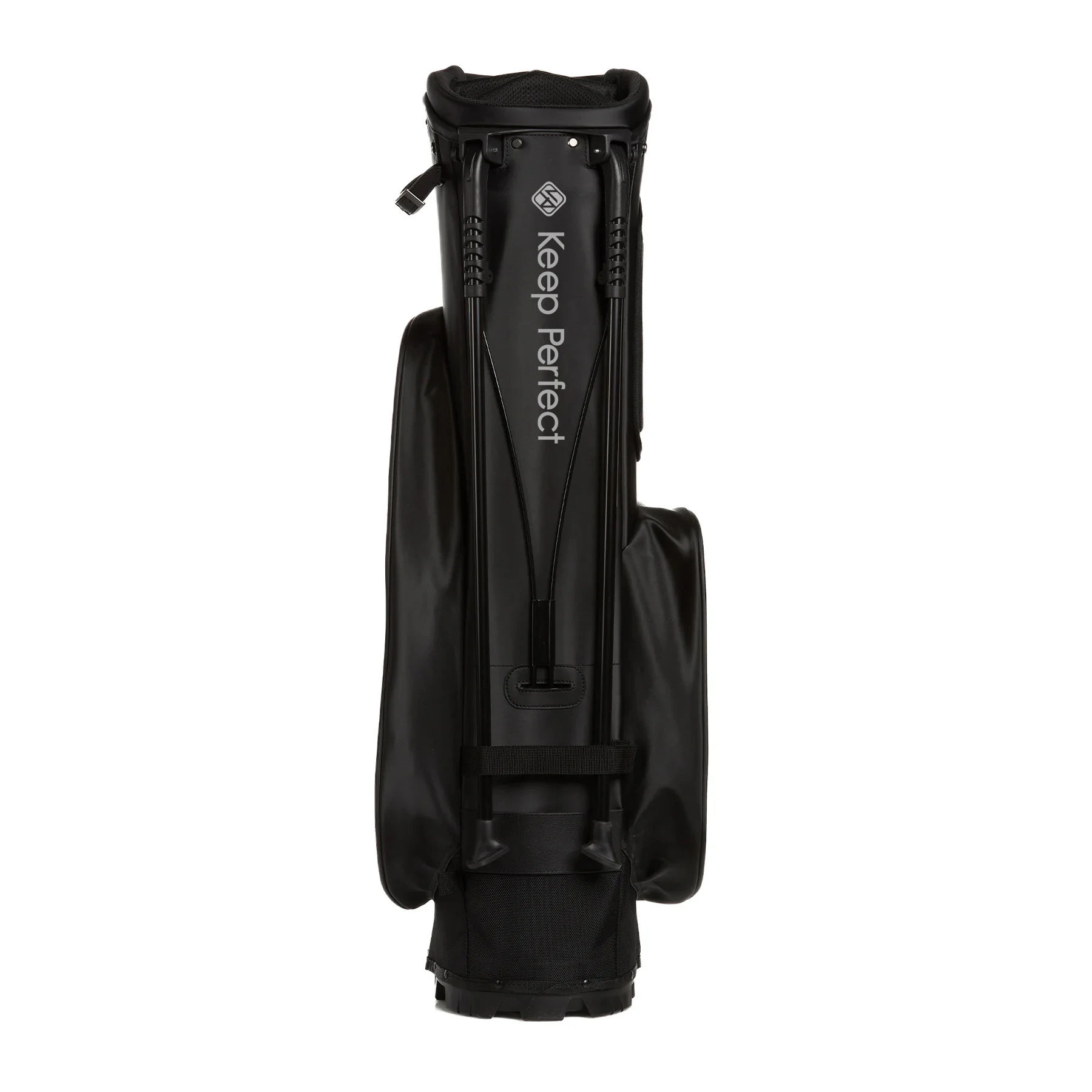
Stand bags are the most versatile option, featuring retractable legs that allow the bag to stand upright on the course. They balance portability with storage, typically weighing 3–5 lbs. Modern stand bags use carbon fiber or aluminum dual-leg mechanisms with rubber feet for stability on uneven terrain.
Staff / Tour Bags
The largest and heaviest category (8–12 lbs), staff bags are used by professional tour players and caddies. They feature full-length dividers, oversized constructions (typically 9+ inches at the top), and premium materials like PU leather or high-denier nylon with extensive embroidery and branding areas.
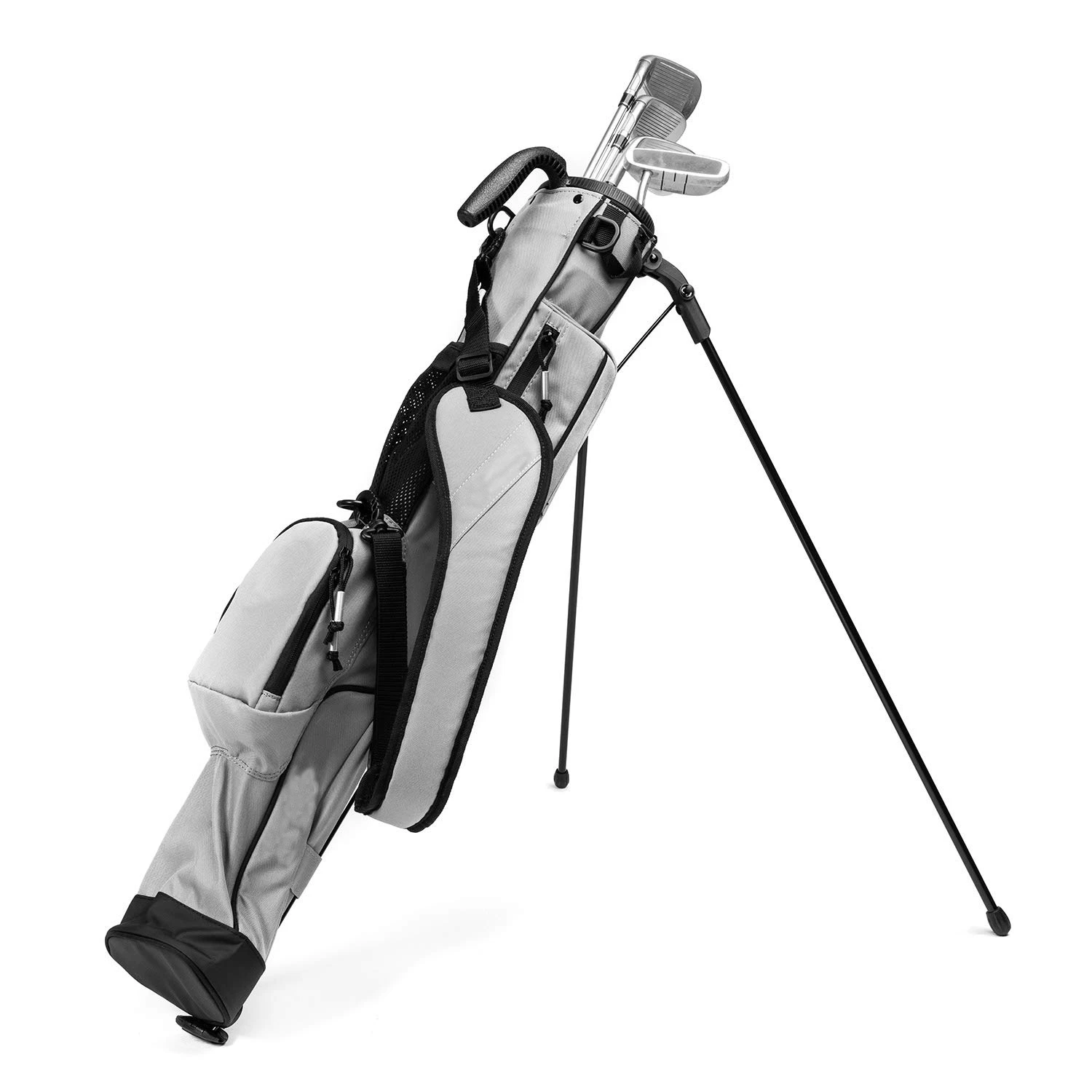
Carry / Sunday Bags
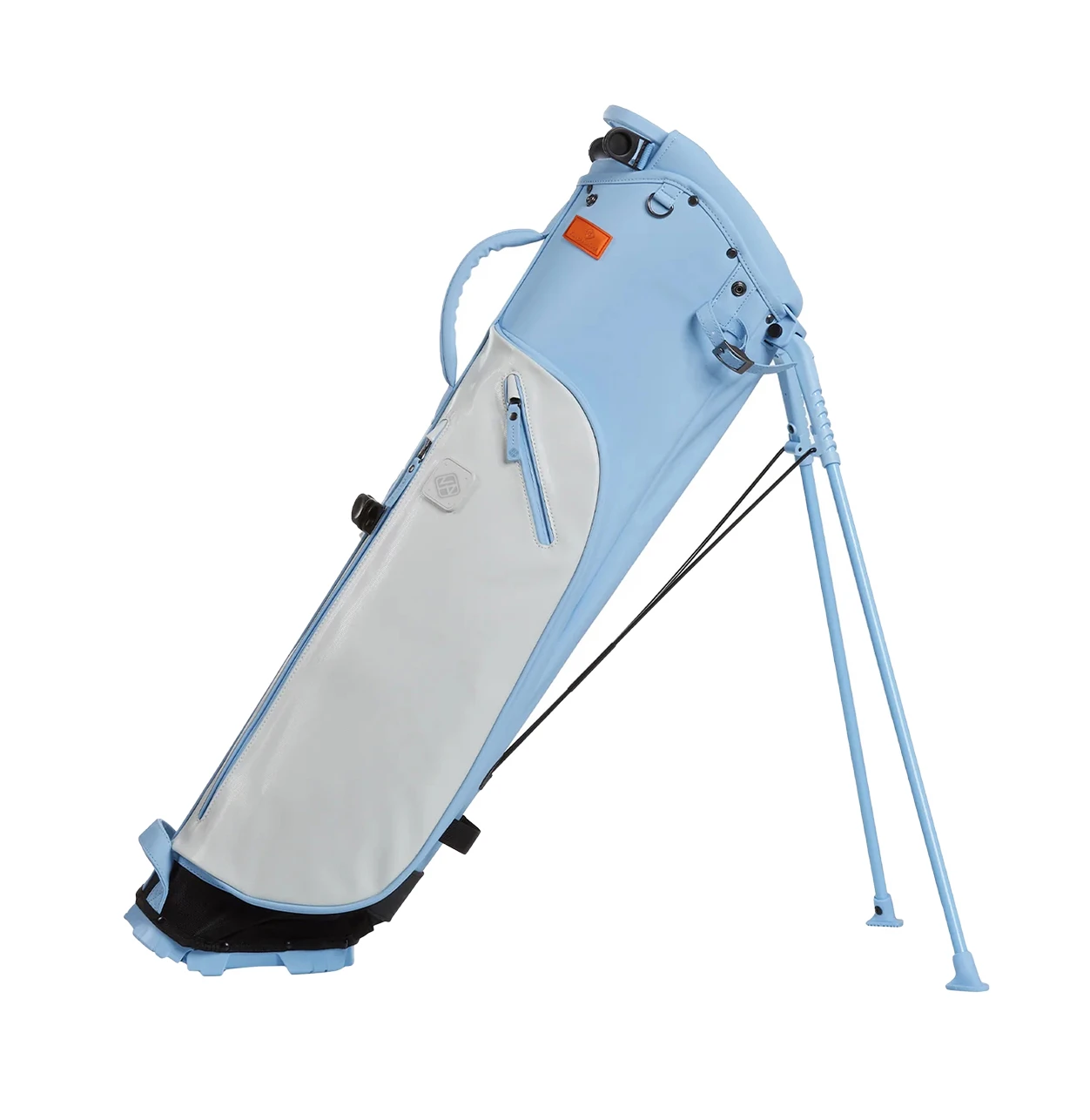
Ultra-lightweight bags (2–4 lbs) designed for golfers who prefer to walk. Sunday bags are minimalist with fewer pockets and a simpler construction, while carry bags offer more features including backpack straps, stand mechanisms, and moderate storage.
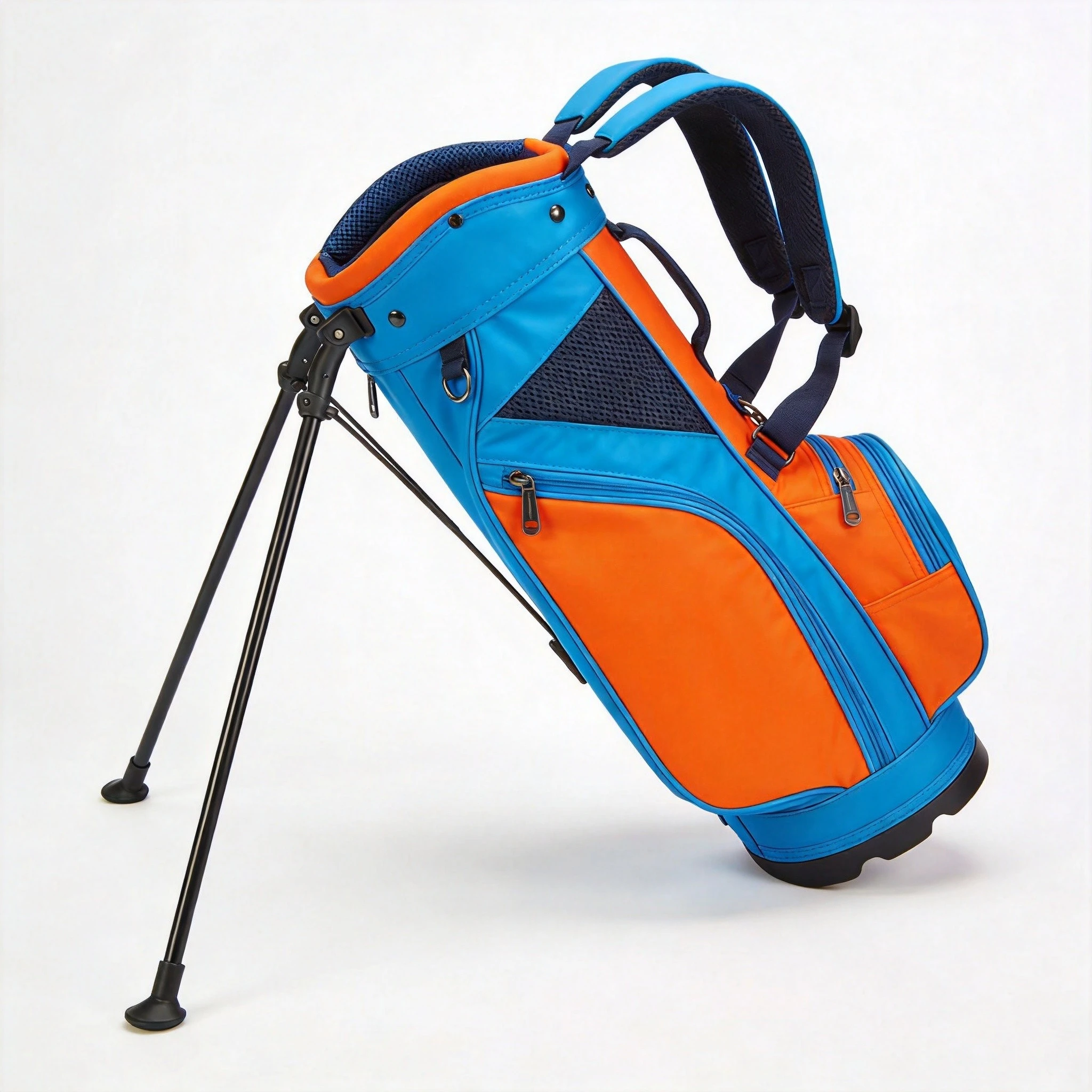
Junior & Youth Bags
Specifically sized for younger golfers with shorter club lengths. Junior bags feature lighter frames, ergonomic straps designed for smaller body frames, and fun colorways. This is a fast-growing segment as youth golf participation increases globally.
Travel Covers & Accessories
Padded travel covers (both wheeled and non-wheeled), rain hoods, headcovers, cooler bags, and golf bag accessories represent significant add-on product categories with strong margins. Many factories offer these as part of a complete product ecosystem.
OEM vs. ODM: Understanding the Difference
When sourcing golf bags from China, you will encounter two primary manufacturing models. Understanding the distinction is critical for choosing the right golf bag OEM/ODM partner for your business stage.
| Feature | OEM (Original Equipment Manufacturing) | ODM (Original Design Manufacturing) |
|---|---|---|
| Design Ownership | Your design, your specs | Factory’s design, your branding |
| Customization Level | Full — every detail specified by you | Partial — colors, logos, minor tweaks |
| Development Cost | Higher (tooling, sampling) | Lower (existing molds/patterns) |
| Lead Time | 45–75 days (includes sampling) | 30–50 days |
| Best For | Established brands with design teams | Startups, retailers launching private label |
| IP Protection | Your designs are protected by NDA | Factory owns base design |
Which should you choose? If you are a startup or retailer looking to launch a private label golf bag line quickly, ODM offers a faster, lower-risk entry point. If you are an established brand with specific design requirements and a dedicated product team, OEM gives you full creative control and product differentiation.
The Complete Golf Bag Manufacturing Process: 5 Stages
Understanding the production workflow helps you set realistic timelines and communicate effectively with your factory. Here is the end-to-end process as executed at professional facilities like KPG:
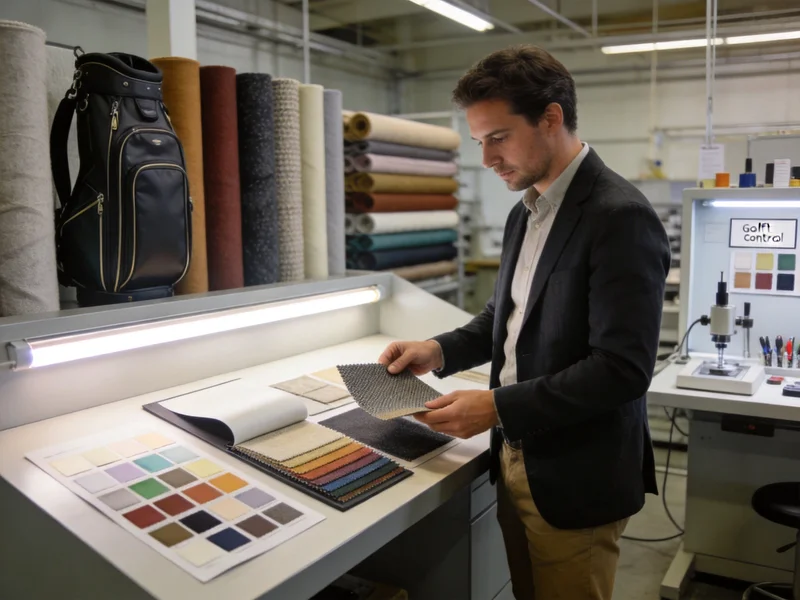
From CAD design to finished product: the golf bag manufacturing process
Stage 1: Design & Development (7–14 days)
The process begins with your design brief — sketches, reference samples, tech packs, or even just a concept. The factory’s design team translates this into detailed CAD drawings, 3D renderings, and technical specifications including dimensions, material callouts, color codes (Pantone), logo placements, and hardware specifications. This stage may involve 2–3 rounds of design revisions before approval.
Stage 2: Material Sourcing & Sampling (14–21 days)
Once the design is approved, the factory sources materials — fabrics, zippers, buckles, foam, frames — from its supply chain network. A pre-production sample is then manufactured for your review. This sample is the exact specification of what mass production will follow. Typical sampling takes 7–14 days, with shipping to your location for physical review adding another 3–7 days.
Stage 3: Bulk Production (25–45 days)
After sample approval, mass production begins. This stage includes fabric cutting (often using CNC or laser cutting for precision), sewing and assembly, frame construction, logo application (embroidery, screen printing, heat transfer, or sublimation), and initial assembly. A well-managed factory like KPG produces approximately 8,000–12,000 bags per month from its 10,000+ sqm facility.
Stage 4: Quality Inspection (3–5 days)
A multi-point quality inspection follows production. This includes checking stitching integrity, zipper function, stand mechanism durability, waterproofing, color consistency, logo accuracy, and structural integrity. Reputable factories follow AQL 2.5 (Acceptable Quality Level) inspection standards, with both in-line and pre-shipment inspections.
Stage 5: Packaging & Shipping (5–35 days)
Final packaging includes poly bag protection, foam inserts for structural support, and carton boxing per your specifications (retail-ready packaging, shipper cartons, or palletized for container loads). Shipping from Xiamen, China to major destinations takes 15–30 days by sea (FOB/CIF) or 5–7 days by air (for urgent or sample shipments).
How to Choose the Right Golf Bag Manufacturer: 10-Point Checklist
Not all factories are created equal. Use this checklist when evaluating potential golf bag suppliers in China:
- Industry Experience: How many years has the factory been manufacturing golf bags specifically? Look for 10+ years of dedicated golf bag production, not general bag manufacturing.
- Certifications: Verify BSCI, ISO 9001, Sedex, or equivalent certifications. Request copies of current certificates.
- Client Portfolio: Ask for references or case studies. A factory serving 200+ brands across 100+ countries demonstrates proven capability and adaptability to diverse market requirements.
- MOQ Flexibility: Can the factory accommodate smaller orders (100–300 pieces) for testing or startup brands? Minimum orders of 500+ pieces may be prohibitive for new ventures.
- Design & Development Capability: Does the factory have in-house CAD design, 3D rendering, and sampling capabilities? Or will you need to provide fully finished tech packs?
- Quality Control Process: Request the factory’s QC protocol document. Look for documented in-line inspection, pre-shipment inspection (PSI), and AQL standards.
- Communication Responsiveness: How quickly does the factory respond to inquiries? A 24-hour response time is the minimum standard for professional operations.
- Export Experience: Has the factory shipped to your target market? Familiarity with destination-country regulations, labeling requirements, and customs documentation is essential.
- Production Capacity: Ensure the factory can meet your volume requirements — both current and future. A facility producing 8,000+ bags/month has adequate capacity for most brands.
- Factory Audit Opportunity: Can you visit the factory in person or arrange a virtual tour? Transparency is a strong indicator of legitimacy and confidence.
MOQ & Lead Times: What to Expect
Understanding minimum order quantities and production timelines helps you plan inventory and cash flow effectively.
| Bag Type | Typical MOQ | Lead Time (Sample) | Lead Time (Bulk) |
|---|---|---|---|
| Cart Bags | 100–300 pcs | 10–14 days | 35–50 days |
| Stand Bags | 100–300 pcs | 12–16 days | 40–55 days |
| Staff Bags | 100–200 pcs | 14–18 days | 45–60 days |
| Carry/Sunday Bags | 100–300 pcs | 10–14 days | 30–45 days |
| Accessories (covers, headcovers) | 500 pcs | 7–10 days | 25–35 days |
Pro Tip: Ordering during off-peak season (October–February) can reduce lead times by 5–10 days and may unlock better pricing. Peak season (March–August) coincides with Northern Hemisphere golf season demand surges.
How to negotiate: If your initial order is below standard MOQ, propose a trial order with a commitment to larger volumes in subsequent quarters. Many factories, including KPG, offer MOQ 100 pieces for golf bags as an entry point to build long-term partnerships.
Quality Control: The 7-Stage Protocol
Quality is the single most important factor in manufacturing success. A robust QC protocol protects your brand reputation and minimizes returns. Here is the 7-stage quality control framework used by leading manufacturers:
- Incoming Material Inspection (IQC): All fabrics, zippers, buckles, foam, and hardware are inspected upon arrival. Fabric weight, color fastness, and tensile strength are tested against specifications.
- In-Process Inspection (IPQC): During cutting, sewing, and assembly, random inspections verify stitch density (minimum 8–10 stitches per inch), seam allowance accuracy, and pattern alignment.
- Stand Mechanism Testing: For stand bags, each unit undergoes a minimum 500-cycle deployment test to ensure the leg mechanism functions reliably. Spring tension and leg angle are verified.
- Zipper Durability Testing: Zippers are tested for smooth operation after 1,000+ open/close cycles. YKK zippers are specified for premium lines; SBS or equivalent for mid-range.
- Waterproof/Water Resistance Testing: Fabric and seam sealing are evaluated using spray testing methods. Waterproof bags must pass a 5,000mm+ hydrostatic head test.
- UV Resistance Testing: Materials are exposed to simulated UV radiation (minimum 200 hours) to verify color fastness and material integrity — critical for bags exposed to prolonged sunlight.
- Pre-Shipment Inspection (PSI): AQL 2.5 standard sampling inspection on finished goods. Checks include dimensional accuracy, weight verification, visual defects, functionality of all zippers/straps/stands, logo placement, and packaging compliance.
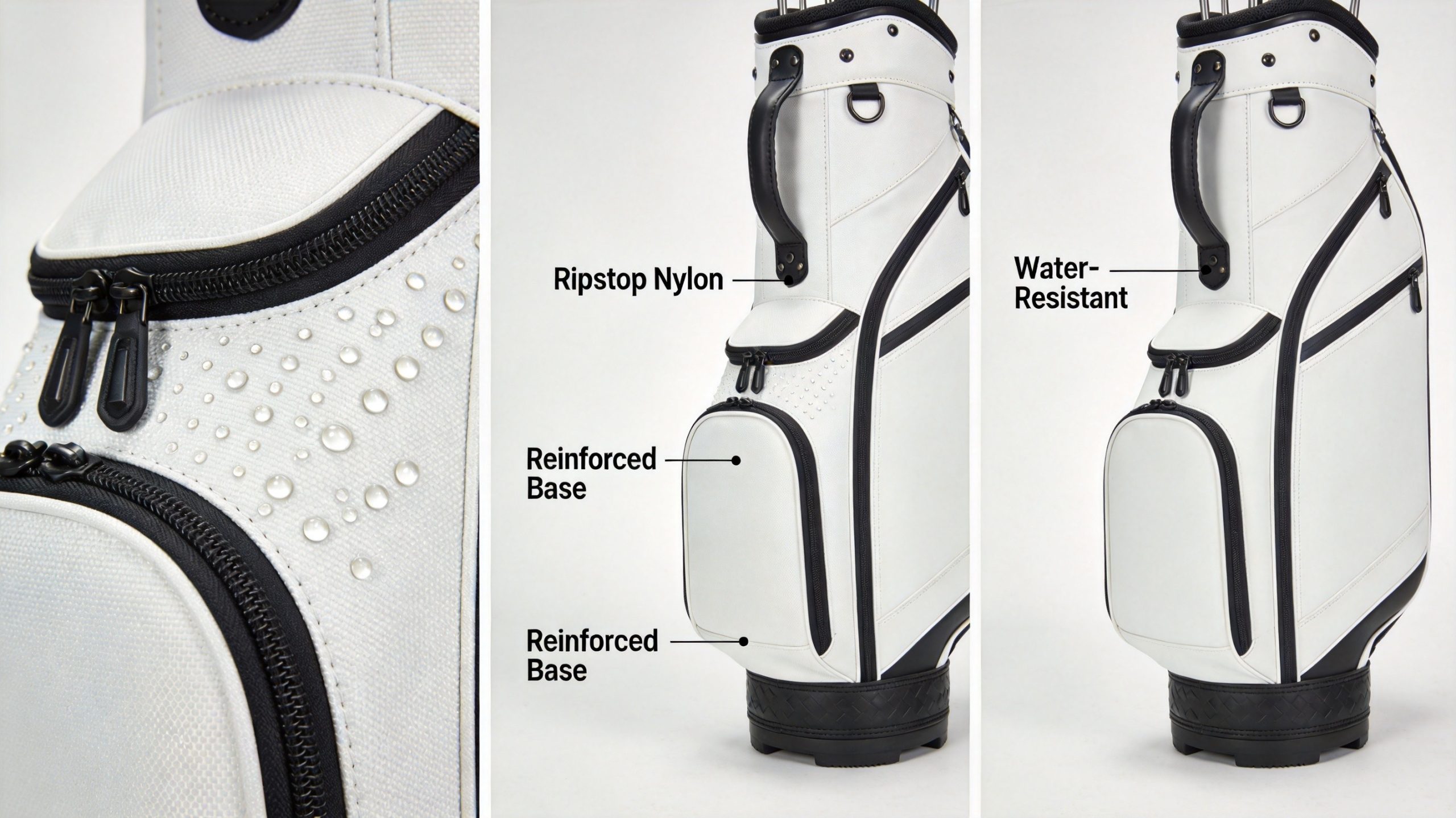
Materials Deep Dive: Choosing the Right Fabric & Components
The materials you specify directly impact durability, aesthetics, weight, and cost. Here is a comprehensive breakdown of the most common materials used in golf bag production:
| Material | Typical Use | Pros | Cost Range |
|---|---|---|---|
| Nylon (420D–1680D) | Cart bags, stand bags | Durable, lightweight, water-resistant | $$ |
| PU Leather | Staff bags, premium cart bags | Luxurious feel, excellent print surface | $$$ |
| PVC / Tarpaulin | Travel covers, rain gear | Waterproof, abrasion-resistant | $ |
| Canvas (Cotton/Poly) | Heritage/retro style bags | Classic aesthetic, durable | $$ |
| RPET (Recycled Polyester) | Eco-friendly lines | Sustainable, GRS-certified available | $$$ |
| Carbon Fiber (Frame) | Premium stand bags | Ultra-light, high strength | $$$$ |
| Aluminum (Frame) | Standard stand bags, cart bags | Lightweight, cost-effective, durable | $$ |
Shipping & Logistics from China
Getting your golf bags from a Chinese factory to your warehouse requires understanding international trade terms and logistics options.
Incoterms Explained
- FOB (Free on Board): The most common term for golf bag imports. The factory handles all costs up to loading the goods onto the vessel at the departure port (e.g., FOB Xiamen). You manage ocean freight, insurance, and import clearance.
- CIF (Cost, Insurance & Freight): The factory arranges and pays for shipping to your destination port, including insurance. You handle import clearance and inland delivery.
- DDP (Delivered Duty Paid): The factory handles everything including customs duties and delivery to your door. Most convenient but highest cost — typically adds 10–20% over FOB pricing.
Shipping Methods & Costs
- Ocean Freight (FCL): Most economical for orders of 500+ bags. A 40ft HQ container can hold approximately 2,000–3,000 cart bags. Typical cost: $2,000–4,500 per container to US West Coast.
- Ocean Freight (LCL): For smaller orders (100–500 bags), shared container space. Cost: $8–15 per CBM plus origin/destination charges.
- Air Freight: For urgent orders or samples. Cost: $4–8/kg. A stand bag weighing ~4 kg would cost $16–32 per unit by air.
- Express (DHL/FedEx/UPS): For samples only. Cost: $6–12/kg with 3–5 day delivery.
HS Codes for Golf Bags
Golf bags typically fall under HS Code 4202.92 (bags with outer surface of textile materials) or HS Code 4202.12 (bags with outer surface of plastics or textile). Your freight forwarder or customs broker can confirm the exact classification based on your specific materials.
Cost Breakdown: What to Expect per Unit
While exact pricing depends on specifications, materials, and order volume, here are typical FOB China price ranges for custom golf bags:
| Bag Type | Budget Range (FOB) | Mid-Range (FOB) | Premium (FOB) |
|---|---|---|---|
| Cart Bag | $25–35 | $35–55 | $55–90 |
| Stand Bag | $30–40 | $40–65 | $65–110 |
| Staff Bag | $40–55 | $55–85 | $85–150 |
| Sunday/Carry Bag | $15–25 | $25–40 | $40–70 |
| Junior Bag | $18–28 | $28–45 | $45–70 |
Key cost factors: Material quality (420D nylon vs. 1680D ballistic nylon can differ by 300%), hardware brand (YKK vs. generic zippers), frame type (carbon fiber vs. aluminum), customization complexity (number of pockets, embroidery areas, printing methods), and order volume (500+ units typically unlock 5–15% volume discount).
Common Mistakes First-Time Buyers Make
After working with hundreds of brands — from startups to Fortune 500 companies — we have identified recurring mistakes that cost first-time buyers time and money:
Mistake #1: Skipping the Pre-Production Sample
Saving $200–300 on sampling can result in a 1,000-unit production run with incorrect colors, wrong pocket placement, or incompatible zipper weights. Always approve a pre-production sample before authorizing bulk production — no exceptions.
Mistake #2: Choosing Based on Price Alone
The cheapest quote often means corner-cutting on materials (thinner fabric, non-branded zippers, inferior foam) or QC (no in-line inspection). A $3 difference per unit can translate into a 50% higher return rate and permanent brand damage.
Mistake #3: Underestimating Lead Times
First-time buyers often assume “30-day lead time” means 30 days from purchase order to warehouse delivery. In reality, the total timeline from design approval to arrival at your warehouse is typically 60–90 days when accounting for sampling, production, and ocean freight.
Mistake #4: Not Defining QC Standards in the Contract
Without explicit AQL levels, stitch density requirements, and testing protocols written into your purchase agreement, you have no enforceable quality standard. Always include a QC appendix referencing specific, measurable criteria.
Mistake #5: Ignoring Packaging & Labeling Requirements
Destination countries have specific labeling requirements (care labels, country of origin, fiber content, UPC/EAN placement). Failing to communicate these requirements upfront can result in customs delays or retail non-compliance penalties.
Mistake #6: Placing Orders During Peak Season Without Buffer
Ordering in April–July without accounting for peak season congestion means longer production queues and delayed shipping. Always plan orders at least 3–4 months ahead of your target delivery date.
Why Keep Perfect Golf? Your Manufacturing Partner Since 2004
With over 20 years of dedicated golf bag manufacturing, Keep Perfect Golf (KPG) — also known as Junyuan Bags — has built a reputation as one of China’s most reliable and capable golf bag manufacturers. Here is why 200+ brands across 100+ countries trust us:
- Established 2004 — Over 20 years of specialized golf bag manufacturing experience
- 10,000+ sqm Facility — Modern factory in Quanzhou, Fujian with advanced equipment
- 200+ Brand Partners — From emerging startups to global tour brands
- 100+ Countries — Proven export capability to every major golf market worldwide
- Certified Quality — BSCI, ISO 9001, and Sedex certified
- Low MOQ — Starting from just 100 pieces for golf bags, 500 pieces for accessories
- Full OEM & ODM Capability — In-house CAD design, sampling, and production
- FOB Xiamen — Convenient port access for efficient global shipping
- Dedicated Account Management — English-speaking team with 24-hour response commitment
Ready to Start Your Custom Golf Bag Project?
Whether you need 100 bags or 10,000, our team is ready to bring your vision to life.
Get a detailed quote within 24 hours.
Request a Quote
Email Us: [email protected]
WhatsApp: +86 17750020688 | FOB Xiamen, China
Frequently Asked Questions
What is the minimum order quantity (MOQ) for custom golf bags from China?
At Keep Perfect Golf, our MOQ is 100 pieces for golf bags and 500 pieces for accessories. This is lower than the industry average of 300–500 pieces, making it accessible for startups and emerging brands.
How long does it take to manufacture custom golf bags in China?
The total timeline from design approval to delivery is typically 60–90 days: 7–14 days for sampling, 30–50 days for bulk production, and 15–30 days for ocean freight. Air freight can reduce shipping to 5–7 days.
Can I visit the golf bag factory in China?
Absolutely. We encourage factory visits. Our facility in Quanzhou, Fujian is open for tours. We can also arrange virtual video tours for international clients who cannot travel immediately.
What certifications should a golf bag manufacturer have?
Key certifications include ISO 9001 (quality management), BSCI (social compliance), Sedex/SMETA (ethical trade), and product-specific tests like REACH, CPSIA, or Prop 65 depending on your target market.
What is the difference between OEM and ODM for golf bags?
OEM means the factory produces bags to your exact design and specifications. ODM means you choose from the factory’s existing designs and add your branding. See our OEM vs ODM guide for a detailed comparison.
How much does it cost to manufacture a custom golf bag in China?
Costs range from $15–150+ per unit depending on bag type, materials, and features. A mid-range cart bag typically costs $35–55 FOB China; a premium staff bag runs $85–150. See our wholesale golf bags page for more pricing details.
Can the factory help with design if I only have a concept?
Yes. Our in-house design team can work from sketches, reference photos, or even verbal descriptions to create CAD drawings, 3D renderings, and production-ready tech packs. This is part of our ODM service offering.
What shipping options are available from China?
We offer FOB Xiamen, CIF, and DDP terms. Ocean freight (FCL or LCL) is the most cost-effective for bulk orders. Air freight and express courier are available for samples and urgent shipments.
Do you offer eco-friendly or sustainable golf bag options?
Yes. We offer bags made from RPET (recycled polyester from plastic bottles), organic cotton canvas, and other sustainable materials. We can source GRS-certified fabrics and provide sustainability documentation for your brand’s environmental claims.
How do you ensure quality consistency across production runs?
We maintain detailed production records, color-standard samples, and material specifications for every order. Our 7-stage QC protocol includes incoming material inspection, in-line checks, and pre-shipment inspection to AQL 2.5 standards. Repeat orders reference the approved golden sample.